
Translated material
Three protests
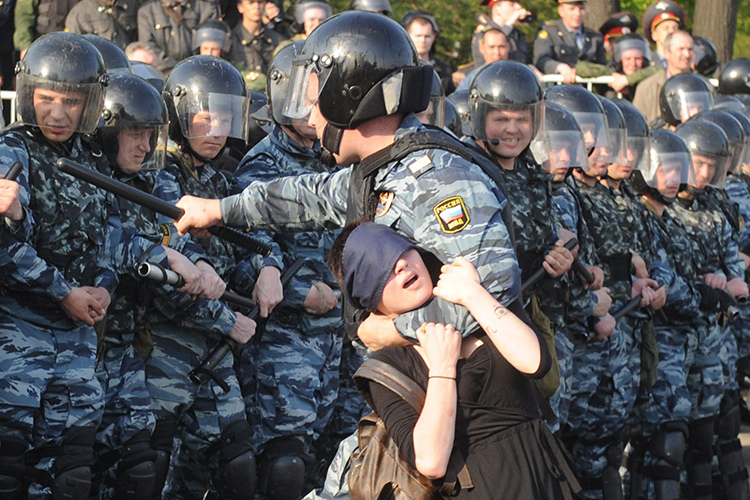
On May 6, 2012, in the history of post -Soviet Russia, it became the beginning of the Putin reaction period. The plan of the battle on Bolotnaya repeated the script tested by Alexander Lukashenko in 2010: a thoughtful provocation is used to legitimize violence against political opponents. This is, in somewhat archaic language, a political reaction. The essence of which is combined with archaic social and ideological constructions with a sharply increasing level of violence. Violence becomes a key element of political balance, despite the notorious 85%.
Although the reaction is finite, it is difficult to live during the reaction. And, evaluating the protests today, we tend to look for “logic of failure” in them in order to draw a direct line by today. This is a well -known trap of determinism: we look at the story as if its goal was to come to the point where we are now. Therefore, the story constantly has to be rewritten.
If you try to get out of the trap of determinism and look at those events, keeping in the mind the experience of other protests and revolutions of the last ten years, then, it seems to me, you can learn several important lessons.
The first lesson: history is often through the back door. The fact is that in today's reflection on protests there is one important silence. Analysts confidently and convincingly say that, how and why it happened and could not happen differently, lowering the fundamental detail that none of the experts, columnists, sociologists and the opposition figures themselves expected in the fall of 2011 that what happened would happen at all. I well remember the discussions then: we have no society, and although discontent exists, it will not result in anything, because there are no consolidation points, the “power” is confidently undergoing elections thanks to the administrative resource and public apathy.
The protest movement is to a large extent what it imagines itself.
From here there are two consequences. Firstly, our discussions about why “nothing happened” must be divided into our misunderstanding of where it came from. And secondly, it is worthwhile to more soberly evaluate the role of “leaders”: they are much more followed by collective ideas than form them.
And this is directly related to the second lesson, which consists, it seems to me that the opposition (or protest movement) is largely what it represents itself. In a striking way, propaganda exists not so much to convince the median voter that he is not on the way with the opposition, but to convince the opposition that it is far from the median voter.
In a rough approximation, we can say that about as many people came to Bolotnaya on December 10 as such an intention on social networks. The Laboratory of Infographics of the then RIA Novosti conducted a wonderful analysis: I collected data on those who recorded in social networks for rallies on December 10, 2011 throughout Russia. It turned out that the number of those who recorded in Moscow is only a third of those who recorded around the country.
It seems to me that if then in Moscow and outside of Moscow, people realized this fact, a lot would have seemed different to them. But at that moment, the idea prevailed from Surkov’s filing that protests were such a surge in the cheerful fanaber of a certain capital's “creative class”. This was only part of the truth, but this concept became very popular, in particular, because it was very for the protesters of the flattering. From this moment, the motive of the contrast between the protests of the “large nation” becomes not only the core of the official doctrine, but also part of the Swamp self -consciousness. And it was a huge winning of the Kremlin, which he continues to develop to this day.
Positive, civilian nationalism provides intercaulid consolidation of protesters. Singing the national anthem and raising the national flags, the square disputes the right to rule among the authorities.
At the same time, the facts, which were not quite fitting into such a picture, were replaced by the periphery. For example, the fact that about 40% of respondents in the national sample said that they said that they generally or mostly support the slogans of the swamp in the focus that they generally or, for the most part, fell out of the focus. Despite this, Bolotnaya herself imagined herself much more. What was actively supported by official propaganda.
Contrary to the Determinist doctrine dominant in Russian analytical discourse, the story seems to be more like such interactive scales. Two bowls fluctuate under the influence of the actions of one side or the other, while participants in the process constantly monitor these weights, the movement of which changes their ideas about what is happening and their willingness to act. As a result, the movement of the scales will depend largely on the representations of the participants about which direction they are inclined.
The third lesson is the direct continuation of the second: the critical meaning of nationalism. We are talking about a positive, so -called civilian, nationalism, although it must be reserved that the border that separates it from nationalism is no longer quite civilian is often thin.
The significance of civil nationalism was convincingly demonstrated by the Maidan. One of the doctrines underlying democracy is associated with the idea of national sovereignty, born in Europe in a romantic era and opposing the idea of the sovereignty of the feudal (ownership). It was here that the nation was realized as a certain imaginary integrity, which is a carrier of legitimacy and has in its integrity the right of government. This doctrine, respectively, took away the right to own Soveren (monarch).
The current 85% exist thanks to violence.
Positive, civilian nationalism in the protests and revolutions of recent decades played a very important role. Firstly, it provides intercaulid consolidation of protesters. Their differences become not as important as their imaginary unity as a nation - a carrier of sovereignty. And secondly, symbolic national consolidation takes away from those who call themselves “power”, i.e. The executive state apparatus, legitimacy. Singing the national anthem and raising the national flags, the square disputes the right to rule among the authorities. And this ultimately undermines the loyalty of the repressive apparatus, which begins to doubt: does he protect the state or a bunch of usurpators?
Fear of national consolidation is an important assistant to the current political regime. He allows him to emphasize what separates public groups and layers, and not what unites them. In Russian protests 2011-2012. Nationalism did not work. The search for Navalny in this direction met the rigid resistance of the "creative class", and with the presentation of Surkov it was believed that it was the main one here. In addition, there is no anthem in Russia. The Stalinist song is a hymn to the leaders, not a nation.
So, in general, it seems, it seems that the events of the end of 2011-2012 were the result of the formation of a new political demand, which was by no means localized in Moscow and was generally much wider than is commonly believed. This demand was certainly modernizing, but its modernity was undoubtedly much more moderate and diffuse than what it appeared on the streets of Moscow.
In 2014, Putin finally managed to consolidate counter -modernization demand, which today makes the impression of an absolutely dominant. However, in this picture there are some inconsistencies.
The average rating of Putin's popularity throughout the 2000s. He amounted to about 75%, but this did not require such a level of violence - political murders, dozens of prisoners for political reasons, prison deadlines for dance in the Cathedral of Christ the Savior, police officers sitting at the rehearsals of the Theater. DOC ”, a hybrid war with Ukraine.
The success of the propaganda machine is that it almost convinced the opponents: what we see today is Russia, and what was then was an anomaly.
Surprisingly, the fact: the current 85% exist thanks to violence. They are not a whole consequence of violence, but without violence are impossible. The then 75% and today's 85% do not differ by 10 percentage points, but these are some different scales, like Celsius and Fahrenheit. And if you imagine that for some reason the Putin prosecutors and investigators, as well as hired bandits, will suddenly stop acting business from tomorrow, pursue activists and bloggers, delete and beat observers on elected areas, close sites and turn off the broadcast of television channels, it seems to me that in six months the opposition will become a mainstream, and the regime will crack at the seams. And do not ask me where all these Obamachmo and Krymnash will go - there, it is obvious where they came from over the past year.
This does not make our life easier. There is violence, and it waves a flag on which 85 is written. But, perhaps, as in 2011, we again miss something. The reaction is finite. Especially, in my opinion, a reaction occurring in such extreme forms. Yes, in the short term it looks as effective as possible. But this is how if you need to get rid of unwanted guests and you set fire to the curtains in the living room. Smoke, child, guests blown away like a wind. But can this be considered a success?
Today's situation and protests of 2011 are two sides of the same medal, these are the same scales and the same unfinished story. In 2011, the protesters failed to achieve convincing and wide consolidation based on the agenda of modernization. It was not possible to present the case so that they are Russia. The current success of the nasty side does not even have that she temporarily achieved such consolidation on the basis of the counter -modernization agenda, but that she almost convinced her opponents: their failure was predetermined by what we see today, this is Russia, and what was then was an anomaly. This is Kashcheevo an egg of the reaction and its propaganda machine. The reaction will end when the thought is mastering that everything is exactly the opposite.