
Translated material
Facebook as a censor
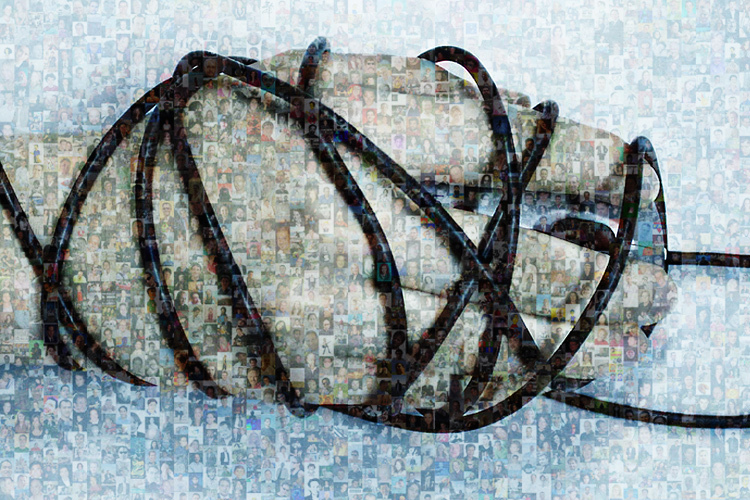
In the sense of Facebook censorship A little better than Russian TV: it also limits access to the news that is contrary to the political convictions of the audience. Such a conclusion has a scientific article published in the authoritative journal Science with a team from the research department of Facebook and the University of Michigan.
Researchers Eitan Bakshi, Solomon Messing and Lada Adamich analyzed the tape of 10.1 million users from the United States, who clearly indicated their political position in the profile. For simplicity, all the variety of views brought to three categories: it turned out 4.1 million “liberals”, 1.6 million “moderate” and 4.4 million “conservatives”.
Scientists monitored how these users shared the news with each other for 6 months (from July 7, 2014 to January 7, 2015). And, most importantly, who saw what news in his tape. Facebook , as you know, shows us only a small part of the records made by friends - and most of them filter in a complex algorithm.
7 million different news publications that appeared in the feeds of users for six months were divided into “soft” (sports, travel, etc.) and “tough” (the fact that newspapers usually print in the sections “Society”, “Politics” and “In the World”). This last category fell 13 percent of all links. The key words that such articles were calculated are “war”, “abortion”, “education”, “unemployment”, “immigration”, “elections” and so on. In the end, the authors concentrated on the fate of those 226 thousand “tough” publications, each of which shaved at least 20 people with political views declared in the profile.
Liberal users have only 20 percent of friends-conservatives.
It immediately became clear that the liberals had their own news, and the conservatives had their own. Instead of discussing the same articles from different positions, people of opposite political beliefs focus on different events and are indignant at each of their injustices. Relatively speaking (if we extend the conclusions to the Russian Facebook segment), some write more about “May 6th Events on Bolotnaya”, others about “victims of May 2 in Odessa”.
Of course, sources are also quoted different: if you saw a link to Foxnews . COM , with a probability of 80 percent, it can be argued that the conservative shared it. And at HuffingtonPost . COM , on the contrary, in 65 percent of cases, liberals refer.
And both streams of news, “conservative” and “liberal”, are actively filtered in social networks.
The first censorship line is the selection that friends do for us: we tend to surround ourselves with people of similar political views. As the authors of the study counted, on average, liberal users have only 20 percent of friends-conservatives. Well, of course, among the friends of the average conservative, only 18 percent are liberals.
If the Frengtland was formed from random records, then on average 45 of 100 news that the user-liberal uses would come into conflict with his picture of the world. But in reality - since friends adhere to similar views and not all in a row shake - there are only 24 out of 100 such “conflicting” news.
It is funny that the picture of the world of conservatives is weaker: instead of 40 percent of unpleasant news after the “censorship of friends”, 35 remains.
When Facebook algorithms try to give us as few uninteresting as possible, the share of “conflict” news falls.
The mysterious Facebook algorithms and the evil will of Mark Zuckerberg personally have nothing to do with these numbers: so far we are only talking about how our choice of friends affect the news picture of the day. What they share - then we see; The reasoning will not change if, instead of Facebook , take livejournal , VKontakte, Odnoklassniki or interest clubs in the real world.
Another thing is that Facebook is strictly thinning our tape, trying to predict the former likes that we will be interested in the new content and what not. Is involuntary political censorship at this stage? Yes, it happens: we often like that which is well consistent with our beliefs - and for smart social networks this is not a secret. Therefore, when Facebook tries to give us as few uninteresting as possible, the share of “conflicting” news in liberals falls by another 8 percent, and for conservatives - by 5.
Finally, the link to the news in the tape does not mean that this news will be read. The third line of censorship is our own choice: even if the news from another camp overcame the first two barriers (“Censorship of Friends” and “Censorship of the Algorithm”) and still leaked into the tape, then for the conservative the probability of clicking on such a link is 17 percent lower than the average, and for the liberal-by 6.
Bakshi and his colleagues emphasize that in the cascade of ideological filters the role of algorithms is not so and big. For the inability to find out someone else's point of view, primarily our free will. What could be more natural than the desire to read like -minded people and unwillingness to like what is diverging with established views? It turns out a paradox: if you provide users with complete freedom of access to information, we will make every effort to misinform.
Soticees are not yet an extreme case. The authors compared a network of friendly relations on Facebook with a network of political blogs before the 2004 presidential elections in the USA - and stated that there are “clusters of unanimity” isolated from each other in blogs, where there is no real variety of opinions.
Facebook is favorably different in that it leaves a loophole for a “different point of view”: we often add people to friends that we met outside the network and not on the basis of politicians - work colleagues, former classmates or stairwell neighbors. Their beliefs are not obliged to coincide with ours - and only thanks to them we know what actually excites opponents. Unless, of course, “clean the tape” whenever reading causes discomfort.