
Translated material
The upgrade of Tchaikovsky
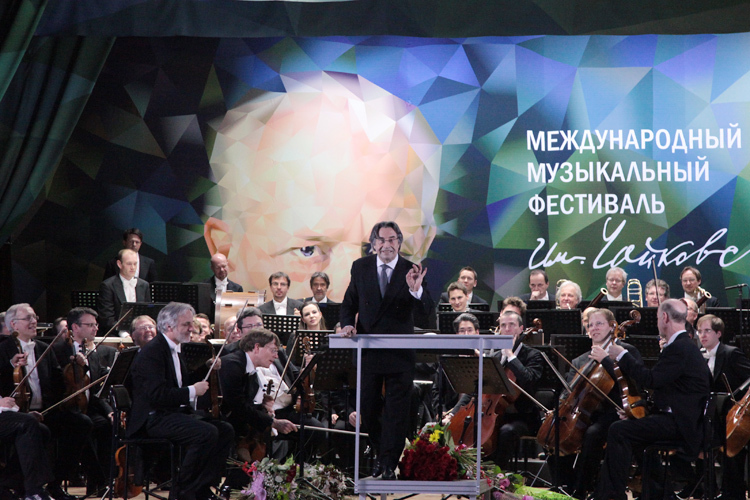
Today is 175 years old Peter Ilyich Tchaikovsky. Gergiev, Matsuev’s day, give a concert in Moscow in honor of him, and by the evening they go to Klin on the new high -speed highway through the Khimkinsky forest - to close the new international festival named after the anniversary there. It would seem that with something, but with Tchaikovsky we have everything in perfect order. The most executable Russian composer in the world, the main breadwinner of the theaters of the opera and especially the ballet. But this is if you do not look closely and do not listen. A more or less loud date found that with “our all” things, there was still a non-manager.
Tchaikovsky's first concert is not the same
For almost a month, the XV competition of Tchaikovsky will begin, and by the final rewarding of the winners in the Great Hall of the Conservatory several times the first concert for the piano with the orchestra, the first chords of which even the one who does not distinguish the BZK from the ZKR. So, almost with confidence we can say that these will not be the very chords that Tchaikovsky wrote in 1875. And some other notes will also be the wrong and the wrong amount.
 © Eduard Schulz
Starting from the first performance in Boston with Hans von Bulov for the piano, already during the life of the composer, the concert had a completely successful life. But the last time in the author’s version, he sounded in St. Petersburg on October 16, 1893, along with the ill -fated premiere of the sixth symphony, after 9 days that turned into a requiem according to his author. And after the death of Tchaikovsky, the concert began to gain momentum already in the third edition attributed to the pianist Alexander Ziloti, who did something more spectacular, reduced something.
But now other times, historical reliability-it seems like the most advanced trend, and on the eve of the 175th anniversary of the composer, the Kleinsky-Reserve, together with the State Institute of Art of Art, has been presented by four dark-borded volumes-claviers and scores of the first and second copyright editions of the concert. And one of them in Europe has already been released with the performance of the orchestra of the German radio and pianist Kirill Gershtein. In Russia, the author’s edition for the first time a year ago was played by Andrei Korobeinikov. But from the contestants of the "Teapier" on the school bench, the bouncing edition of Ziloti from the teeth, of course, can’t be shifted from the teeth.
There are no works
That is, of course, there is some. It was started in 1940, completed in 1990. But it was incomplete and promoted. Standards, as already mentioned, are now others. Four of the circulation of 1000 copies of the concert volume already released - the beginning of a huge path called the academic complete collected works of Tchaikovsky (by the way, not one of our other composer "bastards" also has this). For further work on the meeting, there are many modern developments, there is a great Klin woman Polina Efimovna Vaidman, 40 years old engaged in Tchaikovsky’s archives, there is a Chelyabinsk MPI publishing house, who is in love with this project, there is even a favorable swaying the head of the Minister of Medinsky and the new Klinsky archive with windows on the Moscow-Petersburg highway and without climate control. But there is no money. Meanwhile, such numbers are pronounced: 120 volumes and at least 40 years of work. The planning horizon is a little not in size for our country.
Klin - not yet Salzburg
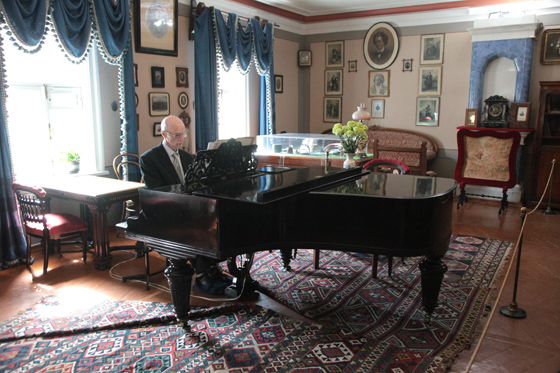
Of course, there is absolute value-a house-museum in Klin near Moscow with unique preservation of the situation. Here the piano sounds on which Tchaikovsky played, stands his desktop. It may well be that the bed is covered with the same bedspread as on October 19, 1893, when the tenant of a two -story wooden structure on the outskirts of the city, unplannedly, left here, leaving the supply of firewood for the winter and the cabbage, which still needs to be chopped, and taking Aleksei from the servant of 60 rubles per cloth for a coat.
 © Eduard Schulz Riccardo Muti
After the death of Tchaikovsky, brother Modest and their beloved nephew Bob, all preserved, bought the house, organized a museum. Their graves are nearby, in the cemetery in Demyanov. The house survived the revolution and two weeks of fascist motorcycle standing (they managed to send all the contents to the Urals, to Votkinsk, from where it later returned intact and preservation).
For musicians, Klin has always been quite a sacred place, sweet precisely his old -regime dust. But now, in connection with the anniversary of the Tchaikovsky and Kapkovo Klinsky Renaissance in the person of the new, extremely active, head of the Alena Sokolskaya district (the most beautiful gesture, the newly consistent transfer of the Museum of Tchaikovsky, which she bought for her own money in one of the antique shops of Moscow), the new winds blew. Being the city with a serious scale. Lawns, fountains, tiles, restored ancient shopping rows and brand new bilingual signs. Well, “our everything”, of course, should work out its tourist component. Indeed, why are we worse than Salzburg? In the pond - swans, in a factory of Christmas toys - clicks, in city buses - the music of Tchaikovsky. Just the head is spinning. But the toilets behind the curtain in the Maidanovo Park, which Pyotr Ilyich once walked, has not yet been canceled.
Klinsky festival - not yet Zalzburg
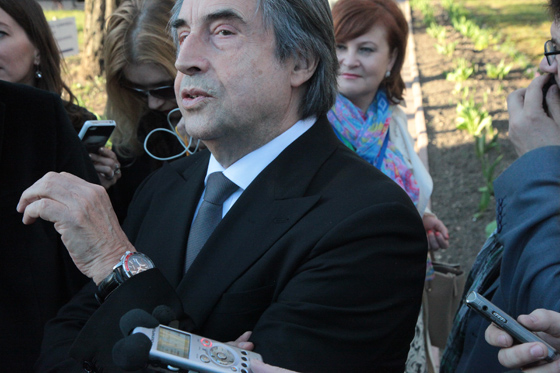
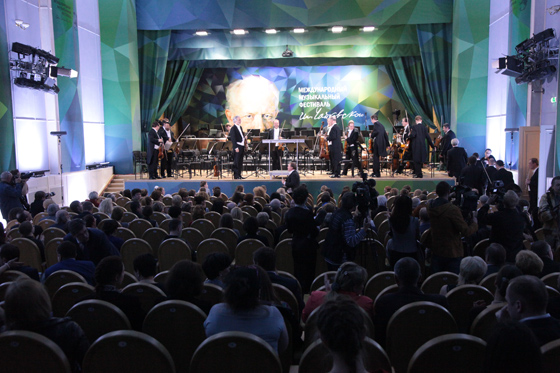
Although the chief orchestra of Salzburg - the Vienna Philharmonic - already spoke in Klin. I almost never believe it, but it was true. Let us leave on the conscience of one of the best orchestras of the world and maestro Riccardo Muti the preceding this exotic performance in the hall at 300 with some kind of place concerts in the Kremlin Palace for 6,000 spectators with a hatch. The great groups also, alas, have a “scatter”. But how cunningly they played the fifth symphony of Tchaikovsky, being next to the legendary place of residence of the composer, passes through a completely different category.
 © Eduard Schulz
It was not a plug-in, arrogant orchestra orchestrath, who does not even need to look at the conductor to play everything perfectly, and the meeting of unusually worried and inspired people, who had hardly squeezed into a small, simple, late-Soviet museum and breathing along with the conductor. The branded ability to live in full every opera moment, making the muti with the best interpreter of Verdi, was quite useful in the symphonic Tchaikovsky, who turned out to be a hero rather than a whiner. The ambivalent finale turned out about the victory of good over evil, and not vice versa. As a Bis superprize, “our all” from “our whole” muti prepared an overture for Verdievsky “Nabukko”.
Viennese Philharmonicists opened the new international festival named after Tchaikovsky, whose artistic director is composer Andrei Golovin. It is started with ambitions and a scope, with a large screen for broadcasts on the central city square (either Soviet or Cathedral), with free taxi from the station to the museum, but it is still not entirely clear for whom - for Klin residents, tourists or authorities. In his eight -day program - a decent set of stars (including Pletnev, Fedoseeva, Gergiev and Matsuev) and a lot of Tchaikovsky’s music (including the author’s edition of the first concert performed by Cyril Gershtein). For the concept of the first festival, this is more than enough. But it is more difficult to continue than starting.