
Translated material
Majority for Conservatives

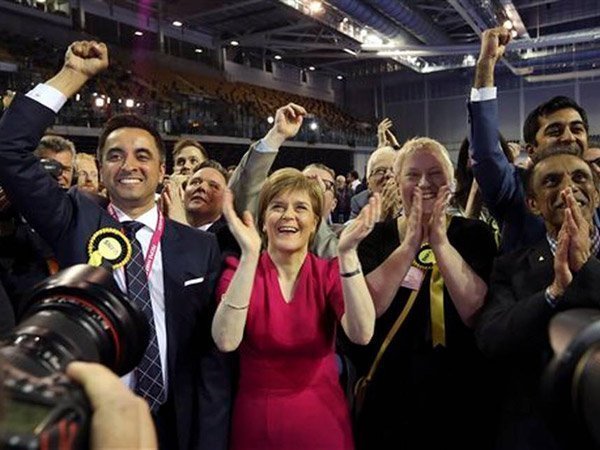 Victory of the Conservative Party in the parliamentary elections in Great Britain Photo: bnd.com
 In the general parliamentary elections in Great Britain on May 7, the Conservative Party won a landslide victory.
According to the latest BBC data , the Conservatives (Tories) received 330 parliamentary seats out of 650 possible, their main opponents, Labor - 232, the Scottish National Party - 56, the Liberal Democrats and the Democratic Unionist Party - 8 mandates each, Sinn Fein - 4 mandates, Party Wales and the Ulster Social Democrats - 3 mandates each, the Ulster Unionist Party (close to the Conservatives) - 2 mandates, the United Kingdom Independence Party (UKIP) and the Green Party - one mandate each.
For complete control over the government, one of the parties must receive 326 mandates (although even 323 is enough, taking into account the non-participation of elected Sinn Féin representatives in parliament). Thus, even the preliminary results suggest that the Conservatives won enough seats to form a government without entering into a coalition with other parties. The current Prime Minister and Conservative leader David Cameron will remain in his post. If we manage to avoid early elections and resignation, then for another five years.

The result was not obvious either to pollsters or to the media. The latter called the upcoming vote one of the most unpredictable in recent years. None of the forecasts made the day before could accurately predict the landslide victory of the Conservatives and the weak results of Labour. Thus, according to the forecast of the portal electionforecast.co.uk on May 5, the Conservatives could count on 281 seats, Labor - on 267 seats, and the Liberal Democrats could get 26 seats.
Voter turnout was almost 66%. Elections were held in 650 single-mandate constituencies using a majoritarian system. In each district, voters voted not for a party, but for a specific candidate, and the winner was the one with a simple majority of votes.
According to the results of the previous elections held in Great Britain in 2010, the Conservatives controlled 306 seats in parliament, Labor - 258, and the Liberal Democrats - 57. After their victory, the Conservatives formed a government in coalition with Nick Clegg's Liberal Democratic Party.
political commentator Sky News Faisal Islam attributes the Conservatives' success to the Tories shifting the blame for their unpopular decisions to the Lib Dems and Labour, in particular by holding the latter responsible for holding a referendum on Scottish independence, thereby depriving Labor of votes.
 Nick Clegg
 Despite the fact that the leader of the Liberal Democrats, Nick Clegg, managed to retain his seat in parliament, key party members lost their seats. In a speech announcing his resignation as leader of the Liberal Democrats, Clegg called the party's loss "the most devastating blow in its history." As one British journalist noted, after a sensational failure, the representation of the Liberal Democrats in parliament “could easily fit in two London taxis.”
It is impossible not to note the sharp increase in the popularity of the Scottish National Party. The SNP, led by Nicola Sturgeon, won 56 of 60 constituencies, taking almost all of Scotland's seats in the House of Commons. Thus, the results of the SNP allow it to significantly increase its influence in the British Parliament, continuing its course towards the separation of Scotland from the United Kingdom.
As economist Konstantin Sonin notes , a complete victory for the SNP in Scottish constituencies will lead to a worsening of the position of Labour, which, as the expert recalls, has so far had a big advantage in Scotland.
 Ed Miliband
 Against the background of the party's defeat in the elections, Labor leader Ed Miliband announced his resignation on SkyNews . He admitted it had been an extremely difficult night for Labour, saying he was disappointed with the results of the vote. According to him, the party failed to cope with the “wave of nationalism” that swept Scotland and did not achieve its intended goals in England and Wales. At the same time, Miliband emphasized that Labour’s failure was his personal fault.
“The new government has a huge responsibility to unite our country. "What unites us is much more than what divides us," he tweeted , pointing to possible attempts by the SNP to again hold a referendum on Scottish independence.
 Harriet Garman
 The interim leader of Labor will be Harriet Garman , who until now was Miliband's deputy in the party and deputy prime minister in the UK shadow government, responsible for culture, media and sport.
The scale of Labour's defeat is reflected by the fact that 20-year-old political science student at the University of Glasgow Mhairi Black, who managed to win one of the Scottish constituencies as an SNP representative, entered the new parliament. She lost to one of the Labor leaders, former cabinet minister Douglas Alexander. Black will become the youngest MP since 1667.
The election results were also extremely unsuccessful for the Independence Party (UKIP) : it managed to get only one seat in parliament with 13% of the vote. Its leader, Nigel Farage, also announced his resignation after losing his constituency seat to a Tory representative. UKIP, which is pro-Brexit from the European Union, performed well in the European Parliament elections in May 2014. Some Russian officials and publicists view this particular party as a promising ally in Great Britain.
 David Cameron
 Meanwhile, David Cameron said he intends to form a new government in the coming days. “It is clear that this was a very successful night for our party. “I still have the same simple goal: to govern the country taking into account the interests of all its inhabitants,” said the Conservative leader.
The British Prime Minister confirmed one of his main election promises - to hold a referendum on the country's membership in the EU by the end of 2017.
See also: Conservatives won the elections in Great Britain Shadow Cabinet Treasurer Ed Balls lost his seat in Parliament Cameron intends to hold a referendum on Britain's membership in the EU Valery Adzhiev Racism in Britain through the prism of Russian perception