
Translated material
Already shakes

Today in the Moscow cinema "Pioneer" a large retrospective of Vera Hitilova begins. The program of retrospectives is not only well -known misanthropic comedies, surreal experiments, but also the early short and late documentary, previously unknown to us, the director’s work.
The sky is naughty, the floor of the hives, a hand chamber, which feverishly gropes an object in a chaos, clogged with cars of Prague Street or in a small -bourgeois order of a small apartment, overflowing with all kinds of good. Wild characters, desperately floundering in an attempt to find either pleasure, or support, destroyed by Freud, Fromm, and by Yaloma. Exlike scenes: rape on a boat in the middle of the Vltava - right under the windows of the presidential palace, a pot -bellied pedophile with a member at the ready, a tenacious stringer who removes the dying old people in the hospice. “Pleasant moments” (2006), the last film, shot by Vera Hitilova, begs for comparison with the subversive “new realism” like “idiots” of Trier, if not for a small detail. Crushing, cheerful music on the soundtrack not only deprives the picture of the “dogmatic” virginity, but also immediately translates the tragedy (and with existential fear and hopelessness, each episode of this team of the drama is impregnated, the main scene of which is the psychotherapist’s office) into a hysterical, kind ofodic comedy. The attack of hysterical laughter, and ends with the walking of the heroine of the film on the torment - strangers and his own.
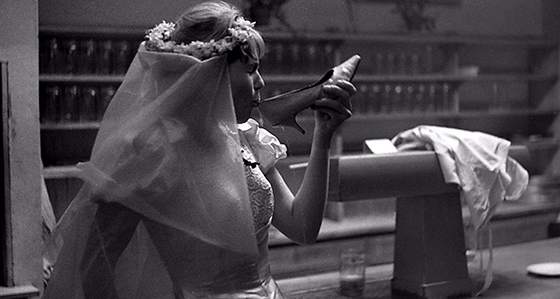 "Pearls at the bottom" (1965)
The transformation of a sad life drama into a farce could be explained by the reaction to an endless repetition - with the exception of a short period of enthusiasm for poetic cinema, Hitilova always shot about the same thing. Melted dreams, decaying connections - social and emotional, the war of all against all, stagnation, melancholy, pain, which there is no one to sympathize. But absurdity has always been an important chitilova tool. Even in its first full meter, an exemplary feminist sketch “About something else” of 1963 (a double portrait of two female modern women-the stars of the Czechoslovak gymnastics of Eva Bosakova and a fictional housewife of faith), Hell of homework neutralized a vigorous music that turned life-damping into plumage. The sympathy of Comrade Vera, imprisoned in jail, did not prevent Hitilova from portraying her character rather grotesque in his typicality than tragic. A real, quiet tragedy fell out just as if an emancipated gymnast - in between hard work to master her body and fears, Bosakov admits that sports life made life impossible as such: dreams, leisure, travel, family - all this was sacrificed to gold medals.
But the drama of a person who has taken a choice, who consciously made his choice, never took Hitilov. Her world, so familiar to the Soviet cinema of the 70s, is the world without the possibility of movement, creation, act. All in vain, speech is no more than the slogan, and the order is a synonym for chaos. In “Panel Stories” (1980), another cinema of the Czech society, the main target of Hitilova becomes not just a small person - but cardboard historical positivism of the Soviet system. Panel construction, a metaphor for building a bright, fair future, was removed as a large-scale production of devastation, absurdities and total atomization, in which there is no place for anyone-neither children, nor old people, nor a bunch of workers, nor a fucker from television, nor young spouses with a good salary.
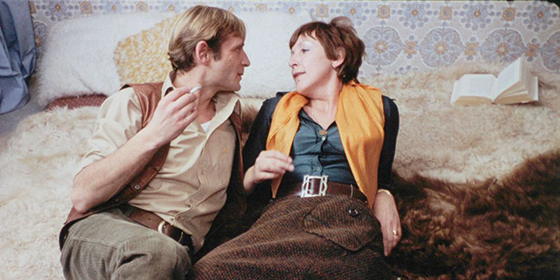 “Panel history, or how the microdistrict is born” (1979)
Even sex, which served as a subversive charge of life in the early surrealistic films of Hitilova, eventually turns into the same tool of enslaveing as a career, work, home hearth and hope. “A hoof here, a hoof there” (1989), a brutal mockery of the missing generation of the seventy (everything happens in unexpectedly trierov interiors with dead ravens on the chandelier and heralds in pots) - this is not just a satire - the chamber here, the camera here gives all the heroes, continuously dragging behind skirts - - But, it seems, the first film about AIDS in the entire space of the socialist camp. The only thing that allowed the heroes of all Hitilova’s films to somehow resist the protocol reality is suddenly becoming a weapon of retaliation. Life - meaningless, joyless and vulgar - takes revenge over vitality. Resistance is impossible (as in the “traps, caps” of 1998, where the young follower of Valerie Solanas herself castrates her rapists, but this execution does not affect the social status quo-nothing more has passed to the symbolic castration to the Fallocrats).
What to do? Like her Soviet colleague (and in a sense, the double) Kira Muratov, Hitilova chooses a hysterical absurdity, the old weapon of the surreal revolution. But the absurdity of Hitilova is a different kind: no matter how joyless and meaningless the life of her heroes is, she is no more than itching, neurosis, inconvenience, albeit causing a surge of rage. This is not pain, not psychosis, not aphasia, not a decay of post -Soviet collapse of the "asthenic syndrome." The human state for Hitilova, who survived the 1968th, but fundamentally remaining in Czechoslovakia (and even shot the film “Hitilov against Forman” about his decision, is nothing more than a bad incident, unworthy of special poetics. The littered horizon, rudely pumping like index finger, transfocation - this world deserves only a comic verse.