
Translated material
After the ball
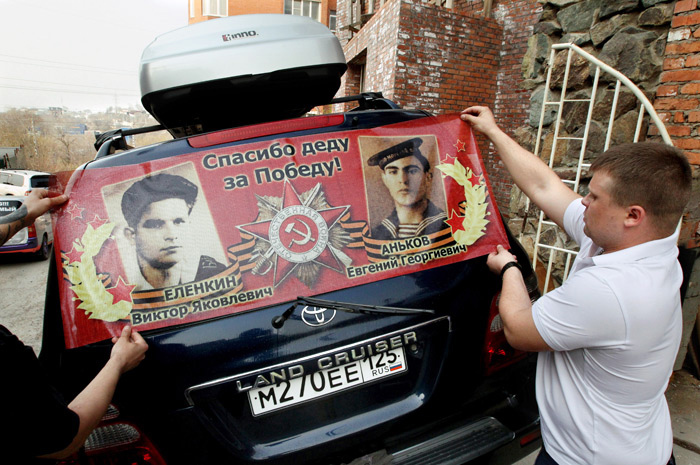
Passion does not subside. It is understandable: the topic is really painful. She, this topic, is the theme of “hybrid”, like everything else now: hybrid war, hybrid world, hybrid history, hybrid memory. And all, as always, dumped into one heap - completely sincere and really exalted feelings of various people who are accustomed to understand this event as an exclusively family business, and a rollingish “feast of winners”, the winners are not clear who and what.
I am not bad about sentimentality. Moreover, I myself am quite sentimental. Sentimentality, if it is not accompanied by anguish screaminess and a bad snake that strikes the nose, carries catharsical potential. And the melodrama is not a low genre at all, this is the younger sister of the tragedy, in happy cases rising to her genuine and cleansing, and not false, simulated pathos.
The fact that the authorities always use private human feelings and bright human impulses, human enthusiasm and sacrifice in their exceptionally skip and distant, to put it mildly, goals, have long been known. This, one might say, is a common place.
I am in this case about something else. About those very “grandfathers” who are “thanks for the victory”.
This is now they are “grandfathers”, and for some “great-grandfathers”. This now has become depressingly few. And it is understandable that as they decrease them and-what is there-these gradual disappearance are quite real-living or departed-people turn into a social and individual consciousness into black and white pictures, covered with thick, cloying and not very transparent varnish. This is inevitable, as inevitable is the alienation of a real and not always appetizing story in a convenient myth to use.
I have already said, and more than once, that the people of my generation, for whom the “grandfathers” were “fathers”, “uncles” and “aunts”, see this not quite the same as those who are younger see.
I grew up among the front -line soldiers, they were everywhere. And there was no special attitude towards them. What was quite natural: they only belonged to the generation on whose head the war fell. So it happened.
They were completely different - smart and stupid, kind and cruel, noble and vile, generous and greedy, beautiful and ugly.
There were a lot of disabled people around me - it was perceived as part of a normal and familiar anthropological landscape. There were a lot of heavy and sometimes very noisy and scandalous alcoholics around me.
In fair quantities, I saw in electric trains and in the markets of the so-called “samovars” that rumbled on their small platforms with bearing wheels. Self -made boyish scooters thundered in the same wheels on the sidewalks.
I heard a lot of conversations and stories around me about military life. To me, who grew up on books about heroes in general and about gioneers-heroes in particular, he seemed treacherously unattractive.
The front -line soldiers circled near beer points. They cursed, hugged, sang with hoarse voices. I heard one of them told the other about how he was captured. “Did the Germans know which order there? - with an incomprehensible reverence, he said. - Not like us. You can’t get there. There you can quickly ... "
I heard how the “bitch-wearers” were bogged down aloud. But it was unsafe then.
I remember the physics teacher Nikolai Kuzmich, about whom they said that he was "shell -shocked." The meaning of this word became finally understandable to me at the moment when he launched a heavy glass inkwell into me for my bad behavior, but, fortunately, did not hit. I remember how the class was quiet - and I am with him. I remember how a huge ink spot spilled over the back wall of the class. I remember.
I heard a lot in those days about the Tashkent Front. For the carriers of the concept of the “Tashkent Front”, it was then, in the early 50s, the most favorable time.
Then, for the first and last time, I saw my father fighting, an extremely uniniting person and, moreover, medium -sized. Hearing in line to the ticket office from a drunken man something about the “Tashkent Front” and that “I spilled blood for you, bastards,” my father immediately moved the man in his ear. He reacted unexpectedly. He scratched his ear and asked completely peacefully: "He fought, or what?" “Yes, he fought,” the father answered. - The Leningrad Front. Have you heard about this? " “Well, I heard,” a man said with some resentment in his voice. - Why immediately fight. Let's go better. I have". From the invitation, the father firmly dodged. They parted not to say that friends, but peaceful. Then I asked my father what kind of “Tashkent Front” this is. He answered somehow slurly, saying just “yes the fool is simple”, but for some reason I understood.
And indeed at that time, the motive "Where did you fought?" So to my uncle, my mother’s brother, who had the uniform of a colonel of tank troops in those years, once a peasant in the quilted jacket was hooked in the train and said: “I am also a tankman. And you, Colonel, where did you fight? " “Nowhere,” uncle answered honestly. "A! In the rear, then, did you sit? " - "In the rear." - "And where?" The theme of Tashkent this time, thank God, did not sound. “In Chelyabinsk,” his uncle answered. "What did you do there?" - the former tanker did not let up. "Yes, I designed tanks there." - “Tanks? Well then, okay. " Uncle Vova was indeed the author of some important engine.
Some of our guys, who were five or more older than me or more, died at the front. It was not that pride for them, but it somehow added respect to them, or something ...
When I went to first grade in the 54th year, the boys, of course, at the very first change began to get acquainted with each other and tell something about their brothers, sisters, parents.
It turned out that two have no fathers.
The first of them (for some reason, I remembered that his name was Borya Kuznetsov) said that his father had died last year. When one of us carefully asked why he died, Borya serenely reported that he had eaten in Easter at steep, painted eggs. Well, he died.
The second - and in a rather vigorous voice - said that his father died at the front. We all were silently silent.
When I told the same evening at home that my father died at the front of one of my classmates, I could not understand that the adults found funny in this. Good laughter! Man died at the front! Not a fig to yourself!
And the living front-line soldiers, I repeat, were completely different: intellectuals and boor, crooks and policemen, military and civilian, crippled and whole-induced, cowards and heroes-all kinds.
Therefore, I, a person of my generation, do not and cannot have any special, some kind of special attitude to the "grandfathers". Yes, this terrible load fell on their generation. Yes, their generation coped with this load. And precisely because it coped and resisted, the next generation was born, that is, mine. And that is why my gratitude for this man -made miracle is so deep, so intimate, so natural and so, if you like, ordinary that it does not require any evidence and no separate formulations.
Therefore, it would never have occurred to me to express this gratitude to me through huge letters on the back window of the car.
Yes, and I have no car.