
Translated material
A breakthrough in relations with the United States is not worth waiting
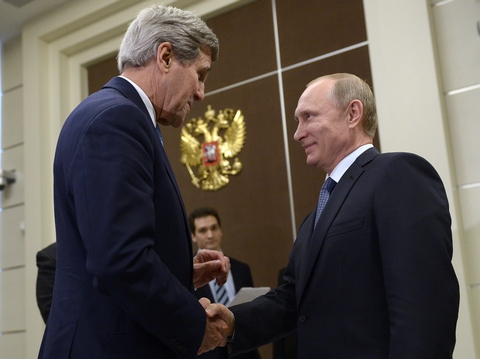
In Sochi, negotiations between US Secretary of State John Kerry and Russian Foreign Minister Sergei Lavrov were held, after which Putin met with Kerry. During the meetings, Ukraine, Syria and Iran were discussed. About what you can expect from these negotiations, the "daily magazine" was told by a political scientist, deputy director of the Center for Political Technology Alexei Makarkin :
What can be assumed now, without waiting for the results of the meeting? Firstly, the visit of Kerry was preceded by an arrival of Angels Merkel and Foreign Minister of France Laurent Fabius. And, apparently, it was not only about Russian politics regarding these countries, but also about Russian-American relations. Thus, they “prepared the soil” for the visit of Kerry.
Secondly, the United States directly wants a more active participation in the settlement of the situation in Ukraine, for example, by connecting its representatives to the Minsk format. In addition, there is reason to believe that the Americans would like to resume the dialogue with Russia on those issues that are significant for them. This is Iran, and the Middle East, and counteracting terrorism - a whole set of serious plots, which were traditionally in the focus in bilateral relations. These relations were frozen, and now there is a desire to defrost their aspects.
Thirdly, the Americans want to get some kind of information “first-hand”. It is clear that there are some external signals that everyone see. At the symbolic level, from the very beginning of the visit by Kerry, they show him that Russia will not give in and will adhere to the previous position to the maximum. The Minister Lavrov came to a meeting at Victory, handed Kerry domestic vegetables, they say, we do not suffer from sanctions, and all those who meet were with St. George ribbons on costumes. In general, a whole set of characters. But it is clear that in addition to such messages addressed not so much by the country with which negotiations are underway, as an external audience, there are also real negotiations that go far beyond the frames of the characters. No one will talk about symbols.
And by the fact that negotiations are going on for a long time, we can judge that failure, most likely, will not happen. Of course, there are different cases, in Reykjavik in 1986, Reagan and Gorbachev almost agreed, and the failure occurred at the final stage. But then the situation was different, because it was about signing the contract, and the parties did not agree in specific conditions. And now we are not talking about either a contract, or even about any large informal agreements, so we can assume in what matters the parties can achieve mutual understanding. Given the current nature of Russian-American relationships, this is not so little.
Most likely, there will be no big breakthrough. The sanctions will not be canceled, mutual understanding, if it increases, it is not very noticeable, trust is unlikely to recover, too much is already wound. There was such a situation when each of the parties sincerely considers itself defending, and the other side - as an aggressor. Russia is sure that the United States entered its spheres of influence and participated in the overthrow of Yanukovych. And the Americans are sure that the actions of Russia in Crimea and in the southeast of Ukraine are aggression. So here it is unlikely that it will be possible to agree. But in some specific issues, promotion is possible.
Photo: Russia. Sochi. May 12, 2015, US Secretary of State John Kerry and Russian President Vladimir Putin (left to right) during a meeting in the Bochars Ruche residence. Alexey Nikolsky/Press Service of the President of the Russian Federation/TASS