
Translated material
Newspaper headlines
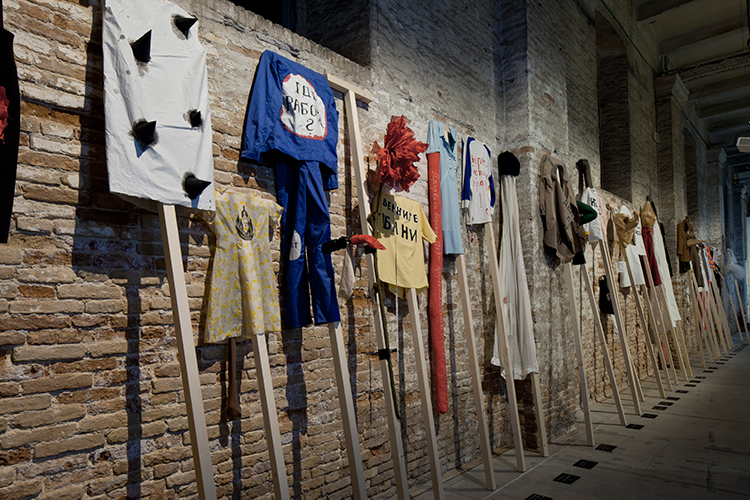
This year, the main project of the Venetian Biennale, entitled “All the Fate of the World”, oversees the Nigerian curator Oksvi Envezor, before that the author of several key exhibition projects-the second Biennale in Johannesburg (1997) and the 11th “Documents” in Kassel (2002).
Already at the entrance to the main pavilion in Jardini, the gaze rests on the four -meter installation of Fabio Mauri “Western Wall, or the Wall of Crying” (1993) - a square of suitcases taken with them by those who set off for one -way - Auschwitz and other death camps. In the neighborhood, another installation of Mauri is a staircase to heaven, which abruptly ends with a thin step with the word “end”, as if inviting to step down. Installations are surrounded by drawings of the artist, on which the same word is written in English ( The end ) and Italian . A funny game of words is obtained when translating between two languages: Fine is the “end” (Ital.) And “good” (English). But do not wait for a happy ending, a bright future. In the next room, the protagonist coughs the main character in the film by Christiana Boltansky. In these two halls, all the hopelessly apocalyptic concept of “all fate of the world” is concentrated.
The curatorial message of OKVI Envezor begins with the famous passage from Walter Benyamin about the Angel of History - the thoughts of which the famous German essay was inspired by the picture of Angelus NOVUS Paul Klee, and this text has since been operating all who is not lazy. This quote, in turn, inspired the curator, but in addition, it perfectly illustrates the main project of Biennale. All the tragedies of the world are collected here: genocide (like Fabio Mauri); political protests, the struggle for freedom and human rights; military conflicts, problems of industrial and post -industrial society, including various forms of operation - postcolonialism, the struggle for women's rights and improve working conditions; environmental disasters; Chaos and cruelty, utopia and dystopia - like newspaper headlines that took the forms of photographs, installations or videos, are literally abandoned at the legs of a discouraged viewer.
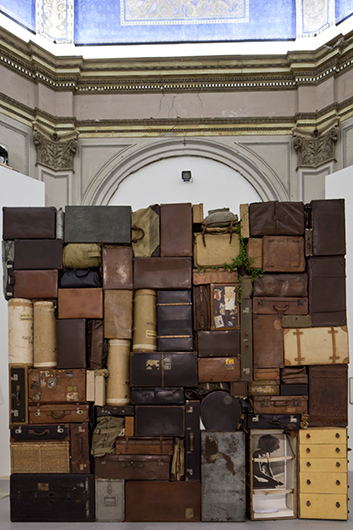 © Alessandra Chemollo / La Biennale di Venezia Fabio Mauri. Western wall, or a wall of crying. 1993
The space is dotted with labyrinants of political and social statements, often torn from context, in the absence of any narrative or logical sequence. Only a few, relatively dynamic, are distinguished and remembered among them-such as the documentation of the performances of the Cuban artist Tanya Brugli or Dora Garcia from Spain: the first naked men in the half, among the dirt and rotting stems of the reed, either depicted cleansing, or performed some kind of ritual; The second invited the audience to interact with the performer who read one of the Lakanov seminars (however, there were very few voluntary accomplices in such projects, as they write ). However, the ideal example is the party project of Edrian Piper, who rightly deserved one of the Golden Lviv , the main award of Biennale. The artist invited visitors to take part in a lifelong performance requiring personal responsibility. Spectators are invited to conclude an agreement with her that: “I will always do whatever I said, what I’m going to do” and “I will always be too expensive to sell myself.” Not everyone is ready to follow these attitudes all my life, but I saw people who put signatures.
It is not worth accusing the curator of the absence of a narrative: Envezor programmatically did not seek to collect all the work under the umbrella of a common topic. He called his work method “using filters” - a set of parameters describing many ideas that become visible through various practices. The “Parliament of the Forms” (as Envezor called the network “filters” on each other) consists of three parts. The filter "vitality. About epic durability ” - the method of creating an exhibition, which is designed to help understand as an event of such a scale as the Venetian Biennale, exists in space and time, how it changed and how it worked with the public. “Garden of the mess” is a large -scale study of the “state of things” and “surfaces of things” displayed in world culture. The last filter "Capital. Reading live " Inspired Louis Altusser's book “Read Capital” , written in collaboration with Etienne Balibar, Jacques Ransier and others, And he explores the significance of the “capital” of Karl Marx in modern history as the drama of modern society - the drama is almost literally.
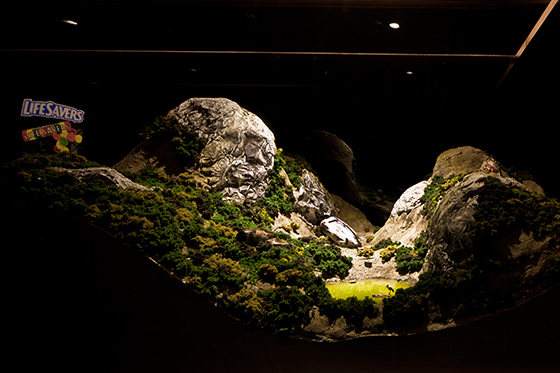 © Alessandra Chemollo / La Biennale di Venezia Cao Fai. La Town, 2014
To revive the exhibition space, the so -called arena is installed in the center of Jardini. On it, throughout the entire period, Biennale, that is, until the end of November, will be performed by performances, readings, films, united by the theme of “Capital” published in 1867 - a book that influenced the course of all subsequent world history. The schedule of the “Arena” includes reading the text “Capital” by actors invited by the British artist and director Isaac Julian, as well as the performances of Olaf Nikolai, Joana Hadzhitomas and Khalil Zhirezh, Jason Moran, Jeremy Deller , Charles Gaines, Mathieu Kleibe Subonno. Unfortunately, my hourly expectation of reading “Capital” was crowned only by the announcement that the performance was canceled by the curator. I hope the rest of the audience will be more lucky.
Not without reason in the work of participants, there are often references to the former USSR and modern Russia as one of the key actors of world history of pain. In the work of Runo Lagomarsino “Following the sunbeam, I found only the Earth” (2012-2014) the Soviet anthem sounds, and among the “Demonstration Disactions” (2015), ricritus of dungeon has images of public speeches for LGBT rights in Russia. In the project “Trud with one plan”, Harun Faroki and Antier Eman, among others, captured the work of actors on the streets of Moscow depicting Lenin, Stalin and Putin (this is one of the results of the Moscow Workshop as part of this artistic study). In the project of the Indian artist Madhusudkhanan “Logic of disappearance. Archive of Marx ”(2014-2015) shows changes in the images of Marx, Lenin and Stalin in the past and present. Lisa Roberts created 12 group portraits based on reliefs - parts of the decor at the Narvskaya metro station (formerly Stalinskaya) in St. Petersburg.
Russian participants in the main project Biennale open their country frankly. Olga Chernysheva draws metaphorical parallels between Russian everyday life and life behind bars - in the zoo. Glukla (Natalia Pershina) in a series with the speaking name “Clothing for demonstrations against the false elections of Vladimir Putin” directly declares: Russia without Putin.
The activist gesture of OKVI Envezor was lost in the infinity of the corridors and halls of Jardini and Arsenal. International Bomond walks around the Venetian Palazzo, reflecting on the fate of the world. Is this not a paradox? How can an exhibition that affects society with a gesture, which even professionals cannot get away from beginning to end in one day? Why did we decide that someone, in addition to the professional community, will spend a full weekend on viewing art, thrown into Venice from the context that gave rise to it, like fish for land?
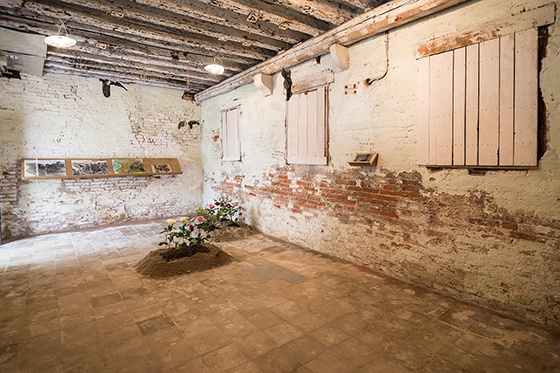 © piero demo Armenian pavilion
As for the national pavilions, the presentation of Armenia under the meaningful name Armenity (You can only not be translated very accurately as “Armenian” or “Armenianness”) deservedly received the “Golden Leo”. Moreover, the current Biennale coincided with a sad anniversary: a hundred years ago, in 1915, the Genocide of the Armenian people was carried out in the Ottoman Empire. The pavilion is located on the island of St. Lazarus, who is called SAN in Italian L à zaro Dei Armeni . Since the 17th century, a quarantine station was located on the island, later the Armenian Catholic monk, Manuk Di Pietro (Mkhitar Sevastiysky), fled along with a group of followers from Seaai, which became an arena of the military confrontation between Venice and the Ottoman Empire. The community built a monastery, a church, a huge library on the island and turned the island into a center of orientalist research. The exhibition includes international artists belonging to the Armenian diaspora. Compared to the rough style of the main project, the Armenian pavilion is distinguished by poetry and subtlety. It is dedicated to such categories as crowding out, territoriality, ethnicity, memory, justice. One of the Armenity project Sarkis - by nationality Armenian, lives in Turkey, he also represents the Turkish pavilion . He in itself personifies the possibility of cultural memory to switch to a new level, the ability to overcome the historical conflict or at least the direction in which it is necessary to move so that this opportunity appears.
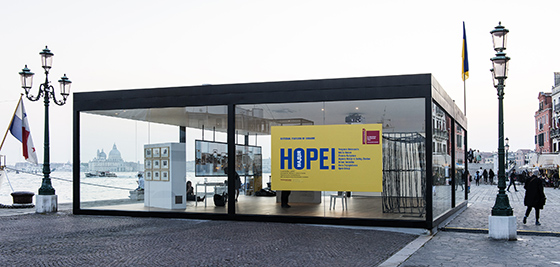 © Sergey Ilyin Ukrainian Pavilion
The current situation in Ukraine turns the installation of the Ukrainian pavilion on the embankment between Jardini and Arsenal into a political gesture. A Ukrainian flag fluttered over a glass cube with an exhibition under the slightly romantic name “Hope” . The curator Björn Geldhof made a lot of effort so that the exhibition took place and that the pavilion is located in a place where he could not go unnoticed. It was he who suggested that the architecture of the pavilion metaphorically relate to the hope of the political transparency of the new Ukraine. In addition, the name of the project is clearly correlated with the name of Nadezhda Savchenko - a Ukrainian military, illegally withheld in Russia.
However, the impression of the pavilion is not the strongest, rather the opposite. Sadly, but the work of beautiful artists Evgenia Belarusian, Anna Zvyagintseva, Nikolai Ridny and Sergey Zhadan, Nikita Kadan, Open Group , Jeanne Kadyrova turned out to be blurred, dissolved in the minimalism of a glass cube, through the walls of which millionaire yachts are visible. In this cube, as in a greenhouse, it is impossible to breathe.
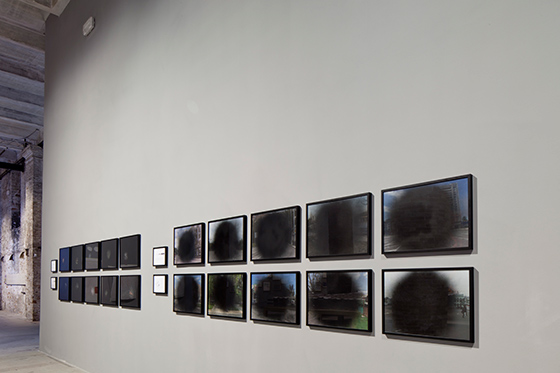 © Alessandra Chemollo / La Biennale di Venezia Nikolai Ridny. A blind spot. 2014-2015
Even more sad that it should not have been. The artists really had the hope of transformation and transparency, at least from the Ministry of Culture of Ukraine, which initially took on itself, and then easily abandoned the obligation to support the Ukrainian pavilion (later participants in the Nadezhda project sent a letter with “gratitude” for this). In connection with such actions of the ministry, independent curators Oksana Barshinova and Mikhail Rashkovetsky were forced to abandon further work on the pavilion - the chronology of work on the project that preceded the refusal was stated in the text of Barkhinova “How I refused to be a curator” . After these events, the artists continued to cooperate with the private institution of PinchukArtcentre , with which they had previously worked before. Unfortunately, the exhibition as an integral project turned out to be mediocre at separate wonderful works of artists. I think that the pavilion and the concept of the curator were killed. It is not necessary to scream to be heard, you can say quietly, but very clearly. Then the words will thunder.
The national pavilions in Jardini and Arsenal were mostly disappointed this year. Only some of them are worthy of mention.
The curator of the Belgian pavilion Katerina Gregosh in cooperation with the Belgian artist Vincent Messen made a bold gesture: the Pavilion presented the thematic exhibition of artists - immigrants from four continents (Asia, America, Africa and Europe), especially African artists. For the first time in the history of the Belgian pavilion, the tradition of solo national presentations was violated. Moreover, for the first time in the history of the Belgian pavilion, a critical reference was given to the colonial and postcolonial connection between Europe and Africa. The place for such a project was not chosen by chance. The Pavilion of Belgium is the first separate national representation on the Venetian Biennale, it was built at the moment when Belgium colonized the Congo and actively pumped wealth from there, using African art brought to Europe to demonstrate its dominance.
The German pavilion also became a space for a group international project called "Factory". The pavilion really turned into a factory of political narratives through which they analyze the images circulating in modern culture. Project participants, including Hito Steierl , Olaf Nikolai and others, reflect on simulative reality, neoliberalism, shadow economy - running topics for critical art, which have recently overshadowed the Ukrainian theme, and therefore all looks a little anachronism.
In contrast to the hypertechnological German pavilion, the Greek pavilion is minimalist. He reproduces the sad story of the fur merchant, whose business is gradually falling. Poland presented a project on the transfer of local art to an alien context: presentations of the Polish National Opera Galki in Haiti. The Latvian pavilion , located in the arsenal, stands separately from all other presentations: a strange utopian space that can be defined as a garage hybrid with a spacecraft, is filled with stories about garage cooperatives and their inhabitants.
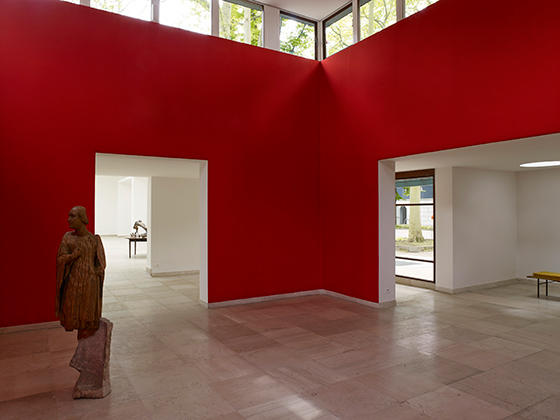 © Nick Ash Danish pavilion
In the Danish pavilion, an exquisite poetic project was located in the Danish artist, the Vietnamese by origin. His works are devoted to multilayer and dramatic historical events and phenomena, such as colonialism, Catholicism, Vietnamese war, as well as the destructive influence of these events on the surroundings of the artist and his contemporaries. This is an example of the exhibition where, through a minimum of words, it is said endlessly.