
Translated material
Theater and mystery
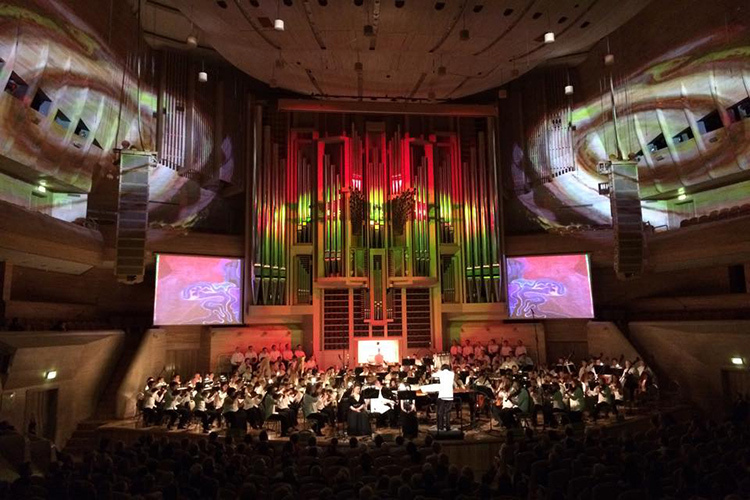
Vladimir Yurovsky dedicated the next working session with his State Counter and the Moscow public to two large dates: the 175th anniversary of the birth of Tchaikovsky and the 100th anniversary of the death of Scriabin. It is easy to guess that far from ordinary honors were invented for each anniversary.
For the first program, held as part of the Philharmonic subscription, Yurovsky took advantage of the literary and musical composition of the famous English musicologist, a specialist in Russian and Soviet music by Gerard Macburni, composed of Chaikovsky’s meetings with Shakespeare. Tchaikovsky did not write the opera Romeo and Juliet, although, it would seem, his topic. But he returned to her many times. The scene of farewell to the most famous lovers after the death of the teacher was completed and orchestrated by Taneyev. In the installation of Macburne, it sprouts from the symphonic overture of the same name. In the symphonic fantasy “storm”, Tchaikovsky appears in the unusual and refreshing role of the Marinist composer. And, finally, in the music of the Hamlet tragedy, an excellent contender for the still not approved, but actively discussed mask nomination “Composer in the Drama”. Throughout the program, the artist Daniil Spivakovsky, sometimes playing out of himself artist Innocent Smoktunovsky, then from the stage, then from the balcony he read Shakespearean excerpts, and the orchestra and soloists illustrated them with appropriate music, dreamy views (Nadezhda Gulitskaya - Juliet and Ophelia, Vsevolod Harvnov - Romeo) Kephira (Maxim Mikhailov - a graveir).
But the skull and kefir, of course, fade in comparison with the inalienability of the plan of another anniversary, which Maestro Yurovsky undertook to be embodied at the invitation of the Moscow House of Music. For the first time in Russia, the most important, but not written essay of Scriabin, sounded in the most complete form.
You cannot say less mysteriously about him. Speaking of Scriabin, if you want, you don’t want to - you dive away from the daytime mind. The man whose contract for the rental of the last apartment ended exactly on the day of his death was born on Christmas, died on the second day of Easter. Some considered him the Messiah. He himself clearly understood that he had a certain purpose. It is only necessary to have time. But I did not have time.
The last two years of his life, he purposefully worked on a cosmic scale of the project. His mystery was supposed to be carried out within seven days on the banks of the Ganges in a specially built temple, reborn humanity to a new life. But first it was necessary to prepare well - for this he came up with a “preliminary action”. Unlike mystery, it was supposed to be performed repeatedly in the main European capitals. A week before his death, Skryabin said that all the music is ready, the most unpleasant remained - to record it. He returned from the last tour, felt poorly, fell ill and died at the age of 43 from a pimple on the lip, where a streptococcal infection entered. Antibiotics have not yet been invented. A notebook with the "action" was open on the piano. The text of the libretto and 55 scattered pages with musical fragments remained. “I am inclined to think that with experiments with time and space, he came close to the interface that connects the person and the world computer. He understood how reality works and how consciousness can affect it, ”said the musicologist-scryabinist Andrei Bandura.
For the first time in Russia, the most important, but not written essay of Scriabin, sounded in the most complete form.
After the death of Scriabin, Father Pavel Florensky, according to some mysterious formula, calculated that the “preliminary action” was destined to be completed after 33 years. And, indeed, in 1948, composer Sergei Protopopov carried out a version for two piano, reader and choir. Then there was a closed execution at the Skryabin Museum. Protopopov did not have time to orchestrate her.
After him, the composer Alexander Nemin undertook this riddle. He devoted 26 years of his life to become, as Yurovsky expressed, "a shadow and reincarnation of Scriabin and finish on his behalf that the scrubs were not given to complete." This is an absolutely incredible, some kind of Leverkin story, if you think about it. Thanks to Nemtin, Skryabin, one might say, survived until the end of the twentieth century. A huge version for the orchestra, choir, piano and soprano lasts three hours and, of course, incorporates not only the luxurious and flying Scriabin sound world, fantastically reliably built in the first part, but also the echo of the entire farthest of the twentieth century. For the first time, the version of Nemtin was performed by Kirill Kondrashin in 1973, then only the first part of three was ready. All three in the 90s were recorded on the Decca label Vladimir Ashkenazi with the Berlin radio orchestra. In 2007, Leaf Segerstam played in Finland.
The pianist since 1973 was everywhere Alexey Lyubimov. He came to the execution of Yurovsky to the house of music as a listener, and his piano party of this marathon race to space Dali handed Alexander Gindin. The choir part was performed by the Sveshnikov choir, the soprano party was mercifully divided between the two performers - the love of Petrova and the hope of Gulitskaya. The video frames of the young artist Maria Kononova, who tired a little at the end of too literal human wingedness, hinted at the Scriabian synthesis of the arts.
However, “tediousness” in this case is not a abusive word. To survive (not to mention to fulfill) this series of ecstatic states of the “preliminary action” that goes into infinity is hard work. Not all listeners sat to the end. But whoever stood - you must think, raised his self -esteem. Before the intermission, it was ordered not to clap, but timid applause was still heard - approximately like in Germany after the sacral first action of Parsifal. Yurovsky agrees that this performance of “preliminary action” is still a compromise, that there are essays “not adapted for concert halls, that there is music that simply does not fit in them.” A recent example, in his opinion, is “ Vita Nova ” by Vladimir Martynov, whom the conductor dreams of performing everything in the right place for her. Wagner was the first to write such music, but he, fortunately, was Ludwig Bavarian, who built a temple in Bayroita specifically for her. And Scriabin was not built such a temple. So the “preliminary action” will remain preliminary, ”concludes Yurovsky,“ until it sounds in the concert hall with applause at the end. ” But actually, this is all to do, to raise this unbearable block behind the authorship of Scriabin-Nemin-it seems, today no less feat than Ludwig Bavarian Bayroit.