
Translated material
(Inter) National SHCHUSEV Green
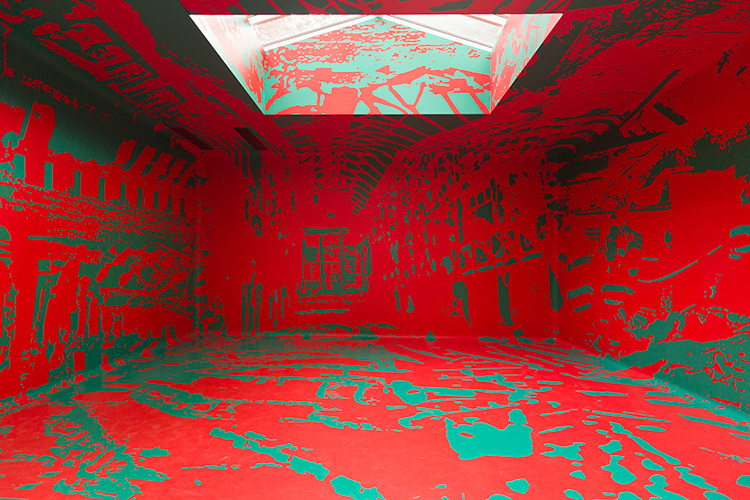
It is customary to understand political representation as a form of self -revision, self -expression and self -government of the subject, which, due to the impossibility of the implementation of these functions, directly conveys them to intermediary institutions. In the case of the Venetian Biennale , where in addition to the main project, a competition occurs between dozens of states, in each individual case these powers are assigned to an entire system of intermediaries. As a rule, it consists of the Ministry of Culture, a private sponsor, members of the jury, commissar, curator and, finally, the artist, and their number varies from the state to the state and largely determines the nature of the exhibitions themselves. At the same time, the representation is manifested, hypostasized and materialized in the symbolic form of the pavilion - a specially built building or a rented room, whose interior is designed to create an artificial microclimate to cultivate a “national”, which should in some way to stand out from the fluid heterogeneity of the “global world of art”.
This year, the curator of the main project once again indicated that the form of representation of art in national pavilions, which historically took shape much later, is archaic (in which the curatorial monopolism of Oksvi Envezor himself is partly manifested). In his text, he forgot to note another nuance: in addition to the obvious problems associated with the concepts of “nation” and “state”, the system of pavilions annually reproduces structural inequality within the exhibition itself, where those pavilions that managed to reserve a place in the Jardini Park, which Russia was convinced to make one of the first, find themselves. After the fall of the Berlin wall and the depolarization of the world, to criticize the national representation by means of the pavilions themselves, which, just in case, reminded Envezor, became considered a good tone. This year, many participants in the “national” projects once again tried to critically rethink this format itself or, on the contrary, to sharply focus on local problems, contrasting it with the universalist claims of the megaph.
So, the 56th Venetian Biennale was marked by several bold political gestures. India and Pakistan, who are still in tense relations, united in one pavilion ; During the centenary of the Armenian genocide, Turkey was introduced by Sarkis - a conceptual artist of Armenian descent; And the three countries, recently located in the center of world attention, spoke about the war on their territory. If Syria did this allegorically, then Iraq and Ukraine spoke out quite openly, and, no less important, both countries during work on the pavilions changed exhibitions, reacting to a rapidly developing political situation. However, from the chief player in the political arena of the last two years, the audience did not receive any of any intelligible commentary.
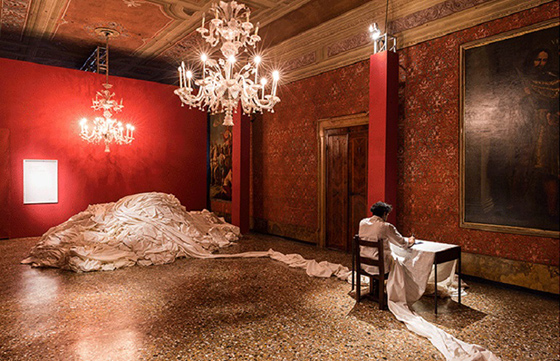 © Mark Blower Shilpa Gupta. "Untitled". Pavilion of India and Pakistan
 As for the Russian pavilion itself, he went out extremely abstract: immersed in contemplation of himself and the reflection of his own artistic story, he leaves the audience at best in a pleasant somnambulic bewilderment or vague guesses about the author’s intentions. Although the curator of the project Margarita Masterkova-Dressyna notes the tendency of Irina Nakhova, representing Russia this year, to the “close of the artistic and political” , Nakhov, from her own words (in the exhibition catalog), builds a series of “references, catch and clues”, which in reality in every possible way relative to its position. The condemnation of violence and lengthy discussions about the loss of historical memory can hardly be called a political statement. Of course, the artist is not at all obligated to draw up a clear political program for the Biennale (especially since any statement about the war in Ukraine in the general atmosphere of Biennale may seem hypocritical). However, the point here is rather that, appointed by the commissar to represent Russia shortly before the famous events in the Crimea, it turned out to be a hostage to circumstances, not only external, but also purely internal. No less important for understanding the specifics of the Russian pavilion and the unspoken war, which has been waged on its territory for several years.
The struggle for the pavilion
"Is it possible to represent Russia?" - Such a question was posed by a group of Russian artists led by curator Viktor Misiano, representing the Russian pavilion at the Biennale Venice in 1995. For the first time after the decades of the representative office, reflecting the official aesthetics of the Soviet Union or, conversely, forming its export appearance, the participants decided to turn to the very problem of representation and representativeness, suggesting that instead of any unambiguous statements of nonsense, the failure of the symbolification and almost a futuristic umpurcation. The answer was thereby negative: the post-Soviet Russia of the 1990s was declared fundamentally unconventional, unarticulated, unsympathetic, and its representation was possible only through violence or through a gesture that Catherine Giogot was captured with “terrorist naturalism” .
After this exhibition, which turned out to be far -sighted, various private funds, state organizations, commercial galleries, individual art historians, independent curators, entrepreneurs, and even artists themselves began to fight for the authority of being official spokes in the modern art situation. If you retrospectively trace the history of the Russian pavilion, it may seem that for two decades the “terrorist naturalism” has passed from the artistic method to the strategic principle of struggle, where the main trophy has become “visibility” (in the eyes of a large world), and attempts to participate in critical dialogue or polemic with international artistic structures stepped aside. However, during the time that Russian artists spent the importance of Biennale to convey to the Ministry of Culture and form a professional partnership between various warring institutions, the national representation has ceased to be taken seriously, and Venice itself has lost its leading position among two hundred biennale, which spread around the world. As a result, Russia remained almost without “biennal” artists with a pavilion in the very center of the Venetian Biennale.
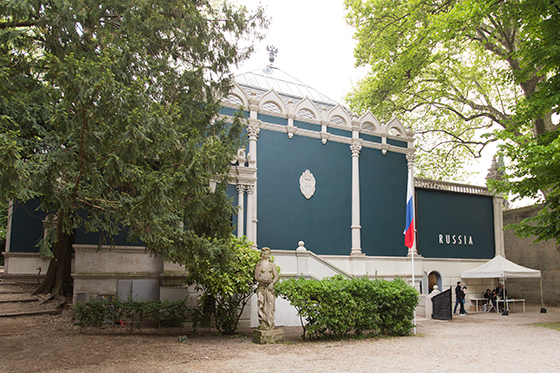 © Stella Art Foundation Russian pavilion on Venetian Biennale
The crisis of the national representation of art, on which the Pavilion system of the Venetian Biennale was historically founded, was directly related to the crisis of parliamentary representation, which, after neoliberal reforms and dismantling the remnants of social states, everywhere carried out over the past 30 years, ceased to be any effective. According to the theoretician Boris Buden, thanks to these processes, national art and culture were descended, deessed and instrumentalized, like the national states themselves, and, therefore, the category of nation in contemporary art has become nothing more than a “player” or an institution of inclusion of artists in the market system. Russian breakthroughs to the West, that is, the transliteration of the provincial Cyrillic of “Modern Art” in the Latin Contemporary Art , today look nothing more than adaptation and targeting of the brand when it withdraws it to the foreign market. But meanwhile, in the case of Venice, the local and the particular is not assimilated to the end, leaving some residue. So, according to the witty remark of Boris Groys, the pavilions retain their “national” specifics in relation to the method of their administration, which reflects and continues the administrative practice of these countries.
In this sense, the history of the management of the Russian pavilion, which is casually, is an excellent illustration of the development of the Russian administrative machine (which in itself requires a separate study). After a long history of the struggle for the pavilion, in which the descendants of the Soviet nomenclature, nouveau riche and museum bureaucrats participated, he finally went to the private fund Stella Art . This decision, talking about changes in the cultural policy of Russia as a whole, also testified that "Russian capitalism committed both the period of the initial accumulation of the 1990s and with the period of" spinning raw materials "of the 2000s and went into the category of" normal "," civilized ", not in need of advertising." The signing of the contract with the Ministry of Culture for six years (which curiously coincides with the new, “stable” period of the Putin’s presidency) led to a change in the format of representation in favor of a solo exhibition, which is explained by a change in orientation to the Western model, where either already proven classic classics of the older generation are also exhibited, which will “not lead” or ascending stars, which need an additional impetus for the final factory of the market.
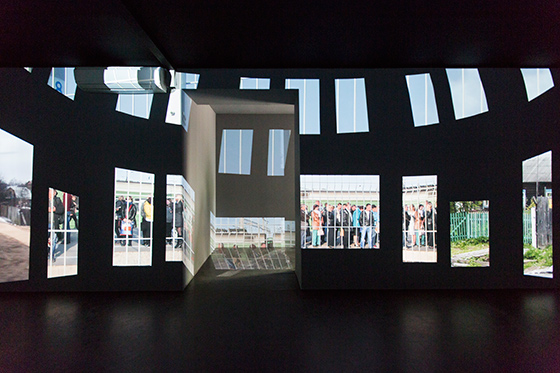 © Stella Art Foundation Russian pavilion on Venetian Biennale
 Although the Stella Art Foundation exhibitions look advantageous against the background of most previous Russian pavilions, it is still its policy raises a number of questions. Despite the fact that the Fund does not directly sell the works of its artists, such a personified representation of the art of one country in a famous world project is a successful strategy for the collection of the collection, which includes all three exhibits: Andrey Monastyrsky, Vadim Zakharov and Irina Nakhova. Another problem is that as a criterion for choosing an artist who is most “worthy to represent all Russian art”, the taste of the same philanthropist is the taste of the same pattern, whose choice falls on conceptualism, which, according to the gear, has become a “like -minded new market economy of Russia”. As a result, instead of creating a discussion with a world artistic system, which the most successful Russian projects were guided by, as well as instead of integrating the young generation of artists and curators, the presence of Russia on the Biennale directly coincides with the advancement of the already consisted authors. It is not surprising that this whole situation, partly reminiscent of the Gerontocracy of the post -Soviet stage, causes a young generation either an aggressive edipal reaction, or, conversely, the ultimate indifference to “domestic” art.
Pavilion about the pavilion
Completion of pavilion architecture - Sine qua Non works of any curator and artist in the Jardini Park. The result of this interaction may turn out to be a formalist, aesthetic experiment, as, for example, in the case of Austria of the artist Haimo Zobernig this year , whose participation in the project comes down to the creation of several not immediately recognized black structures, complementing the original Hoffman -Craramiter pavilion and emphasizing the interpenetration of nature and culture, interior and exterior. However, the architectural intervention can take the form of a well -articulated political statement, which once Hans Haak achieved the famous project “Germany” (1993), for which he turned the marble floor of the pavilion, laid out on the site of the parquet after the meeting of Hitler and Mussolini.
The Russian pavilion is engaged in the restoration of the most important symbol of colonial expansion, imperialism, and nationalism, and at the time of the progressive growth of populist sentiments.
It is significant that this year the Russian pavilion for the first time after the project of Ilya Kabakov, represented in 1993, was based on the principle of site specialty . Instead of rearranging accents that exposes hidden architectural motifs, or, on the contrary, a certain gesture that undermined its super -symbolic meaning, Nakhov and Tullus, make a meaningful (in every sense) gesture of returning the neo -Russian Tsusevsky tower of its historical green color. Given its replication through the name itself, the covers of catalogs, newspapers and photos on the Internet, the resulting deep green shade I want by analogy with the patented color of the artist Iva Klein to name the International SHCHUSEV Green . However, the author of the author of the text to Sergei Eisenstein, who believed that “color is primarily ideology,” makes us think about the ideology of this project itself and the appropriateness of applying the Inter prefix to it.
Although the curator says that the “premise” green color meant “Hope” or “Spring update” for the artists, its “symbolistic potential”, according to the well -known semiotic principle of arbitrariness of the sign, does not indicate renewal, but, on the contrary, makes a sharp reversal back, “to the roots”. Correction of the oversight allowed during the previous reconstruction of the building, the return of its authentic color, the fetish is focused on the original appearance of the architectural masterpiece, on its materiality and materiality, in the primordiality and auraticity of green paint metonymically speak of “historical justice”, for which the inevitable reactivity is visible. While, for example, Belgium pavilion with the Personne et Les Autres project reflects on its colonial past, the Russian pavilion is engaged in the restoration of the most important symbol of colonial expansion, imperialism, and nationalism, and at the time of progressive growth of populist sentiments. Such a reading is not a reproach for the authors of the pavilion, which can hardly be convicted of conservatism; It only indicates how in the current situation the conversation in the color of the color can easily distort any statement.
 © Stella Art Foundation Russian pavilion on Venetian Biennale
 In his catalog, the curator also writes that “the Green Pavilion” restores the harmonic unity found by Alexei Shchusev between the stylistic “revalism” of the architectural solution and the natural context - the garden, the lagoon, etc. ” The motive of the pavilion mimication pays attention to another key aspect of green - its inevitable militaristic connotations (in particular, the image of “polite people” or “green men” (hence the action of Ukrainian artists in the Russian pavilion . - Ed .)), Which cannot be avoided when the threat of world war is more noticeable than ever. But, as one critic successfully remarked in a conversation with me, the authors of the project managed to choose the rare shade of green, which in itself does not cause any associations with camouflage (which, in principle, make it extremely difficult), but resembles a noble shade of the walls of museums and other cultural institutions that have not been related to “big politics”. At this very moment, the suggestive potential of the color comes into conflict with its symbolic power: a high -minded temple of art seems to look down on this variable political context.
Feminism stopped on the run
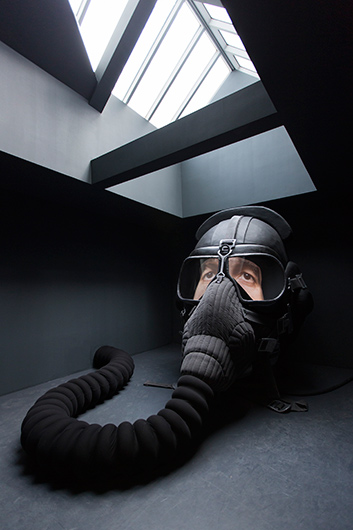
In fact, the repainting of the walls themselves was never carried out due to bureaucratic troubles, so they were covered with a layer of drywall. Tupitsyna perceives this curious fact metaphorically as the image of the internal state of Moscow experimental artists: “In a sense, they themselves were covered with drywall, taking into account their many years of isolation from the public, press and artistic institutions.” A similar image of isolation arises in the first hall of the main floor. It houses a giant head of the pilot, lined with quilted jackets (another slippery connotation), from which the eyes of the artist, or the local inhabitants captured by her, look bewilderedly. Nakhova describes this work as follows: “The figure of a pilot is a figure of an artist, isolated from the whole world, closed to the cabin of a supersonic fighter and caring his own unpredictable mission ... Communication with the world around us is extremely indirectly: a set of used and recognizable gestures is extremely small, and the reaction of observers is inadequate.”
Both the curator and the artist talk about the closed art of the Soviet underground, once again romanticizing the image of a bunter artist and mythologizing this isolation itself. In this regard, it is not entirely clear why it was once again reminding the distress of artists in the Soviet Union, if it is precisely the unique context, no matter how unsightly it was, as a result, made them exhibits of the Russian pavilion. It is no less strange in the context of the “Marxist” Biennale Envezor to meet the opposition of individualist freedom of expression and Soviet communalism. Talking once again to the world artistic community about all this, for some reason the curator bypasses the other aspect of isolationism in silence-the almost complete absence of women in the pantheon of Soviet art, that is, their double silence: from the side of both the official and unofficial circle.
Само же слово «феминизм» как будто нарочно вымарывается из всех текстов, а во вступительном слове президента фонда речь идет о «чувственном, глубинном, эмоциональном измерении, которое доступно лишь женщине-художнику».
Сама Тупицына, отвечая на вопрос «Российской газеты» о феминистских мотивах тогда еще не реализованного проекта, указывала , что «поддержка художницы на таком уровне будет восприниматься на Западе как реверанс в сторону феминизма». Она оказалась права. К примеру, газета The Guardian именно так и интерпретировала вышеописанную работу: «…ее эффект разрушительно точен. В возрасте 60 лет Нахова — первая женщина, представляющая Россию». Сам факт экспонирования художницы в Российском павильоне действительно можно рассматривать как феминистский жест (но в данном случае этот жест принадлежит не куратору, а комиссару выставки Стелле Кесаевой), а в высказывании самой художницы, какое бы оно ни было, будет содержаться определенная доля феминизма. Однако, несмотря на «дистанцирование от фаллической иконографии и мужской проблематики», выставка и ее каталог почему-то изобилуют неисчислимыми реверансам в сторону «белых мертвых мужчин» (Щусева, Малевича, Хлебникова, Каменского, Татлина, Бойса, Родченко, Эйзенштейна, Матисса и Ротко), как если бы куратор считала, что для признания женщины в качестве художницы необходимы бесконечные оглядки на авторитет предшествующих ей богоподобных творцов. Правда, можно и повернуть ситуацию на 180 градусов, предположив, что павильон, наоборот, был задуман как пародия на бесконечное цитирование авангарда.
В этом смысле намного более выигрышно смотрится интервью 1985 года, снятое Сабиной Хэнсген (представленное на первом этаже павильона), где Нахова, находясь внутри своего легендарного инвайронмента «Комната № 2», старается всячески увильнуть от навязчивых расспросов ее коллег. В частности, ее бывший муж Андрей Монастырский пытается направить ее речь в русло, согласующееся с принципами формальной логики, добиваясь от нее установки причинно-следственных связей, проведения четких параллелей и соблюдения закона непротиворечия. Этот же момент более четко драматизируется в каталоге выставки, куда включена помимо расшифровки видео еще и стенография двух обсуждений ее работ в кругу московских художников. Примечательно, что во время обсуждений сама Нахова, спасаясь от интеллектуального насилия, пряталась на кухне или вовсе была вынуждена покинуть свою квартиру, в связи с чем в тексте остались исключительно мужские имена. Воспользовавшись отсутствием художницы, участники этой дискуссии попытались дать ее работе четкие определения и искусствоведческие интерпретации и тем самым встроить Нахову в свой символический порядок. С этим соглашается и сама художница: «Иосиф Бакштейн апроприировал “Комнаты”, запустив их в мужской, патриархальный дискурс» (впрочем, я и сам тут оказываюсь носителем такого дискурса).
Не совсем понятно, зачем лишний раз напоминать о бедственном положении художников в Советском Союзе, если именно тот уникальный контекст, каким бы неприглядным он ни был, в итоге сделал их экспонентами Российского павильона.
Эти три документации — видео Наховой, отвечающей на вопросы невидимых респондентов, и транскрипции, сделанные без ее участия (которые, кстати, можно рассмотреть как метафору художественной критики как таковой), — весьма убедительно критикуют патриархальные устои и гендерные иерархии советской и российской художественной сцены. Однако небольшое видеоинтервью теряется среди спектакулярных видеопроекций, а расшифровки спрятаны внутри каталога, сопутствующего выставке, который мало кто читает. В самой экспозиции если даже Нахова и пытается говорить о положении женщины в маскулинной и фаллоцентристской среде концептуализма, то опять-таки исключительно обходными путями, в отличие от ее ранних и более смелых работ. Само же слово «феминизм» как будто нарочно вымарывается из всех текстов, а во вступительном слове президента фонда речь идет о «чувственном, глубинном, эмоциональном измерении, которое доступно лишь женщине-художнику». В результате вместо критического послания павильон как будто бы эссенциализирует «женское» и дерадикализирует феминистское послание, что доводит до абсурда приуроченный к этому событию разворот The Art Newspaper Russia с выносом «женские павильоны — тренд нынешней биеннале» .
Борьба за историю
Выработка критических категорий, которая вносила бы различие в существующую таксономию искусства (например, дифференциация исторического и неоавангарда), — пожалуй, самое важное, что может сделать художественный критик или историк искусства. Однако в современном «постконцептуальном состоянии» любая попытка обособить и абстрагировать течения или «-измы» чаще всего является не более чем очередной формой включения художников в систему (например, как это происходит с «постинтернет-искусством»). Что касается постсоветского и в целом постсоциалистического контекста, производство категорий оказывается здесь не просто рыночной стратегией, но своеобразной борьбой за вступление в права наследства — полномочия распоряжаться интерпретацией концептуализма и, следовательно, его презентацией мировому сообществу, обеспечивающими успешную академическую карьеру.
Одним из первых российских критиков, предложивших новую и оригинальную критическую категорию, был Борис Гройс, чей «московский романтический концептуализм» (1979) сумел (хоть и не сразу) пошатнуть англосаксонскую гегемонию. В качестве «печати различия» московского круга художников он подчеркнул «лирический» и «романтический», а также исключительно русский характер концептуального искусства с его приматом внутреннего и потустороннего мира. Уехав за границу, Гройс стал одним из основных агентов «внутренней колонизации» и распространителем этого искусства, успешно продвигая творчество художников, с которыми он был связан профессиональными и личными узами (в частности, недавно он выступил куратором павильона Монастырского). Другой «агент влияния русской культуры на Западе», философ и теоретик культуры Виктор Агамов-Тупицын, предложил альтернативную полемическую категорию — «коммунальный концептуализм», отсылающий в первую очередь к стихии коммунальной речи и коллективным способам видения.
 © Stella Art Foundation Российский павильон на Венецианской биеннале
Позднее к этим двум категориям прибавились еще две, которые придавали концептуализму новое политическое измерение. Тупицын ввел словосочетание «московский партизанский концептуализм», его Тупицына перекодировала в одноименную выставку (куда вошли Нахова и Павел Пепперштейн). Под ним понималось искусство, дающее отпор культурной индустрии и арт-институциям, а сам этот термин использовался, чтобы подчеркнуть «все еще маргинальный статус этого движения в постсоветском пространстве». К этому следует прибавить и более поздний термин, который независимо друг от друга использовали Дёготь и Гройс, — «коммунистический концептуализм», наделяющий особым статусом тот характер экономической модели Советского Союза, в которой существовали и работали эти художники.
Это многообразие предикатов, приставленных к одному и тому же условному кругу художников, напоминает рыночную стратегию «дифференциации» продукта, когда различные компании, выпускающие по сути один и тот же товар, пытаются правильно определить его конкурентные преимущества и тем самым найти соответствующую группу покупателей (в этом контексте покупателями окажутся в первую очередь крупные музеи, академические издательства и университеты). В результате с одной стороны мы видим «зеленую» интерпретацию, представленную четой Тупицыных, где была изъята коммунистическая составляющая. С другой — «красную», в сторону которой со временем эволюционировали такие критики, как Дёготь и Гройс, наделяющие концептуалистов антикапиталистическим потенциалом. На одном полюсе история предстает линейной, где «не прервалась “нить авангарда”, позволившая найти выход из лабиринта соцреализма». Такой подход устраняет из поля своего рассмотрения соцреализм, восполняя тем самым разрыв «авангарда, остановленного на бегу» через неомодернистские практики андеграунда. Другой подход, наоборот, основан на парадоксе, диалектике и разрыве, где дискредитированное официальное искусство восстанавливается в правах, тем самым усложняя и переворачивая логику поступательного и телеологического движения.
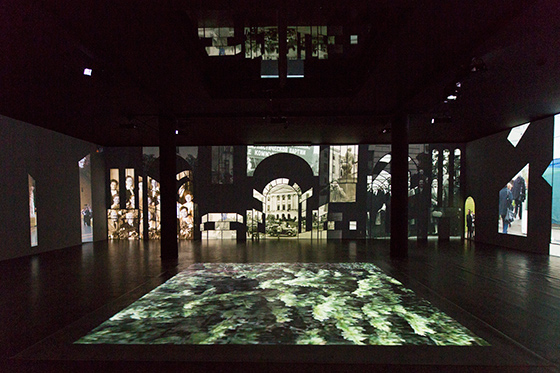
Это противостояние двух моделей истории искусства является подспудным мотивом самой выставки, и оно символически достигает максимального напряжения в последнем, психоделическом зале экспозиции («Основные цвета», 2003), которое основано на противостоянии красного и зеленого. Если, как указывает Тупицына, Кабаков, выставивший в Венеции в 1993 году игрушечный красный павильон, показал обособленность неофициального искусства от официальной культуры, то жест Наховой является возвращением искусства обратно в его историческое состояние, то есть его «деинтериоризацией» в утраченную традицию. Желание окрасить павильон в зеленый цвет можно расценить в этом смысле как своеобразный реванш или, заимствуя термин автора каталога, акт своеобразной «дередификации» искусства. Это спасение зеленого павильона от красного, торжество коммунального и партизанского концептуализма (с его небезызвестными зелеными стенами) над романтическим и коммунистическим, предпочтение либерального нонконформизма квазилевому соцреализму есть своеобразное ритуальное изгнание призрака Маркса, в очередной раз разбуженного Энвезором. В общем контексте биеннале, на который, конечно, куратор павильона вовсе не обязана ориентироваться, попытка перевода творчества Наховой на «койне» современного искусства оказывается превращением ее в один из постсоветских искусствоведческих диалектов. Хоть вся выставка и является гипертекстом, основанным на цитировании ключевых фигур авангарда, чьей преемницей оказывается русская художница, сама Нахова здесь как бы снова отсутствует, становясь «пустым центром» в раскраске «соедини точки», через которую историкам искусства удобно провести нужную им линию.