
Translated material
"In Russia, everything needs to be exposed"
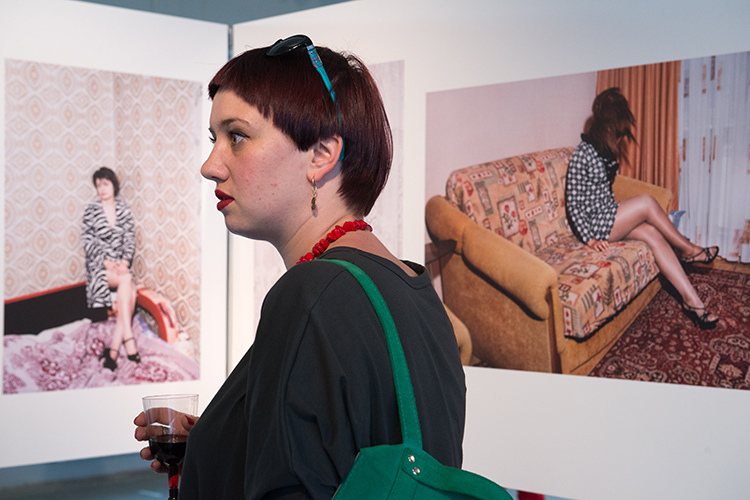
From May 15 to June 13, Artplay is an exhibition of winners of the international documentary photo competition World Press Photo 2015. In WPP this year, a Russian trace is again well visible. Firstly, the winner of this year, the Dange of Danes, Madsen Nissen, is dedicated to the intimate life of a gay-pair from St. Petersburg. Secondly, in the laureates there are two Russian photographers: Sergey Ilnitsky, who was awarded for the photo “Kitchen table in Donetsk” and for the sports photo series “Fending Speed”, and Sergey Ponomarev, who became the third in the news category for pictures from the Gaza sector.
We asked people who visited the opening - professionals, photographers, photo editors and ordinary spectators - what they think about World Press Photo 2015 and about the state of documentary photography in Russia and in the world.
Lawrence Corteveg
WPP exhibition coordinator
- Are there many photographs devoted to the horrors of war and violence?
- Yes, a lot of cruel photographs: wars, murders, corpses, battles. But that is why we show this exhibition. Because we believe that the world needs it. This is what is happening on our planet. Yes, perhaps this does not happen nearby. But is it important, because somewhere it is still. We are all residents of one planet. And when we see this, at least we know that it is.
- What do you think about Russian photojournalism?
- To be honest, I know little about Russian photojournalism. But I know for sure that every year about 200 photos from Russia come to us. This is a lot. And at this exhibition there are Russian winners - Sergey Ponomarev and Sergey Ilnitsky. I think they tried well - they told the story in the language of photography. It's great when the photograph gives us to feel like a part of the story.
- Why did the work of the Danish photographer Mads Nissen won about the homosexual pair? Did you like her?
- I really liked it. This is a photograph of love. Love is what we all need. This is what makes us happy. Yes, this is love between two men. But this is life. The photographer tried to show this to the world, despite the negative attitude to same -sex love. They just love each other.
WPP is a free exhibition. If we were asked if we can show the exhibition without this photo, we would answer - no.
This is a photograph of love. Yes, this is love between two men. But this is life.
Valery Nistratov
Photographer, teacher of the school of photography and multimedia named after Rodchenko
- It did not seem to you that the exhibition has a lot of work dedicated to the war?
- No. In fact, the photographs have less violence than in previous years. It so happened that the blood literally poured onto the viewer.
- Do the participants abuse Photoshop?
- In general, using photoshop is not prohibited. But it is used to improve the quality of the photograph - straighten color, brightness. This year, about 20% of the work was removed due to the use of Photoshop. But here's the point. The guys were carried away. Somewhere the details were removed, somewhere they added something that was actually not, they connected several photos into one. And when the originals showed, the jury had to choose new winners. Especially a lot of these in the category "Sport".
- Does photojournalism have a future in Russia?
- No. Because there is no wide free media for implementation. Yes, we have the media. But they all obey the state. And there is no need to talk about free development. There is no strong media that could support photojournalism. It goes as a complement to text materials, but not as a separate type of journalism.
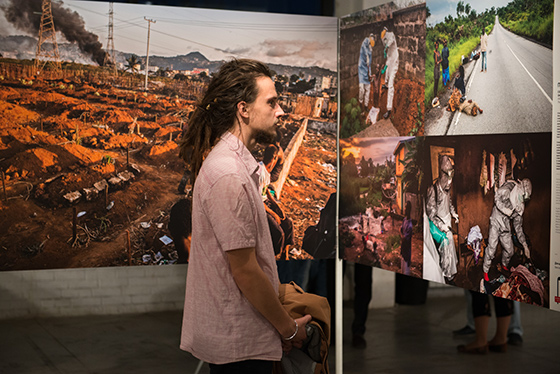 © Lena Balakireva
Denis Sinyakov
photographer-freelancer
- Your impression of the exhibition?
- I liked the jury this year. From year to year, he is dancing, but this time, it seems to me, he is more interesting than usual.
“Isn't it too safe to exhibit a photo like Mads Nissen in Russia?”
- No, this is not bold, this is normal. In Russia, everything needs to be exposed. Compared to past years, there is nothing bold. This only recently has become so inadequate that even such an innocent picture causes so many controversy. But it is wonderful that the organizers were not afraid and brought it. And there are neither Cossacks nor the “young guard”, as I see.
- Does photojournalism have a future in Russia?
- In the days of lack of freedom, crisis, the most interesting projects are born. In this sense, I do not worry about the photo. Another thing is whether there will be the number of magazines and sites where the photographer will be able to show his work. But this is not important. So, in these conditions, the guys will look for other funds. I see a huge number of young talented guys who do a truly worthwhile job.
In the news, we are usually told that the plane crashed, and not about the fact that the plane landed.
Peter Antonov
photographer, teacher at the British Higher School of Design
- What do you think about the exhibition?
- All that is exhibited here is in the traditions of WPP . There is nothing to surprise. There are series that should mean that the competition is changing and keeps up with the times. But in principle, all this is traditional, and this is how the results of the competition looked last year.
- Are there many photographs devoted to military topics? Is it a lot of cruelty?
- This year there is not as much cruelty as usual. Last year, maybe there were also fewer. It seems to me that some years were more bloody. This is what should be expected from the format of the competition. Life by 99.9% consists of lack of violence. And this festival shows this share of a percentage when this blood occurs. The competition does not talk about what life looks like. Traditionally, he talks about some conflict situations, about what illuminates the press. In the news, we are usually told that the plane crashed, and not about the fact that the plane landed.
If we were asked if we can show the exhibition without this photo, we would answer - no.
Sarah Zezerman
Blogger of the "best community of Moscow bloggers"
- Your impression of the exhibition? Whose work was most remembered?
- It is difficult to highlight one author. Social photographs, photographs depicting everyday life - this is important.
- Is there too much violence in the photographs?
“I don't think it's bad.” It is necessary to show that people understand. It’s better to see in the photographs and come to the fact that you do not need to fight and kill. Maybe the photograph will help to realize that you need to live differently.
- Do you agree with the choice of the jury?
- Yes, I agree. But, as Maksimishin said: "Take photos and select photos - two different skills." I take it for the most part. Therefore, I can’t talk about the selection. This is a matter of taste, gaze. But I agree. But many against such photographs, they say that you do not need to show it. It seems to me that the most difficult thing is to make the right choice.
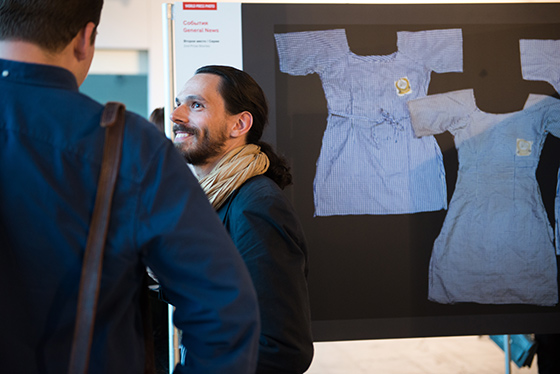 © Lena Balakireva
Alexander Sorin
Director, curator of the Fotodoc documentary photo center , organizer of the WPP exhibition
- Your impression of the exhibition? What did you pay attention to?
- I immediately drew attention to the work of Russian photographers. They familiar with many guys personally, worked with someone together. And when you see a familiar surname in the list of winners, this is a blow at once on consciousness, by emotions. First of all, you pay attention to this. And this is not an attempt to prove that I am objective. But this is important to me, because familiar people are behind these photos, I can imagine in what conditions these photos were taken, and for me this is a big emotional shake.
-What is your opinion about the winning photo?
- I have no complaints about this photo, although many experts have doubts that this photograph was documented, that this is not a production. Still, it is very difficult to accidentally end up in a room with two gays making love. At the same time, I understand that WPP , unlike other competitions, is for photographers-journalists. And what problems are raising here? Firstly, the difficulty of performing a particular task. This task was really very difficult to fulfill. Secondly, the problem is really important. And for Russia including. But all over the world, too, not everything is so smooth with the perception of the public of the same -sex love. Therefore, as I understand it, for the jury it was a kind of manifesto. This is a journalism competition, and not just a photograph.
In the 21st century, blindly believe everything that you see on the screen is frivolous.
True, there is still a lot of things here. I was greatly surprised by the scatter from the classic approach to reports, for example, like Seryozha Ponomarev, to such non -standard (at least for WPP ) shooting with drones. Very complex, non -banal moves, when a person removes the personnel of peaceful life from the drones, conducting associations with those who died in Pakistan from missiles released from drones. Look, here is a peaceful wedding, and people died in the village of such and such. Schoolchildren are walking, and somewhere in places of hostilities children died. I welcome any experiments, this is the front line to pull out this. But I suspect that the simple viewer is not clear in these photographs. Few read descriptions carefully, they came, looked. Well, yes, entertaining - here's funny photos from above. People, shadows. At the same time, it is completely incomprehensible to them what the project was about. Oddly enough, journalism for experts. Not for everyone. Just cash. Therefore, on the one hand, I am for attempts to find new. And then everything will freeze, nothing will move. It is necessary to develop, it is necessary to maintain and develop unusual approaches. On the other hand, such photos cannot be called understandable for a simple viewer. And all this in one boiler this time.
- Is there much cruelty in the photographs?
- WPP - This is the exhibition not photos, but journalists. They work in hot spots. Wars, earthquakes and all muck, of course, in the spotlight. This is an integral part of this competition.
- What is the future of Russian photojournalism?
- I do not believe in Russian features of photojournalism. There are some world trends, and when you lag behind them, you find yourself in the cave. Your photos become unnecessary, and as a photographer, reporter, nobody needs you either. Now, thanks to the Internet, the world has become small, and what is happening in the town of B100 of Moscow is not easier to understand what is happening in the States. If we talk about Russian specific approaches, we periodically have any remnants of Soviet approaches, but they often have little relation to journalism and rather solve ideological problems. I do not think that there is a certain system of values. Moreover, photography. This is not English, not Russian, not French. This is read more or less. Once the cross of documentary cinema with a photograph, with text, with sounds and others were the destiny of five strange intellectuals. Now look at: all Internet publications have actively used this. Because it is an important, necessary and correct form of news feed.
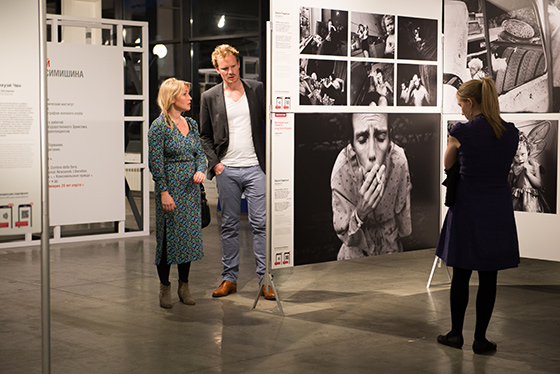 © Lena Balakireva
Pavel Kosenko
photographer, founder of the creative laboratory "Wednesday"
-What do you think about a winning photo?
- You need to understand that WPP is not quite a photograph, this is a significant event from the point of view of world social issues, society. Criteria such as composition, artistry, have a deeply secondary value. The main thing is the context. Any current context has the right to take a victorious place. From this point of view, the choice of the winner is justified.
- Is there much cruelty at the exhibition?
-WPP is always blood, so it did not seem to me that there was something out of the ordinary. WPP is always like that.
There are neither Cossacks nor the “young guard”.
Alexandra Gorokhov
Photo editor, worked with the Russian Reporter, Russian Planet, National Geographic, Time
- Your impression of the exhibition?
- It seemed to me that this year there was much less noise both around the competition itself and around the exhibition. On the one hand, this can be explained by the fact that in the country “officially” there was one topic for discussion, on the other, the choice of a winning picture.
- What do you think about the photo that took first place?
- I was somewhat disappointed. The winner of last year, for example, was interesting because it was “something else”, without blood, hell and with some hope. Nissen's picture causes approximately the same emotions as the appearance of Pussy Riot in the series “House of Cards” - embarrassment, disappointment and shame. You can climb deep into the political jungle, trying to explain this choice, which I do not want to do at all. This picture did not hook me.
Much more was hooked and seemed interesting: this is the excellent journalistic work of Sergei Ponomarev, the actual project of Thomas Van Hauteriv about drones. Ebolaw Müller, which, probably, was worth a little less retouched. My unconditional favorite is the photo editor Buvant Kilich. He manages to shoot fantastic shots. The heartbreaking in terms of meaning and incredibly visually beautiful reporting of Jerome Sessini about the confused Boeing and his own Maidan. And Arash Hamushi, who was lucky to remove the incredible - forgiveness of the woman of the killer of her son in Iran. This did not seem to happen, and after the publication of these photographs of death, 25 more sentenced were escaped. As a photojournalist, he managed to influence the world a little. A very good selection of portraits this year, I like everything in general, both in meaning and in execution. Especially the series of Paolo Verzone and Andy Rokelli, unfortunately, who died in Slavyansk in the last May. In the category "Nature" everything is also beautiful and interesting, and this is always an outlet for those who do not like blood.
- Is there much cruelty in the photographs?
- This year is a little, and that's good. This is the professionalism of the photographer and the jury - even to remove the most terrible and bloody story through the symbol. Look, for example, at one of the winners of 2012, Niclass Hammarstyma: his duckling is a gloomy island removed from the water. And people who accuse the contest of inciting and abundance of blood, I want to say that it is a little hypocritical to turn away from what is happening in the world and plunging into their carapace, besides, the hell on the Internet is probably looking at the Internet.
In Russia there is no strong media that could support photojournalism.
- Does photojournalism have a future in Russia?
-Which year everyone says that photojournalism dies and is about to die completely, but I don’t think so. On the contrary, with a growing stream of information and the crazy speed of its consumption, I more and more want to concentrate on something specific. Photos from the scene on Instagram or Twitter, of course, help to feel in the thick of events. But, firstly, these photos are unprofessional, and secondly, they do not tell a story. Everyone likes to scroll the tape on Facebook, but a good book brings real pleasure for the mind. I would generally draw a parallel with literature - now that people began to perceive the information visually, we can move from general to the private, visually tell the stories and characters of people in existing circumstances, go to distant places and see stories from there, for example, Vlad Sokhin does. In order to create stories, you need talent, not all photographers can do this. You can follow the consequences of the explosion for a week on the Boston Marathon and then forget about it forever, or you can tell the stories of the restoration of the victims of the explosion of people.
- Is it possible to trust photojournalism?
-In my opinion, in the 21st century to blindly believe everything that you see on the screen is frivolous. I, as a photo editor and as a reader, always try to check all the facts before publishing something or believe something. The journalist always has a temptation to believe only what he witnessed, and convey only such a point of view. But in life, and in the text, and in the photograph there are always two truths, we must remember this to everyone.
Novel
Employee of the Scientific and Production Corporation "Systems of Precise Instrumentation"
- Your impression of the exhibition?
- I liked everything. Good works, good exposition. It is important, a lot of space, people do not push, everyone can calmly consider photos. In terms of organization - everything is great. And there are descriptions. I like to read. You better understand the idea of the photographer.
- Did it seem to you that there is a lot of cruelty in the photographs?
- Violence in photographs is the spirit of time. And then, this is world Press Photo , that is, what is shown to us in the news. It didn't shock me. All photographs presented at the exhibition are unusual, memorable.