
Translated material
Space statistics

Another accident of the Proton launch vehicle gave rise to an analysis of the situation in the space industry as a whole and a comparison of the leading space powers, which include, in addition to Russia, the USA and China.
Russia today remains the world leader in space launches, but the share of these launches is steadily decreasing from year to year, firstly, China is greatly increasing its launches, and secondly, the number of space powers is growing and many are starting to launch satellites on their own. Since 2010, Russia has carried out 177 launches, of which 11 were recognized as accidents, here is a summary table of launches:
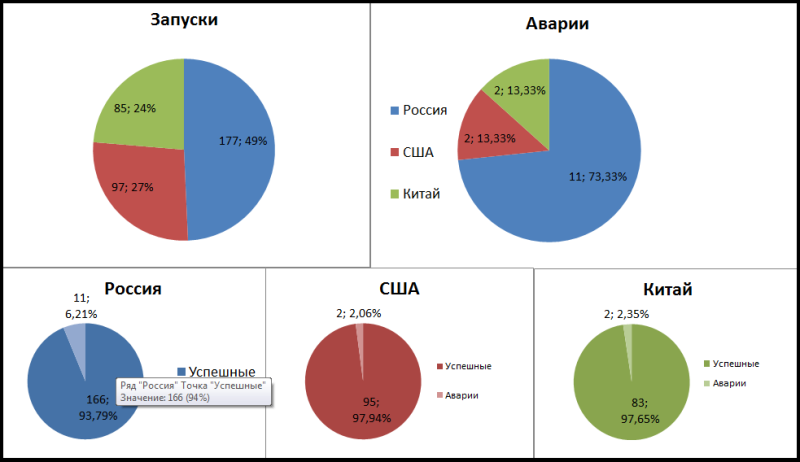
As you can see, Russia makes as many launches as China and the United States combined, but it already accounts for 3/4 of the accidents. The share of emergency launches in Russia is almost 3 times higher than in America and China.
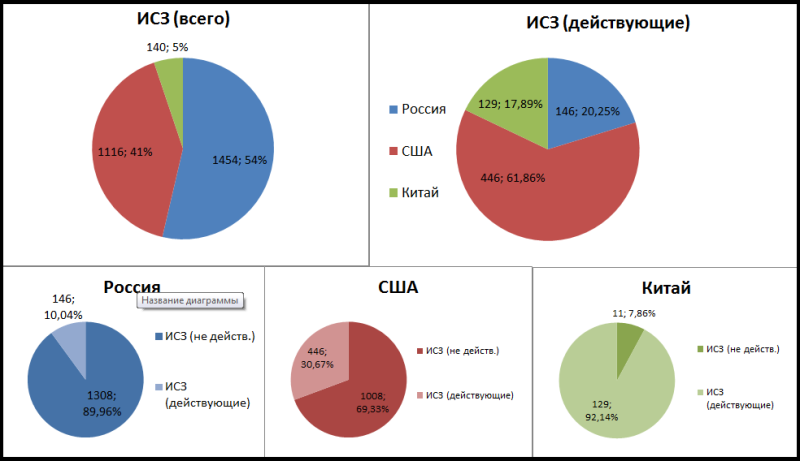
The second important indicator, the number of artificial earth satellites (AES), the table below shows the number of satellites for all time (Russia includes all Soviet satellites):
Again, the situation is similar, Russia has launched more satellites than the United States and China combined, but in terms of the number of satellites in operation today, we have only 1/5 of the total number, and China is predicted to overtake Russia in this indicator in the near future.
Now a little about the efficiency of the space industry; there is data on the number of employees in the space industry:
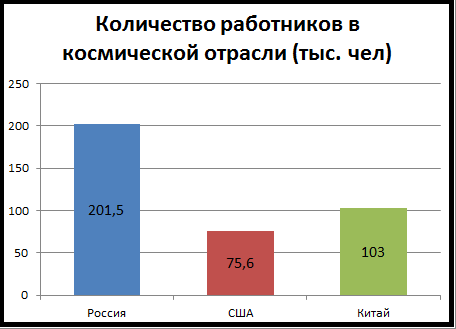
As you can see, we are leaders here too, but if we compare these figures with real successes in space, the indicators will not be so optimistic:
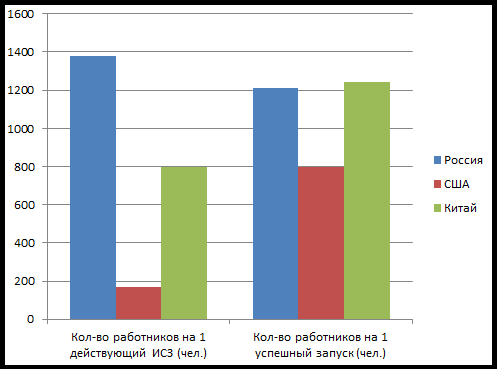
In fact, this is an indicator of labor productivity in the space industry, where we are very inferior, especially to America. This is nothing more than competitiveness, and with this approach, in the near future Russia will be ousted from the space sector. It is clear that something needs to be done, the State Duma recently adopted a project to create the Roscosmos state corporation, what will this give? In my opinion, it will add several thousand more people who will need to pay salaries. We'll get a second Rusnano, which has a lot of money but no return.
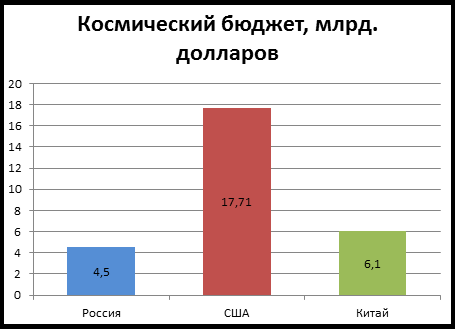
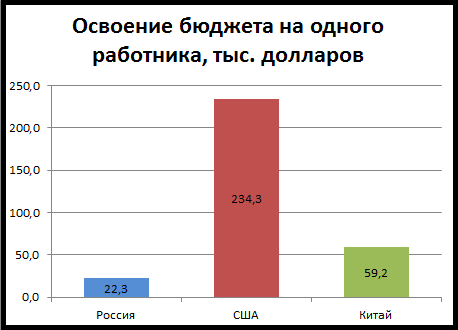
If we translate these indicators into money ( space budgets ), we get:
It turns out that the bulk of our space money is simply eaten up by numerous workers (assuming an average salary of 1 thousand dollars, it comes out of 22.3 thousand, 12 thousand goes to salaries, and 10.3 thousand is the cost of materials, equipment, technology, technology. If we assume that the Chinese have the same salary, then they have 4 times more money left for the technical part).
From all of the above, it is clear that the Russian space industry is in a deep crisis and rests solely on the potential laid down in the USSR. We still have rockets designed in the Soviet Union and spaceships developed under Korolev. Chinese electronics are widely used on domestic satellites. Programs for the study of deep space have been completely curtailed.
The space industry has long been run not by specialists, but by managers who know a lot about money, but do not understand anything about space and space technologies, and who can still squeeze money out of the industry and can defraud the state for additional injections. Despite the extreme limitation of funds, corruption has not bypassed the industry, just look at the epic construction of the Vostochny cosmodrome. With this approach, Russian cosmonautics is doomed, and it turns out that in 50 years the main achievement of Russian cosmonautics will remain the launch of the first cosmonaut.