
Translated material
Donbass in Venice
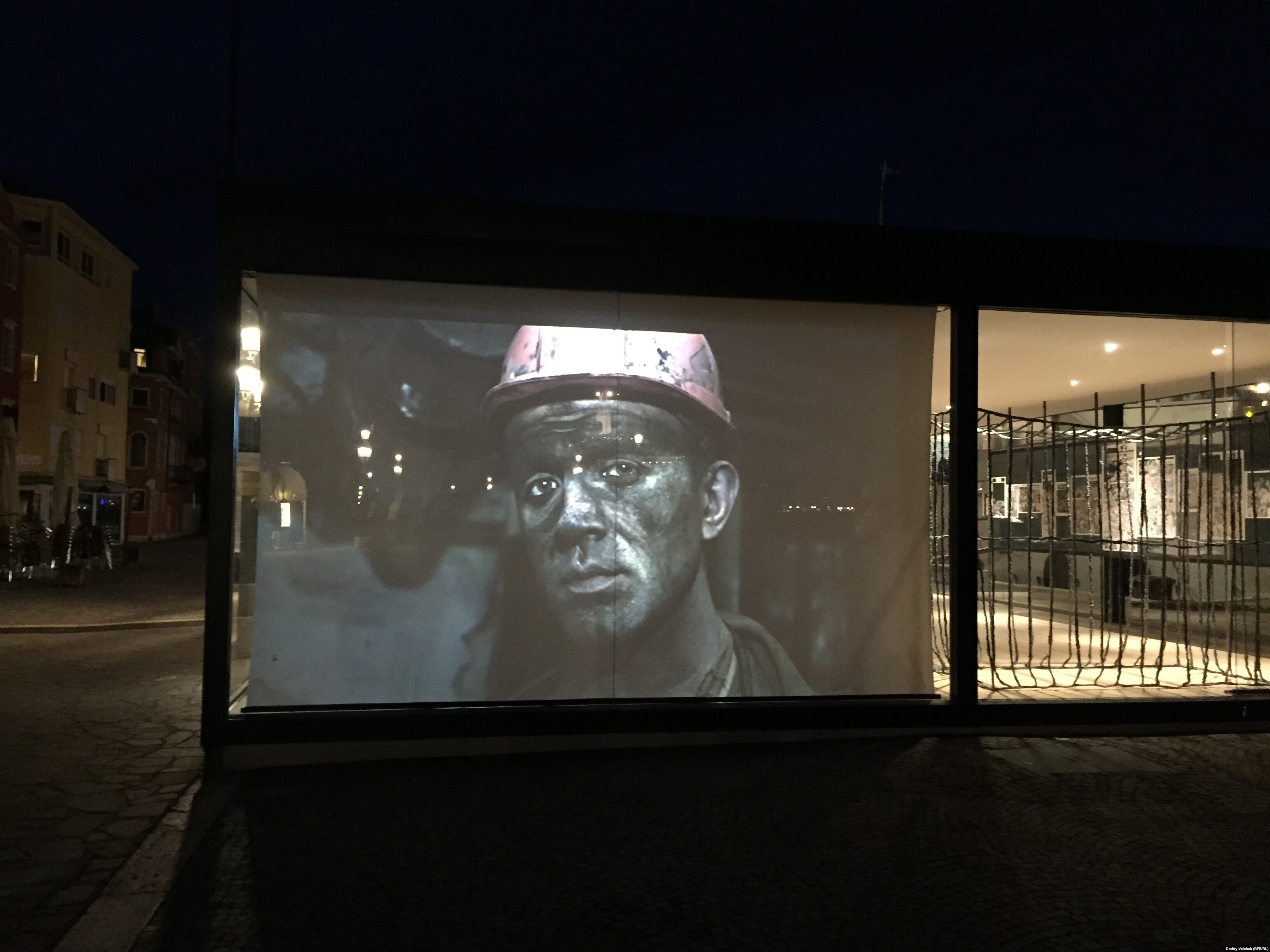
Hunger strikes, occupation and demonstrations on the biennal of contemporary art
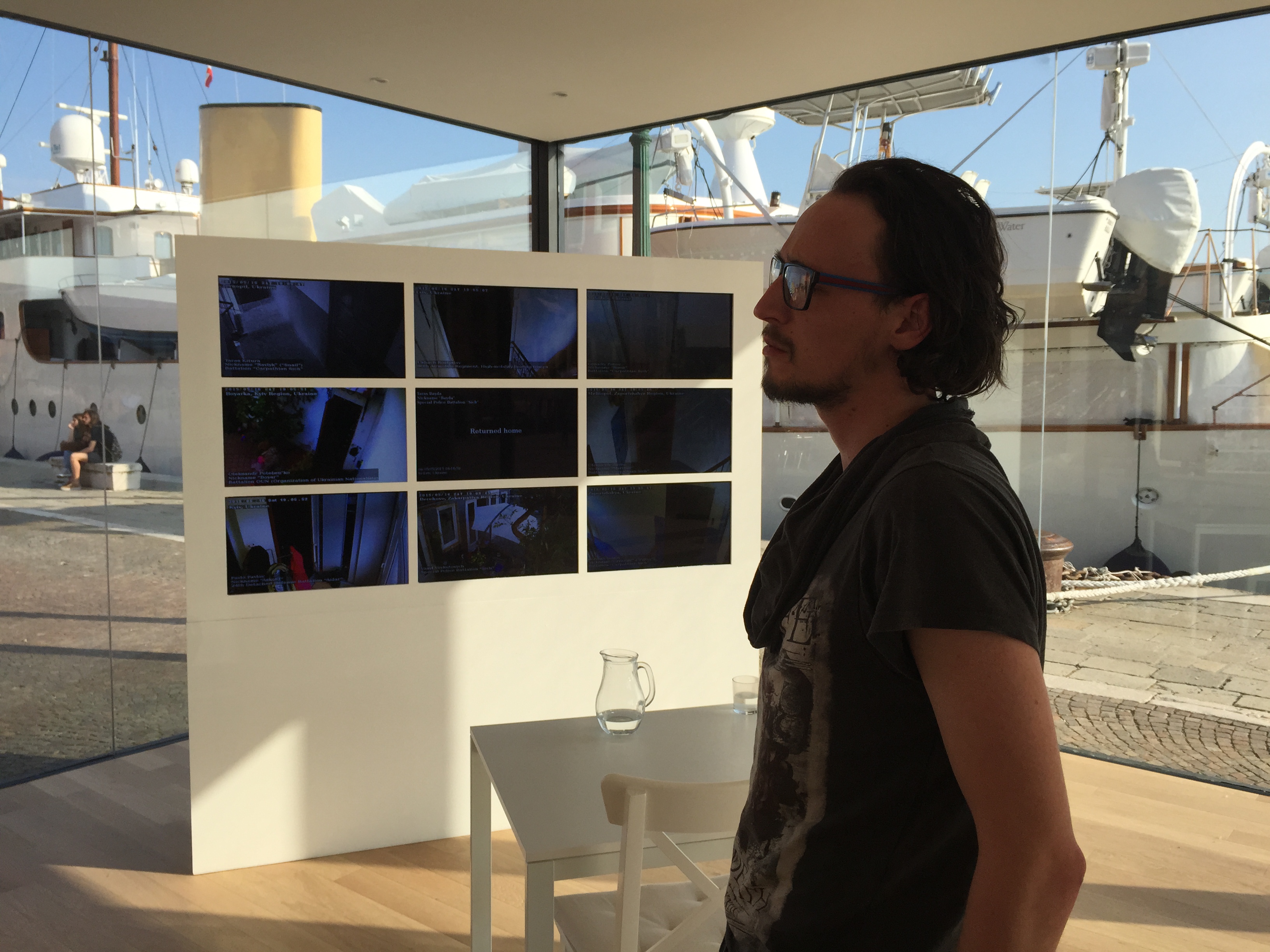
In front of an empty table, at which Pavel Kovach is sitting, nine monitors. Right broadcast: cameras are directed to the entrance doors of eight Ukrainian apartments. There are soldiers who are now in the east of Ukraine. One monitor is black, the soldier returned home. Nothing happens on the rest - doors and doors, but Pavel Kovach carefully looks at them. On the back of the monitors - photos of nine dining tables in these houses. Someday the soldiers will return and sit at these tables. Pavel is waiting for them and does not eat anything. In front of him is only a glass of water. This is a real hunger strike, and it has been going on for several days. Soon Pavel will be replaced by another artist from the Open Group, then another, and so on until the end of the work of the Ukrainian pavilion at the Venetian Biennale.
At 6 pm, having spent 8 hours in front of an empty table, Pavel Kovach tells Radio Liberty about the performance, which is called "a synonym for the word" wait "."
Hunger strikes, occupation and demonstrations on the biennal of contemporary art
- How were these nine military personnel selected?
- A very long process. We talked with more than two hundred soldiers. We went to the Donetsk region, not far from the sands. A very long process, very difficult. 15 people scored, but some had problems with the Internet, family questions.
- Are these people who are not related to your group?
- We have the main composition - four people, but depending on the project we gain different number of people. More than 400 people participated in our project. It happens 6, there are 8, there are 3. The group is “open”.
- That is, the soldiers also actually became members of your group?
- In this case, we just asked them to remain soldiers, and not enter the “open group”.
- Are they all on the front line?
- Yes, the majority on the front line.
- One returned home. It happened when the Biennale began?
- Just on the first day when I started a hunger strike. A photograph of the moment of returning the soldier home was even taken.
- How do they react to the fact that their houses are shown in Venice? Understand the essence of this performance?
- At my level, yes, of course, - as far as I can shoot from the machine gun. Understanding contemporary art is quite difficult. Everyone should be a professional in their environment.
- How do you yourself explain the task of this action?
- It is very difficult to talk about the project that has just begun. It changes, at every moment something can happen that it will change the position of the gaze. But the main original idea is the expectation, the expectation of this or that, such a pause in life, the red light on the road.
- We are talking in the pavilion called "Hope", and it is transparent, because it is the hope that Ukraine will become a new, open after the revolution. These hopes come true, because a year has already passed after the revolution?
- The main thing is that the war ends, then it will be possible to speak more constructively. Now a lot of young people die. It's hard to talk about development. A little bit, lame, we will get out of the situation, change it. We must start with themselves, everyone should be a professional in his own business. The janitor must sweep the streets well, it should be respected for this, because it is his work. The politician should be a good politician and respect the janitor for the fact that he is a good janitor, and the janitor must respect the politician for the fact that he is a good politician. Until there is no realization of his responsibility for what you are doing, there will be chaos. The problem is that our person loves things, but uses a person. But it should be the other way around, a person should use things, and love people.
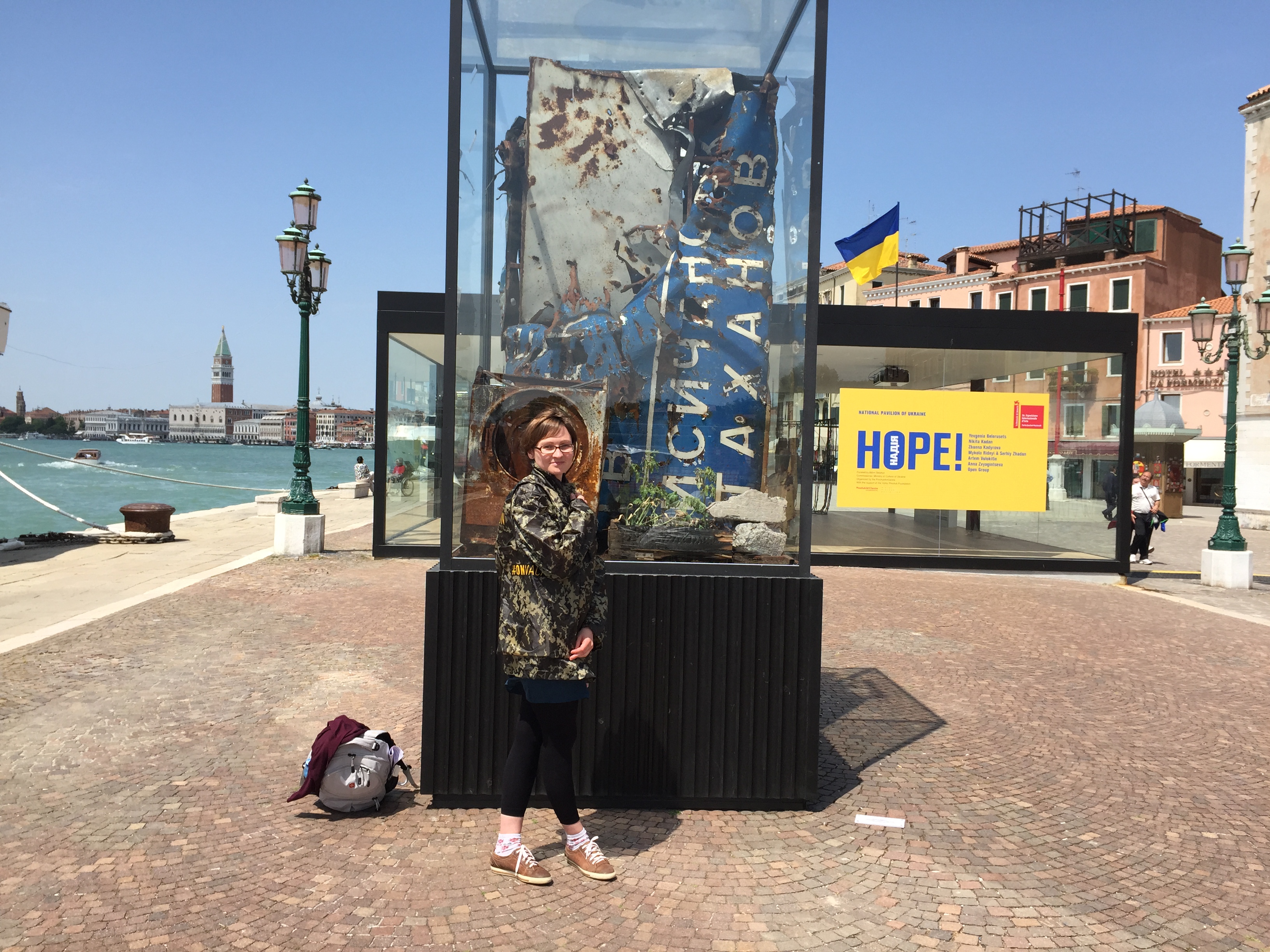
The Ukrainian pavilion called "Hope" is transparent, and, talking with Pavel Kovach, I look at the work of Nikita Kadan "difficulties of profanity", standing on the embankment. In a glass window-a torn rifle pointer "Lisichansk-Stakhanov" and rusty fragments. Near this monument to Donbass destroyed by the war, we meet with Evgenia Molyar, a member of the Groups group, who occupy the pavilions on the Biennale, imitating the Putin soldiers, the "green men". The movement began in the Russian pavilion, but it was not limited. Uniform "vacationers" - green camouflage jackets with the inscription #onvacation.
Hunger strikes, occupation and demonstrations on the biennal of contemporary art
- We put on the form and just communicate with people, get acquainted, tell, offer people to join us, choose any pavilion on the Biennale. We started our action in the Russian pavilion, then continued in the Chinese pavilion, in the United States pavilion, in Turkish ...
- And how did your group arise?
- You can say spontaneously. We have many artists from Donetsk and Crimea. In general, the group is international, people from different countries. This idea with soldiers on vacation in Crimea seemed to us absurd, we wanted to use it: creative reflection on how such absurd things could appear in the media space as serious. Therefore, we adopted the topic "Soldiers on vacation" and also decided to come on vacation: to Venice on Biennal. It is easy to find us, we have an information site where you can contact us. In the Russian pavilion, people approached us: we know about you, we were looking for you, give us your form, we also want to join.
-Let us clarify that this action is not directed against the Russian pavilion, because the pavilion itself is also to some extent anti-Putin: at least this is an art that Putin is unlikely to like, Medinsky and all this public.
We understand that the Kremlin is an evil that we are trying to fight in this way
- Of course, absolutely not against the Russian pavilion. This is an action that expresses how artists relate to the fact that one country will occupy another country. This is not necessarily an interaction between Ukrainian artists and Russian activists, we walk through all pavilions, tell everyone. From Serbia, the guys were happy to take our forms and went to the Serbia pavilion, because they also want to express their attitude to the policy of their country in this way. At first, for several days all the activities were concentrated near the Pavilion of Russia, there were many Russians, Ukrainians. Now these are mainly foreigners, people from different countries, from different continents. When we begin to talk about this story, about how the Crimea was annexed, about how the soldiers behaved, it turned out that everyone knew this story, everyone understands what is being discussed, they say: yes, this is absurd. All support us. There was not a single case that someone did not understand or somehow spoke negatively.
- And how are the people in the Russian pavilion, who ensure order there, relate to you?
- On the first day when the action began, after an hour and a half, when everyone realized that this was not part of the Russian Pavilion program, they called the police and brought our guys, but they continued the action on the street. Then the next day we met the director of the pavilion and the artist Irina Nakhova, they spoke very positively about the action. Now, when we come here, we are already saying: "Hello guys." - "Oh, it's you again." Absolutely normal.
- Do you like the installation of Irina Nakhova?
- I really like this exhibition, the beautiful is simple, one of the best here.
- After all, she will reformulate the question that you ask: Russia is a bear or a hare? For you, is Russia exclusively a bear or a hybrid of a bear and a hare?
- Of course, we share Russia and the Kremlin. We understand that the Kremlin is an evil that we are trying to fight in this way. Some say that our action is too ironic, funny, "you seem to be just having fun." But in fact, this is a serious thing. It is also necessary to talk about serious things, too, sometimes you need to add irony. We speak easily and directly about serious things.
- Are you a Kiev woman?
- I am a Kiev woman, but I am now working in the Isolation Foundation, this is a fund in Donetsk.
- And in the former premises of your fund a prison or prisoner of war camp ....
- Last year, the militants captured him and made a prison. And the fund continues its activities in Kyiv. We have several videos shot when there was a capture of the territory, there people who perform the functions in the cultural departments of the DPR, in this video, one of them was held by the catalog of Boris Mikhailov and said that this is not art, it must be destroyed. He even used the term "degenerative art." By the way, we used this video when we made the information exhibition of the Isolation Foundation in Palais de Tokyo in Paris, before our eyes these reports turned into art objects, because we showed them in the exposition space, tore out of the context. They are so absurd: it is difficult to believe that this actually happens, so they really became art objects before our eyes.
- We know quite a lot about Russian actionism: there is Pyotr Pavlensky, the “war” group, now the new very interesting group of the Blue Horseman . And what happens in Ukrainian actionism, does it develop after the Maidan in new directions?
- Yes, it is developing. There is artist Masha Kulikovskaya, Crimean. Her action was in Moscow on the Crimean bridge, where she washed the Crimean flag in the Moscow River, red and blue colors were washed off. Before that, during the "manifestos" she lay wrapped in the Ukrainian flag on the steps in the Hermitage . There are small groups, for example, in Kharkov, where the guys work with a local context, they say very interesting about local problems. Kharkov stands between the ATO zone and between peaceful Kiev, it seems that everything is quiet there, but the situation is very tense. Artists are trying to somehow show it. There are interesting actions, but not as global as they were previously and as in Russia.
- Any revolution affects art. Is it possible to say that the Maidan made Ukrainian art in a new direction?
- It cannot be said that this has already happened. Because in fact, the events that began on the Maidan have not yet ended - this process continues. Art is trying to react, but we cannot say that this phenomenon is a consequence of the Maidan. No, the Maidan is still ongoing.
- I understand that you are not a politician, but what is your personal feeling - how will the war end, the whole story that your performance tells about, and will it end soon?
- I really want this to end as soon as possible and the military operations stop. But it is impossible to predict, because no one can understand why this is happening. We cannot understand the reason that the Kremlin sees in this. Why do we have Russian soldiers? Yes, we can somehow analyze the situation, we understand that there was a gradual rejection of the eastern region. And there was a lot of guilt of the Ukrainian state in this, of course: we did not pay attention to the fact that we had a multinational country, multicultural, we talked about everything, but not about the fact that we are different. But some absurd actions on the part of people who are now aggressively fighting in the Donbass. If I understood their goal, then maybe I could somehow predict, but I actually do not understand.
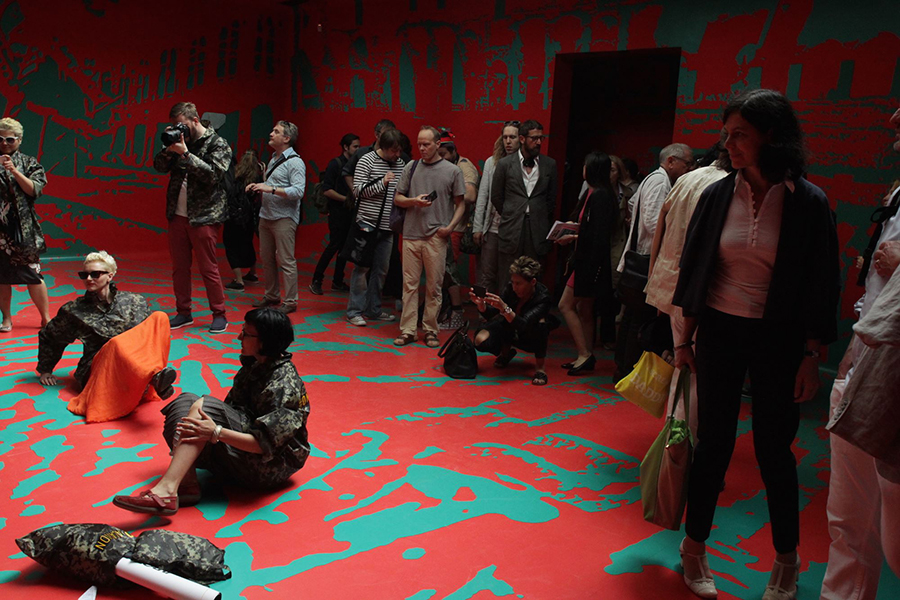
The artist from St. Petersburg, Konstantin Mitenev , speaking under the name Kostya Goldtv, held near the Russian pavilion and at the entrance to the Venetian arsenal performance "The Department of Art from the State." At the same time, Kostya Goldtv says that his policy does not interest him:
Hunger strikes, occupation and demonstrations on the biennal of contemporary art
- The idea of an exclusively aesthetic plan, I did not put any political connotation in it. I do not do anything but art and drew attention to the fact that the art is bureaucratic, is overgrown with a mass of all kinds of infrastructures. Art-Institution supports collective creativity, and I refused all forms of collective creativity because I realized that it was absolutely hopeless.
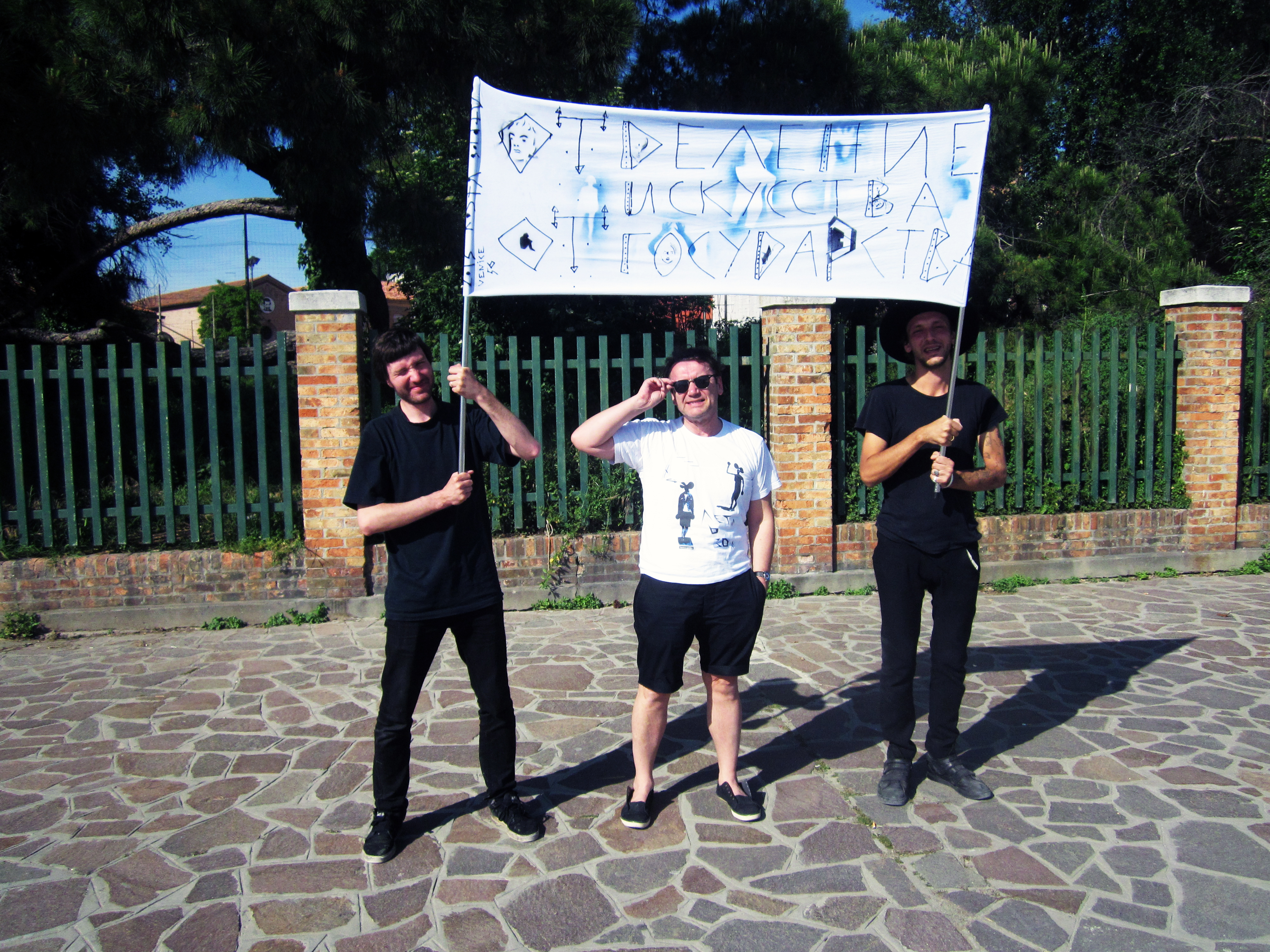
The position of the Ministry of Culture causes me squeamishness
In Venice, I prepared two banners, two banners, on one of them it was written by Cyrillic "The Department of Art from the State", on the second - the same in English. I was wearing a white cylinder, a white T -shirt with my own print and shorts. I recorded information about my action to the iPhone and from time to time it included and moved at the entrance to Arsenal, where the ticket offices. Then I found the back wall of the Russian pavilion, from the side of the embankment, and on this wall placed my second banner, stretching it as a banner "The separation of art from the state."
- You said that this has nothing to do with politics, but now the state for the first time in the post -perestroika years has become annoying to intervene in cultural affairs. What Minister Medinsky does is well known. Doesn't it bother you at all?
- Of course, politics is the material of actual art, and I observe with interest the actions of the political plan. I am very interested in the “War” group, I support Pussy Riot and constantly watch them on my Facebook. The modern position of the Ministry of Culture is unpleasant to me, moreover, it causes me squeamishness. But no matter how they wave their batons, they cannot affect the situation in art. The power of artistic ideas exists besides any state resources. Another thing is that there are institutions that depend on them and are interested in them, these institutions cause me a feeling of disgust. Therefore, of course, I follow politics, but it is not interesting to me, because I am an autonomous artist, and everything I do is the aesthetic gesture of an autonomous artist.

