
Translated material
Fear as a spiritual screening
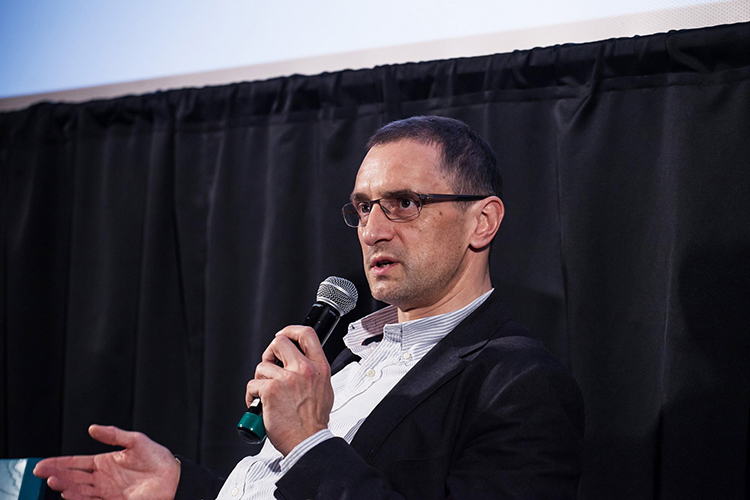
In recent years, sociologists have celebrated the constant growth of various fears in Russian society. These fears are skillfully controlled by the state, sometimes inventing new ones. We publish a fragment of the speech of the historian, professor of the Higher School of Economics Sergei Medvedev as part of the project of the Yegor Gaidar Foundation on the topic of what role real and imaginary threats play in our society, who is beneficial for the atmosphere of fear and how to deal with it.
I recall my school childhood and primary military training lessons. They were led by a retired lieutenant colonel, and we often used such a term - a “threatened period”, when we had to put on gas masks and a column to advance, as I remember now, in the direction of Manino -Vanino -Chigiri. This phrase “threatened period” has settled in my memory, and now, looking at our reality, I understand that we are told again that we are in the “threatened period”. This was neither ten, nor even more than twenty years ago. But today it does not let go of the feeling of threat, a feeling of fear that comes from the media and, as it were, is dissolved in the air, in the spirit of time.
I will give three completely banal examples. The mayor of Berdsk canceled the elections under the pretext that, as he says - such a magical phrase - “received operational information”: a certain “Western agents” wants to disrupt the election of the mayor in Berdsk, in the geographical center of Russia. Without going far - in Transbaikalia Palais of grass. A representative of the president in the Siberian Federal District Rogozhkin arrives there and says half-seriously and stronger that these fellow fells were arranged by specially trained opposition to Transbaikalia on the day of Holy Easter. And the third: you remember recent excesses in the elections in the suburbs - in Zheleznodorozhny and Balashikha, opposition were beaten. In this regard, the chairman of the Moscow Region Wildanov said that the elections were disrupted by Nazis observers prepared in Poland. Here are three examples of images of fear that is used today as a political technology that is universal explaining the variable. Almost all the problems of our inner life are regulated, explained and put forward by power precisely in the context of fear. But the problem, of course, is wider than these anecdotal episodes.
Another railway track was dictated by fear, which differs from Stefenson in the West, and from this we still change car carts on the way to Poland.
If you look at Russian history, many of its most important acts were somehow dictated by fear. Why was the Baikal-Amur highway built? This is a fear of China that China will cut the Trans-Siberian Railway and, accordingly, you need to stretch an alternative railway branch from Tynda to Komsomolsk-on-Amur, which is a thousand kilometers further from the border. Why was the domestic computer industry slaughtered in the root? We had very good developments that have been conducted since the Second World War, and in the 50s, the first attempts of systemic integration were made in our KB. But in the 60s under Khrushchev, the Soviet computer industry was completely destroyed and actually transferred to the rails of borrowing from the United States. This was dictated by fear that America would overtake us in this strategic industry. It was under the influence of this fear that it was decided to entrust the development of domestic KGB computers, who knew nothing else but to steal technology from the West, to disassemble American computers to the last screw and reproduce them on a Soviet basis.
Why did the Soviet-Finnish war begin? Why did Stalin invade Finland? Again, fear regarding the strategic security of Leningrad, the desire to move the border from Leningrad, in connection with which it was necessary to capture and occupy the Karelian Isthmus. I recently read the interesting book by Sean Makmikin, entitled “The Russian Origin of World War I”. It is quite controversial, but there are amazing evidence of paranoia in Russia on the eve of the war. There was a feeling that the Germans would occupy us from day to day. You know that another railway track was dictated by fear, which differs from Stefenson in the West, and this is still changing wagon carts on the way to Poland. They don’t change to Finland, because Finland was part of the Russian Empire and there was a Russian track, and they were changing to the west, because it was believed that aggressors would come on an armored train and reach Mother Moskva and St. Petersburg. Accordingly, this idea of total fear is spelled out in the main milestones of the existence of the Russian Empire and the Soviet Union.
 © Yegor Gaidar Foundation
The question that I would like to put in this discussion: what are the origins of this fear? Is it immanent Russian civilization as such or it is more political technological, that is, these fears are created by the ruling elite for more effective management?
From the point of view of cultural studies, I will turn to an absolutely restored, but from this no less adequate research by Ronald Inglhart - World Values Survey . One of its main schedules - the nation is ranked on a scale, where, on the one hand, the value of survival, and on the other, is the value of self -expression. And it always turns out-that in the early 90s, that in the mid-2010s-that the values of survival prevail in Russia. Moreover, Russia is perhaps the most extreme country in this part. Together with us in the cluster there are a lot of East European countries - Moldova, Romania; Ukraine is slightly closer to the values of self-expression. And in terms of self -expression, Protestant, North European countries - Sweden, Denmark stand out; A little less than the USA, England, but in any case, they are all in about the same cluster.
Here I would like to recall the work of another American not sociologist, but the historian of Edward Kinan. He wrote a very short, but very important work - literally 15 pages long, called “ Muscovite Political FolkWays . " The background of its creation lies in the fact that Kinan seemed to be addressed from the State Department with a request to write a historical overview of the causes of foreign policy behavior and thinking of the Soviet elite. And it was either in 1982, or in 1983. The time is very tough, the most peak of the Cold War, the “double decision of NATO”, the placement of the CC-20 missiles, the shot down South Korean Boeing, the boycott of the Moscow Olympiad-in general, everything is bad. And at this moment they turn to him with the question: why do tips behave in this way? And unexpectedly for many he did not write about Brezhnev, did not write about Stalin, did not even write about Peter I and Ivan the Terrible-he began to write about how the village survived in the East European forest in the period before and after the Mongol-Tatar invasion.
Why do we have so many guards in Russia - up to two million people? Healthy men who are sitting down by pants and radiant seeds. Why are they?
And now-climatic conditions, geopolitical conditions, natural conditions, low fertility of lands, the need to engage in frying and agricultural agriculture, a zone of risky agriculture-freezing can be in June, can be already in August. In the X -XI centuries - the constant invasions of the Polovtsy, the Mongols came in the XIII -XIV centuries - the risks are so high that one peasant cannot survive, only the whole village can survive. From here the Russian community and delegation of individual sovereignty to the community level are taken. Further, Kinan says, the Moscow period begins, and this model of behavior - a limited sovereignty for the sake of the interests of the community, a limited sense of property - is simply projected on the Moscow prince, and then on the king. That is, he sees the origins of the foreign policy and generally Russian political structure in climatic and, so to speak, historical and geopolitical conditions of the life of a remote peasant community in the East European forest. The values of survival in contrast to the values of self -expression are very strong, if you follow the Inglhart research, are spelled out in our history, this is an archetype of our political consciousness. This is one side of the problem.
The second side - a year or a half ago, in the “Domestic Notes”, the article by Simon Cordon “Classification and ranking of threats” was published. In it, he takes a very interesting study in which it comes to the conclusion that threats are system -forming for our state. That is, we will take a step back into the political theory - there is a state as a kind of Leviathan, if you take the Hobbes theory, and there is anarchy, a huge number of risks and threats. Leviathan-state arises in order to minimize these threats, to create a certain perimeter of safety. For this, already in the twentieth century, Karl Schmitt and Georgio Agamben tell us about this - it takes the right to declare a state of emergency, be higher than the law, and this is the final act of sovereignty.
Cordonsky looks at this from the point of view of the administrative market, that is, a certain system of relations between various bureaucratic structural elements of the state in which each of them maximizes its benefit. We have a resource state, and its essence is that we have one great owner - the same Leviathan, the same state that disposes of the entire national resource. This happens with kings, this happens with the Bolsheviks, this happens today under Putin. De facto we have one resource manager. Accordingly, in the structure of the state there are various bureaucracy that compete for access to this resource. In this case, this is not only an oil resource, not only oil money, spilling one way or another to all elites, all corporations, all classes. Here we are talking about the resources of the administrative, political, financial, access to financial flows.
 © Yegor Gaidar Foundation
In the structure of the state, there are certain agencies, the essence of which is to reflect threats. We have a lot of these agencies - these are various power corporations. In general, a power state is very developed-again because our state is a resource, based not in the market, not in trade, but on the redistribution of resources. Why do we have so many guards in Russia - up to two million people? Healthy men who served in the army, aged 20 to 50 years, who show the hours and hours per day and scraped seeds and scraped seeds. Why are these guards? Why do we have such a large police, why do we have so many different agencies duplicating each other's functions, why do we have the Investigative Committee and the Prosecutor General? All this gigantic pyramid of security forces exists and has always existed in the structure of our state in order to control and guarantee redistribution processes.
What do these security officials do besides that they control the redistribution of resources? They tell us all and sovereign, the sovereign: we reflect threats. In fact, they need threats. The more threats, the greater the resource of one or another agency. Here, says Cordonsky, a kind of threat production begins. That is, they begin to compete with each other for the production of various fears. Accordingly, our entire political life boils down to the fact that power agencies constantly, monthly, annually invent more and more threats, throw them into public space, bring them to the sovereign’s consciousness and, based on this, receive more and more resources.
In order not to be unfounded. The orange revolution is in its pure form in an invented threat. That is, a certain objectively existing, having an internal origin in a neighboring country, is taken, and is portrayed as part of a worldwide conspiracy against Russia. It is said that this was all invented by Western intelligence, that this is all - part of a huge conspiracy against Russia and, accordingly, special structures, special types of policies to reflect this threat should be created. The famous “E” center is being created, the “Young Guard of United Russia” is being created, the movement “ours” is created - this whole huge cluster, which is transferred to very large budget resources and which in different forms is still flourishing.
The security forces begin to compete with each other for the production of threats. Entire industries are created for the production of virtual entities.
AM OF THE ROOM, we suddenly are told that for us a threat is a global Internet. Either Apple phones are so programmed that they listen to all Russian people, or our financial transactions that are held on Visa or MasterCard on distant American servers are jealous of our national security. Again, all countries live in this system, and we have people who say: no, wait, here is a true threat to the national security of Russia. That is, the threat is constructed, the threat is sold to the state, the threat is sold to Putin, and then very good budget resources are allocated for this case. For what? To create an absolutely unnecessary GLONASS system, different from GPS , to create a national payment system so that we do not have Visa and Mastercard . No one doubts for a second that this will never work, but billions of dollars are allocated for this. Under a fictional threat coming from the West, entire industries are created for the production of such virtual entities.
In this sense, it turns out that those parts of the administrative apparatus that produce the most believable threats form the agenda. In fact, the agenda was captured by them, captured by the security forces. Ukraine - this was also in its pure form of the sale of a threat. A completely working, technical moment of politics in the post -Soviet space is taken - the Association of Ukraine with the European Union. Everyone went through this, and Moldova played it, and many post -Soviet countries joined NATO, and Russia looked through all this through the fingers. Ukraine could sign an association with the European Union at the Vilnius summit, Russia would have been absolutely nothing. But then the red light is lit: Akhtung! Threat! Ukraine goes out of hand, Ukraine goes to the west! And unexpectedly on this harmless episode, a confrontation spiral arises and begins to spin, that this is the red line for which we cannot cross, we cannot let Ukraine out, we cannot allow it to sign the association with the European Union. The unprecedented pressure on Yanukovych begins, Yanukovych does not go to Vilnius in response to this, then the Maidan unfolds - you know the further. Against the background of the Maidan, against the backdrop of the overthrow of Yanukovych, it is said that this is all done with American money. Why, one wonders, did they do it? Then, sellers of threats answer in order to place American nuclear missiles or American aircraft carriers in Crimea, which, incidentally, will not go to Bosphorus and Dardanella in life. Accordingly, this is a very good justification in order to enter the Crimea and, as Putin says now, even seriously think about the threat of nuclear weapons.
Russia stands at fear. Russians feel victims. This victimity is spelled out within a Russian person.
Here, by the way, it is interesting that these threats are Self-Fulfilling Prophecy - a self-exploring prophecy. These are self -giving threats. Almost all the threats that are sold to Putin and which the state reacts to, come true precisely due to the reaction of the state. There was absolutely fictitious at the time of October-November 2013 the threat that Russia could lose Ukraine. As a result of hysterical and incompetent political and military steps of the last one and a half years, we have lost Ukraine. Not because the West had some kind of malicious strategy on how to squeeze Ukraine out of Russia, namely because Russia laid out a rake itself and went through all these rakes. The same is the threat of NATO expansion. They came up with that NATO also wants to put Ukraine in his pocket. Again, as a result of all the actions of Russia, what do we get? Together temporary - the constant base of NATO in the Baltic countries, and now Sweden and Finland are also thinking about joining NATO. Now take the threat of fascism. How many brains were washed to us with this very threat: here they are the Jews, the Nazis drive in Kyiv trams, here the sponsors of fascism in Europe also raise their heads, and the Poles prepare the Nazis for our elections. What did we get in the end? We received fascism in Moscow itself. In fact, all current chauvinistic, militaristic sentiments were the reaction and consequence of this desperate struggle with fictional Ukrainian and European fascism.
These threats are apparently inevitable. Looking at the five hundred years of Russian development - the existence of Rus', the Russian Empire, the Soviet Union, I understand that threat and fear are an important part of our policy. If it is completely simplified, Russia is at fear. In fact, mobilization based on a threat is a management tool and a mechanism for the formation of a political community in Russia. Politics is formed on the basis of fear. When fear leaves the system, it becomes unstable. Например, я вижу причины распада Советского Союза в большой степени в том, что исчез страх, и возвожу генезис этого распада к 5 марта 1953 года, к смерти Сталина, потому что он был верховным гарантом страха. Пока жив был Сталин, существовал страх, который был цементом между кирпичиками административно-командной системы, когда ты отвечал жизнью за исполнение мобилизационных приказов. Уникальной системы, да. То, чего Советский Союз добился в ХХ веке, впечатляет. Но впечатляет именно потому, что все это стояло на страхе.
Иными словами, страх является той самой духовной скрепой, которая обеспечивала существование Российской империи и советского государства в периоды мобилизации. При этом страх также сформировал определенный комплекс. Страх был не только внутренним стержнем системы; страх был интериоризирован людьми. Воспринят именно в виде комплекса жертвы. Русские себя чувствуют жертвами. Эта виктимность прописана внутри русского человека. Меня всегда забавляют лозунги, когда Жириновский и ЛДПР идут на выборы: «За русских, за бедных!» Идея в том, что русские бедные: а почему? Почему, скажем, таджики не бедные, почему молдаване не бедные? Нет, бедные именно русские. Вот это ощущение какой-то невероятной собственной зависимости, собственной виктимности превратилось в то, что Ницше и Макс Шелер называют ресентиментом, и оно происходит из чувства униженности раба.
Здесь работают не только политтехнологии, не только корыстные приватные интересы силовиков, начиная с Малюты Скуратова и заканчивая современными чекистами. Здесь зарыт большой психологический комплекс в отношениях русского человека с государством, который заставляет человека чувствовать себя бессильной жертвой, просителем, потерпевшим, так что основным жанром общения человека и государства становится жалоба. Снизу вверх идут жалобы, а в ответ на жалобы сверху вниз приходят ресурсы. Письма в редакцию, письма в Центральный Комитет, письма президенту, прямая линия с Путиным — это все тот же самый старый правдинский жанр жалобы. Все это вместе коренится в нашей специфической политэкономической системе, основанной не на обмене, не на частной собственности, а на распределении ресурсов. А на выходе из этого черного ящика мы получаем страх, чувство жертвы, мучительный русский ресентимент и такие политические комплексы, как «Крым наш» и чувство геополитического окружения, инфантильное романтическое чувство, что мы одни супротив всего мира, что Россия одна против Запада.