
Translated material
The art of technology
Russian mediaart is a very chamber direction. They are engaged in a couple of Moscow sites (M'ars Gallery, Laboratoria Art & Science Space ) and several curators. Someone from the list will definitely appear at any exhibition: Dmitry Morozov, Dmitry Kavarga, Stain , the group “Where are the Dogs”, Vadim Epstein, Sergey Kasich, Jan Kalnberzin, Evgeny Afonin, Mathrioshka , Julia Borova, Tundra , Hello Compater .
At the same time, it is quite possible to talk about recognizable Russian handwriting or even about the Russian school of Mediaart. Artists are interested in programming situations, tools, spaces and worlds, inside which you can live and communicate with their inhabitants. Such art objects are based on the most often-software code and generative graphics, and the works themselves are not statical: they change, respond, interact with the viewer.
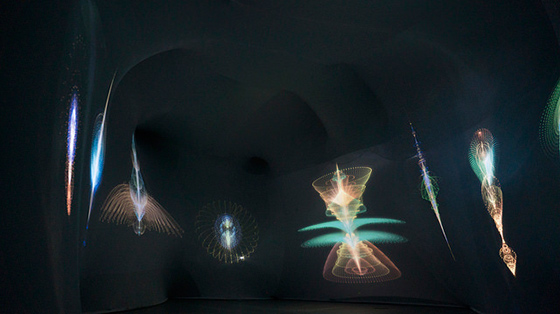 © Antrum - Mathrioshka
Authors: Tatyana Plakhova, Mathrioshka (Eduard Haiman, Vadim Smakhtin), Sergey Kasich. With the participation of Elena Zhdanova and Gleb a watchman.
Twilight in an artificial cave. Strange geometric shapes are displayed along the walls. Any of them can be touched. The membrane of the cave is springy, stretches, and the figures respond to touch. “Antrum” is the joint work of the artist Tatyana Plakhova (she came up with “mathematical” organisms) and Mathrioshka studio. The founders of Mathrioshka Vadim Smakhtin and Eduard Hayman have long been looking for new ways of interacting with architecture, technological art, new plasticity and communication language: “Tactile contact with other space and geometry allows you to rethink the attitude to the outside world. We are interested in joining dialogue, trying to change something in the environment by the methods and means that we are developing. Basically, they are based on the data, on the possibilities to operate and transform from the conceivable - into virtual, from mathematical - to physical, from inconspicuous - to visible. One of the most interesting tasks is to come up with new computing tools for artists so that they can create their work. ”
Authors: Tundra project. Artists: Alexander Lecius, Alexander Sinitsa, Sound: Semyon Perevshchikov, Klim Sukhanov, Anton Kochnev.
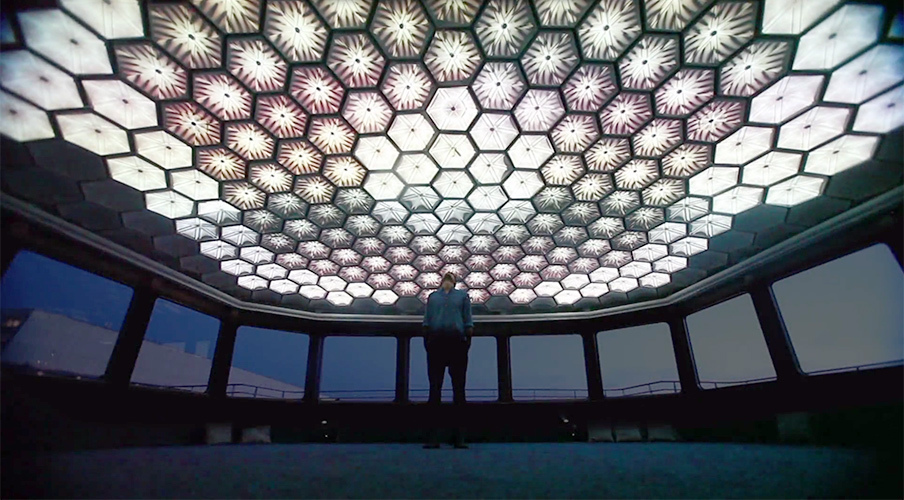
Once this whale was anchored by the Crimean bridge. At night, the spectators gathered at nights “Bryusov” at the panoramic windows, blue hexagons shimmered over them - they reflected the waves and performed a whale symphony. Now Bryusov is closed, and the installation " My Whale ” updated and transferred to the M'ars gallery. Now the whale takes six meters and two floors. On the second, you can feed it by applying a smartphone to a special device. Keith will thank - a wave of visual effects.
Kita was created by the St. Petersburg team Tundra . The design of cardboard and wooden guides was collected and programmed in a week, and then revived using TouchDesigner , seven projectors and two computers. Tundra specializes in creating interactive installations (about one of the latter, “Hyperjump” , have already written the Creators Project and Wired ).
Authors: Sasha Gavrilova and Sergey Titov , sound - Lazyfish (Alexander Potekhin).
Moscow media artists Sasha Gavrilova and Sergey Titov often work with algorithmic art - on large -scale media installations and video processes. They went to India, to the ancient architectural complex of Achutara, to transfer it to digital eternity. They collected a 3D model from serial photography, wrote an algorithm for visualization, added sensory sensitive to the movement of the viewer-as a result, the interior of the ancient Indian complex manifests itself from emptiness and breaks up into dust, for a moment creates a different space and time around.
Sasha Gavrilova: “Much is new and interesting, including the work of Russian authors, sooner or later is on the network - on Vimeo , Creative Applications and other resources. Of the Moscow communities, Soundartist has interesting projects, we appreciate the 4s4R and Steereotactic work ... And there is, of course, the hope that there is an underground, which we - so far - do not know anything. ”
Author: Dmitry :: vtol :: Morozov.
Five hydraulic presses capable of crushing almost anything are installed in the exhibition space with provocative annotation. The viewer is offered to choose any (or better-valuable) thing of those that is with you (a mobile phone is ideal), put it under the press and destroy it for some 40-50 seconds. The rattle and creak will record a special microphone, then the recording is converted into a unique 20-minute audio album-and now it can be taken away with you. The artistic provocation and the beauty of the response gift are interesting - it seems to be absolutely technological, devoid of human touch, but at the same time a single one, with personal history, emotional subtext, value.
In addition to presses and microphone, the author used ARDUINO , Mac Mini , PureData , Max/MSP and Applescript microcontrollers.
Dmitry :: vtol :: Morozov is an inevitable hero of any article about Russian mediaart: Huffingtonpost , Wired , Creative have already written about him Applications , Vice , Co. Design . He himself, among interesting domestic authors, is indicated by Stain , the group “where dogs run” (“digitization of water”), Valentina Fetisov (“installation of experience”) and Sergey Kasich.
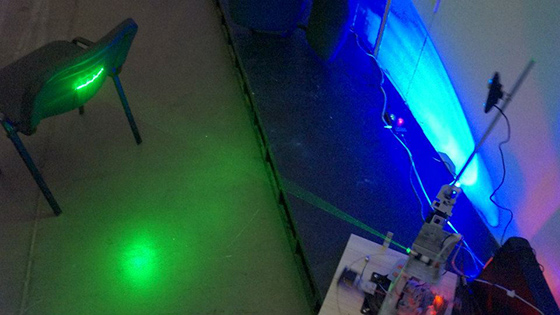
"Way / What are you" - Sergey Kasich
 © Sergey Kasich
Author: Sergey Kasich.
The laser scans the room and the audience located in it and makes sounds: the longer the beam, the higher the frequency. So each viewer becomes a separate note, and the exhibition space becomes a party. The laser rangefinder was assembled by the founder of the community Soundartist . ru ( sa )))))) Sergey Kasich from improvised means-laser poisoning, webcams and tram microphone. Sergei not only experimented in the field of sound art, but is also one of the active teachers and organizers of master classes on interactive art.