
Translated material
Russia on the "torture" map of the world
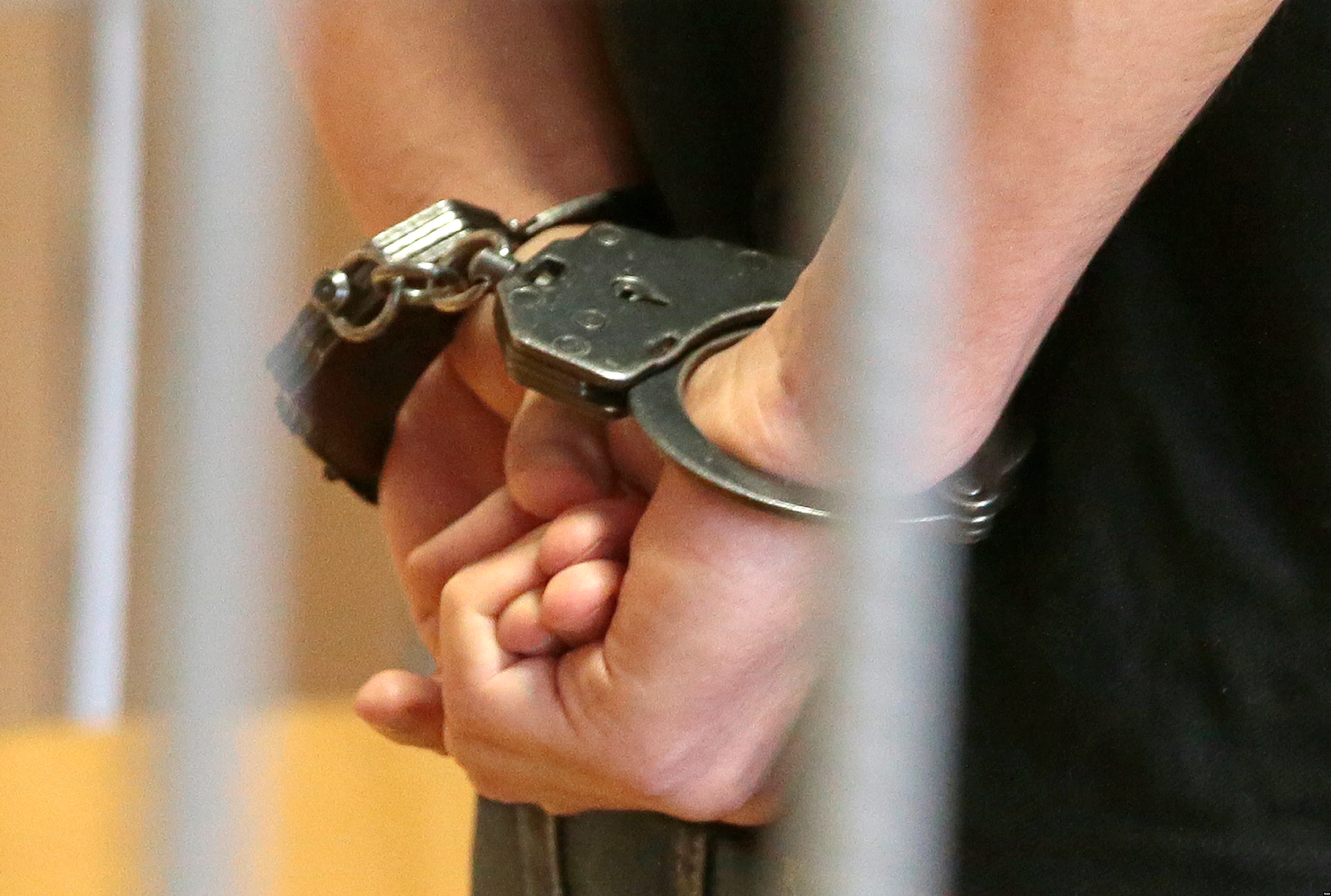
The Danish Institute against torture assesses the situation with human rights in Russia as a rather alarming
A week ago, from Russia (formally due to the incorrect design of visas), three employees of the Danish Institute against Dignity torture , who took part in an organized by the Russian committee against torture of the seminar, were expelled . This human rights organization from Denmark with more than 30 years of history, which opens against torture and is engaged in the rehabilitation of their victims. The decision of the Russian authorities in Copenhagen did not cause nothing but disappointment and misunderstanding.
The Dignity Institute, which is the National Research Center, is located in Copenhagen, its rehabilitation center is also located there, where refugees who are tortured in their homeland are treated, says its director Karin Versland :
- We work around the world, being in partnership with more than 30 countries, usually in the southern hemisphere. We have more than 100 employees of various specialties: these are doctors, psychologists, social workers, physiotherapists, lawyers, anthropologists, sociologists. I myself am a doctor by education.
-On your Internet page there is such a phrase-"dignity actively counteracts the use of torture, changing the mechanisms that underlie them." How is this done in practice?
The most difficult part of our work is to help people return back to the normal perception of life
- Depends on which country we are talking about. This is almost always comprehensive work, since we are starting from the local event context. Some countries in which we work can be called post -conflict, which have passed through a revolution or war - this, as a rule, leads to the destruction of infrastructure and law enforcement system. In such cases, we work at the political level with those who take responsibility for what is happening in the country. In particular, we can mention Tunisia, where we have been working intensively for more than three years together with representatives of local authorities in order to help them restore the legal system to which the country's citizens would have trusted. In addition, we strive to establish a system of public control over the work of prisons - our inspectors visit places of imprisonment in order to make sure that the detention of prisoners and the worthy appeal from the prison administration is worthy of acceptable conditions.
There are countries of a different order-those in which torture is still practiced. The other day I returned from a trip to Sri Lanka, where I visited several rehabilitation centers, in which experts work with recently freed from the places of imprisonment. This is a typical example of a country where torture has not yet gone the past, and the most difficult part of our work is to help people return back to the normal perception of life destroyed during their stay behind bars or in police areas, where they are sometimes cruelly mocking, the body and the psyche.
Our work is both diverse and multi -level. But at the same time, we always analyze the situation based on the experience - which methodology will work better on the spot.
- What is the most difficult in your work?
This requires great flexibility and the ability to establish a common language with people, let’s say, by no means Danish mentality
- In most countries where torture is commonplace, local authorities, police, the administration of prisons, as a rule, deny the presence of such cases. And the most difficult thing in such a situation is to identify the fact of violence. But this, in principle, is solved, since other human rights organizations that conduct a variety of documentation on the topic work on the same field. It is easier for us with such organizations to come into business contact, establish cooperation - and this helps a common cause, since we jointly reconstruct the true picture of what happened. All this requires great flexibility and the ability to establish a common language with people, let’s say, by no means Danish mentality. So in our work there is often an element of danger. And although we have our own models and tactics of negotiations, the human factor always plays the main role, the ability to agree.
Of course, it is more comfortable to work in countries that have joined the UN Convention against torture, because in this case they are connected by obligations. But, as a rule, we don’t have to choose the conditions - we try to find a loophole, an approach, and if there are people in the country, agreeing to meet us, showing an interest in cooperation, and when, according to our estimates, the situation in the country is quite stable for the safe stay of our employees, we begin work.
- Since what time did you cooperate with Russia and what are the main directions of this joint work?
We transported our colleagues in a car for prisoners. They were detained for more than a day
- Russia is a relatively new country for us - an invitation to visit Nizhny Novgorod for the exchange of experience came from the Russian committee against torture, if I am not mistaken, in the fall of 2014. We turned to the Russian Consulate in Copenhagen, explained the purpose of the visit, after which we were given visas. Generally speaking, Russia somehow fell out of our field of vision, because we are used to perceiving it as a neighbor in Europe. But we knew that there were problems in Russia, so for us it was a debut project-to find out in practice how things are and offer something from our developments. For the trip, we selected three of our colleagues - a psychologist, an expert on legal issues and manager. My employees said that last Wednesday, when they were at the hotel and prepared for the next working meeting, employees of the Russian migration service, ten people suddenly appeared. We checked passports, visas and stated that they should proceed with them. We transported our colleagues in a car for prisoners. They were detained for more than a day, after which on Friday they were allowed to leave Nizhny Novgorod demanding to leave the country on the same day.
- It was reported that Dignity employees had problems with visa documents ...
People were psychologically injured by the very fact of detention, because they could not understand what their fault is?
- We never understood what exactly happened: on our part everything was absolutely legal. Our employees were at the Russian Consulate in Copenhagen, the purpose of the trip was a meeting with Russian colleagues and the exchange of experience. Visas were obtained without problems. For the first time in 32 years of the existence of our organization, we are faced with the like - none of our employees had ever expedally expelled from the country, having in their hands an absolutely legal visa.
- What are the impressions of your employees from contact with the Russian legal system?
- They say that they treated them quite neutrally, did not beat, did not intimidate. But, of course, the situation itself was extremely unpleasant - neither representatives of the migration service, nor the judge who considered the case, were especially kind with them. And although our employees have experienced, they have seen a lot, but people were psychologically injured by the very fact of detention, because they could not understand what their fault is? The final shock was the charges, which they did not expect. It was the worst in that situation, I suppose.
- Did Dignity have a ban on entry into the country in the future?
- Speaking of truth, I do not know anything about this, since I myself was at that time outside the office and have not yet read all the documents about this case. I only know that they were fined 2 thousand rubles under an administrative article on a violation by a foreigner of the rules of entry or the regime of stay in Russia.
- Do you guess what actually caused this incident?
It seems to me that Russian society is becoming more and more controlled by the authorities
- I believe that the problem here is in the recently adopted Russian law on foreign agents. From my point of view, a person working in the field of human rights protecting - a law prohibiting citizens to unite and work to create a best society is antisocial. This law is trying to limit the entry for human rights organizations trying to make public life transparent, limits the rights of Russian citizens. It seems to me that Russian society is becoming more and more controlled by the authorities. In Denmark, the adoption of such a law (if this is generally possible to imagine) would cause a powerful explosion of indignation in all layers of society, with all the ensuing consequences.
- Will Dignity change its policy in the Russian direction in connection with what happened?
- We plan to figure out in the near future in more detail what exactly and why exactly happened in Nizhny Novgorod. Dignity is a democratic organization, we make decisions after a collective discussion. But we are not going to lose contact with Russia and you definitely won’t call us underpants. If we see that another window of opportunities has opened to enter into a dialogue, then we will use it.
- What does Russia look like on the "torture" map of the world on assessing your institute?
The cameras in Russian prisons are small and extremely overpopulated, the food is bad, they often treat prisoners rudely, humiliating their human dignity
- We evaluate the situation on the basis of reports of other international and national organizations. We have gloomy statistics at the disposal, in particular, in Ukraine. It is very difficult to get an accurate picture of what is happening, because in some countries they are very sophisticated in concerning the concealment of the fact of torture. In my opinion, Russia on the world scale is closer to the zone of serious human rights. Two factors play a role here - torture, when people are subjected to indescribable physical pain and humiliation behind bars. Another part of the problem is how they generally treat people who are deprived of freedom in what conditions they are kept. I think, in both cases, in Russia there are serious problems in Russia. You can often hear that the cameras in Russian prisons are small and extremely overpopulated, bad food, they often treat the prisoners rudely, humiliating their human dignity.
- Amnesty International has published a report on the torture of prisoners in the east of Ukraine, in which both sides of the conflict are criticized. What do you think about it and what do you see a way out of the situation?
Of course, we have a great desire to help people, but we are not "ambulance"
- We see a lot of similar reports, in particular, from the warring Syria. The action causes opposition: if one of the parties to the conflict behaves with barbaric cruelty, the other responds the same, comes into action the biblical principle of "eye per eye". I think this is what is happening now in Ukraine - I have no doubt about the veracity of the report by Amnesty International: cruelty reigns on both sides of the front line. I do not think that the Ukrainian authorities regarding the war, more humane than their opponents. Of course, we have a great desire to help people, but we are not "ambulance", so to speak. We are a human rights, not a humanitarian organization - until the armed conflict continues until the shooting is subsided and kill people, we are not interfering. Our hour occurs when a relative lull is installed, when it is necessary to try to rebuild a normal life back. I can definitely say-on the day when someone in Ukraine or in Russia says: “Enough, we want to return to a peaceful life,” we will certainly help them.