
Translated material
The main supplier of images
Why Ekaterina Shaposhnikova, who published in the publishing house “New Literary Review” The book “Look through the clothes” of the American fashion historian and costume.
“Any piece of clothing is more like Rubens than a chair” - this phrase Ann Hollander became a kind of slogan of her book and was quoted by critics as a statement of a new fashion concept. In the “look through the clothes” step by step, the costume in works of art and clothes from real life, which Western European society preferred to wear for two and a half thousand years, are extremely examined in detail. Based on the comparison, the obvious is loomed - a dressed or stripped figure looks much more convincing if we see not a real person in front of us, but a character. Fashion, according to Hollander, is primarily a metaphor that helps to turn an ordinary person into an image ascending to any of the periods of world culture, depending on which conventions are adopted in society at the moment. Denying the utilitarianism of fashion and its applied nature, by analyzing the main trends of the art of ancient, medieval, the era of revival and modern times, the author proves the inalienable and inalienable right of fashion to be on a par with painting, graphics, sculpture and architecture.
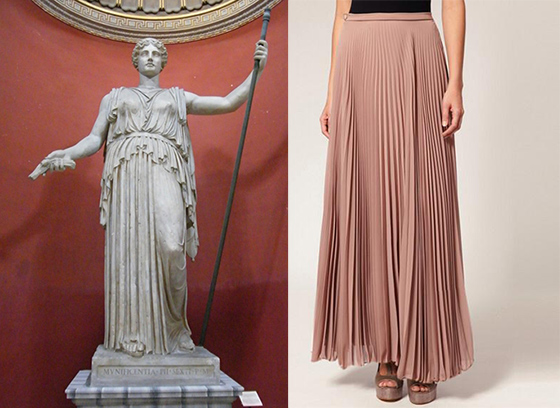
Analyzing the marble drapery of ancient statues, Hollander considers the formula “Clothing - part of everyday life” as erroneous. And the term "realism" is like a self -deception of critics. The drapery could not have looked in real life as a statue, but this is how plissed clothes in the age of technological tissues began to look. It was not reality that inhaled life into the field of art objects, and they, as in a science fiction film, materialized in the modern world.
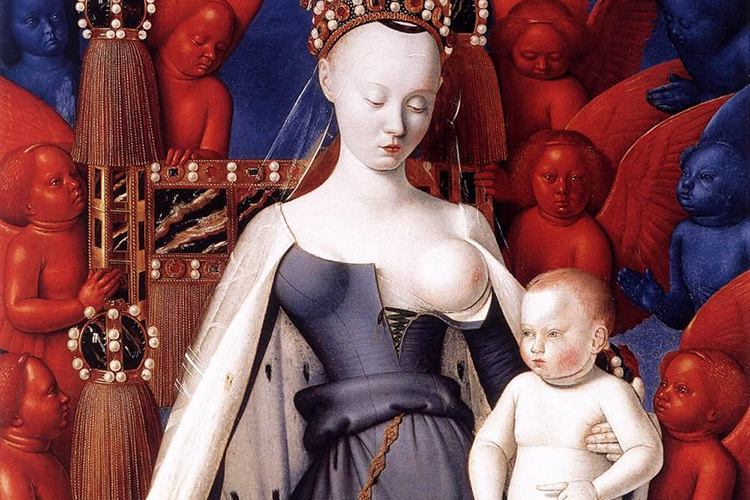
Even in the image of a naked body, realism exists only in the eyes of the viewer. Portraits of the Fontainebleau school, naked Rembrandt, the “naked” francisco Goya and the biblical plots of Hugo Van Der Gus and Lucas Cranah are physiologically only because the image of the human body is closely connected with the time adopted in a dressed form. An invisible corset that supports the shape of the model, the elongated leg line, the lack of proportions in the depiction of the foot, “skin lighting” - all these are evidence of the influence of social phenomena, and fashion among them, on the perception of beauty, but in no way.
That is why, when moving to the philosophy of a modern city costume, the first thing the author indicates is the illusoryness of the convenience and democracy of modern fashion. No matter how hard the designers and fashion critics try to convince the fashionable audience in the opposite, it is obvious that the trends are formed by the “idea of beauty” and other ideas that hover in the air of our time, and not at all the thought of convenience.
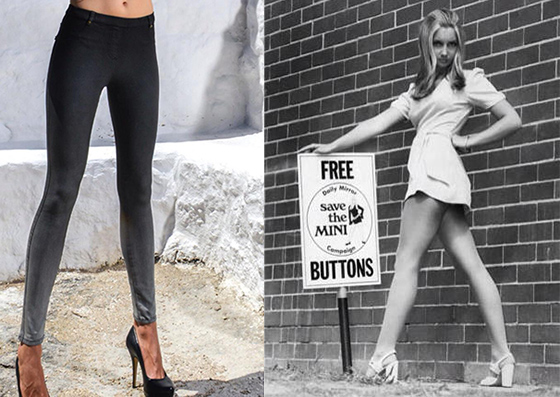
Allowing itself sarcastic comments: “Do jeans in which the labia is clearly drawn, and in order to fasten the zipper, you have to go to your back, can be called convenient from a physiological point of view?” - The author also affects the feminist aspect in the history of fashion, pointing to its ambiguity: “When women explain why they do not wear fashionable objects, they say that convenience is important to them. But it was precisely the convenience that the first supporters of the mini-skirts that appealed to the ideal of freedom raised the convenience. ” The mini-skirt was not only a banner of feminism, but also proclaimed the convenience of one of its main goals. After a decade, the convenience of this piece of clothing was called into question. In the same way as the situation with jeans: practical workwear turned into an inquisitive tool in the form of jeans-senni, fitting each fold of the body. Can the concept of comfort change over a century or the human body is completely dependent on the idea of it, just as the artist’s view depends on the requests of the environment that consumes artistic objects? Hollander asks this question in every chapter, emphasizing the symbolic nature of fashion, bringing it closer to the rest of the visual arts. And gives a detailed answer, illustrating it not only by reproductions and fragments of biographies of key figures in the history of fine art, literature, music, but also by a thorough analysis of the most minor changes in the costume for each era.
 © "New Literary Review"
In this concept, fashion as the main supplier of images is much closer to visual arts than religion, politics or economics. And all issues arising in the process of studying visual arts are reduced to the main thing - is it not so often a change in the stylistic vector in the world of fashion by a product of changing self -awareness? Isn’t the imagination that engine that triggers a huge materialization of images in order for a person to create his own personality, identify it and demonstrate it to others?
“Clothing is not completely like visual arts or the theater, it is not equivalent to the architecture or the art of furniture, it is not parallel to food or sex. It is firmly associated with the individual self -awareness of each person and his system of social roles ” - this is how the place of fashion in modern culture is determined.
“Glaps through clothes” a few decades ago brought out discussions about the meaning of the costume in the history of art to a fundamentally different level. And this is another reason to regret that the book was translated unforgivably late (it was written in 1978) into Russian. It is difficult to exaggerate its significance for the fashion philosophy, in which Plato’s dialogs, the poetry of Charles Baudler, the contrasts of Georges de Latur and the engravings of Albrecht Dürer appear in different variations much more often than it is customary to think when visiting fashion shows.