
Translated material
"Mole" in the Casa Rosada palace?
What could Edward Snowden and President Argentina talk about in Moscow
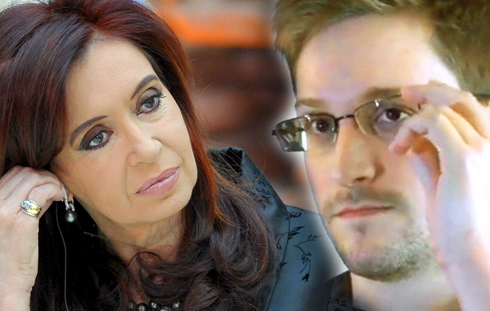
Edward Snowden during a confidential meeting in Moscow with Argentina President Kristina Kirschner could transfer to her the data of the US intelligence agencies on the USA influence in the Argentinean tops, including in the direct environment of the head of state, the German Internet publication Myheimat writes. According to the publication, the hostess of the Presidential Palace of Casa Rosada, whose second term expires at the end of the year, was going to publicize the information received from Snowden, but in her environment she was strongly advised not to do this. Kirschner accepted this advice and did not allow leaks in the press.
The shadow of the Falklands of the first about the meeting of Christina Kirschner with the exposure of the secrets of the American intelligence services, a former employee of the National Security Agency (ANB) and CIA, Edward Snowden, was reported in early May, the Argentinean newspaper Buenos Aires Hereld, published in English. The meeting allegedly took place during the Kirshner’s visit to Moscow at the end of April and lasted about an hour - the newspaper became known about this from Anthony Romero, the Executive Director of the American Union of Civil Freedoms (ACLU), who provides legal assistance to Snowden in the United States and is his confidant. “I don’t know why she (Kirschner) did not speak publicly about this,” Romero told the Argentine publication.
If his information is true, then Christina Kirschner became the first head of the state to meet with Snowden. Nothing is reported about the place and exact date of the meeting, but, presumably, it took place between April 21 and 23.
The list of topics discussed during the conversation is also unknown. However, it can be with a high degree of confidence that one of them concerned the cyber operations and surveillance, which was carried out by London against members of the Argentine government during the armed conflict between Argentina and Great Britain around the Malvinsky (Falkland) islands in 1982.
On April 2, on the 33rd anniversary of that war, the American Internet publication The Intercept and the Argentinean television channel Todo Noticias published the results of the investigation, which concerned British surveillance of Argentina. The Argentine government did not comment on these messages, but despite this, a serious diplomatic scandal erupted in London and Buenos Aires. Forin Office called Alicia Castro to the carpet in the UK, and the head of the Argentine Foreign Ministry, Eector Timmerman, demanded explanations from the Assistance of the United Kingdom in his country of John Friman.
What did Kristina Kirschner want to hear from Snowden? It is possible that she intended to receive additional data on the monitoring of Britain against Argentina, which would give the Argentine authorities additional arguments in a diplomatic dispute with London. And maybe the defector from the NSA was ready to inform Kirshner and some data on the surveillance that the United States carried out against members of the Argentine presidential team. Indeed, thanks to Snowden, it became known that this kind of surveillance is carried out almost around the world, and in Latin America, American “nets” came into, in particular, Brazilian President Dilma Rousseff. The publication of these data was so outraged by Rousseff that in 2013, in protest, she abolished the state visit to Washington, and then, speaking at the UN General Assembly, accused the US administration of encroachment on the sovereignty of Brazil.
Another famous incident is associated with the exposures of Snowden. In July 2013, a number of European countries - Spain, Italy, Portugal and France - did not allow landing on the territory of their countries an airplane, on which the President of Bolivia Evo Morales, who returned to their homeland from Moscow. According to the American special services, Snowden could be on board the aircraft, who allegedly promised political refuge in Bolivia. As a result, the plane sat in Austria, Snowden on board did not seem, but the story itself caused powerful protests in Latin America. Kristina Kirschner even left state affairs for several days and went to the Bolivian city of Kochabamba to express her solidarity with Morales.
Sympathy and formalities in Latin America were generally close to heart Edward Snowden. The governments of Venezuela and Nicaragua formally offered him political asylum. The former agent persistently proposed to go to Latin America “Message’s colleague” - Julian Assange, who has been on the territory of Ecuador's Embassy in London for several years. “Latin America has shown itself in the last 10 years a real fighter for human rights,” said Assange of CNN. “On this continent, there is a strong tradition of providing political asylum to enemies of the authorities in other countries.”
However, with all the sympathies of the left Latin American governments to Snowden, a formal invitation to settle in them and limited themselves. For the two years that Snowden spent in Moscow, none of these states reinforced his readiness to shelter the fugitive with some specific actions.
As for Snowden himself, as Anthony Romero assures, now the fugitive has “more likely to challenge judicial persecution in his homeland,” since in America the action of a “patriotic act”, adopted after the attacks of September 11, 2001 and allowed special services to listen to citizens' telephones. “Today, Snowden can only be accused of publicly promoting the illegal actions of the special services,” Romero believes.
** ---
Help nt **
In the United States, Edward Snowden was charged with disclosing secret information. He handed the media documents on electronic system surveillance programs, and in June 2013 he fled from the United States to Hong Kong. From there, he flew to Moscow to head from the Russian capital to Ecuador. However, in the end, he remained on the territory of the Russian Federation after the US authorities canceled his passport. Snowden spent more than a month in the transit zone of Sheremetyevo Airport. During the year, he was in Russia on the basis of a decision to provide him with temporary asylum, the term of this permit expired on August 1, 2014, after which Snowden received a residence permit in the Russian Federation for a period of three years.