
Translated material
Venezuelan boomerang
Rosneft will invest $ 14 billion in the Venezuela oil and gas sector - the head of the company Igor Sechin agreed on this the other day in Karakas with President Nicholas Maduro. He hopes with the help of Russian investments to save the country from economic collapse. But there is less and less time: today it is already in the shortage of food. How the Venezuelans survive and what awaits them - recognized The New Times
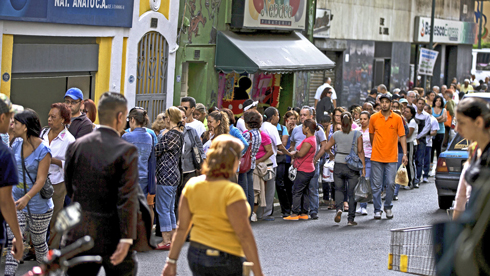
Queen for products, Karakas, 2015
Residents of Karakas are waiting for the "X" day, each - his own. By order of the government, local supermarkets on a certain day make only those whose identification certificate ends at certain numbers. On Monday, the lucky ones are those who have the last numbers 0 or 1, on Tuesday - 2 and 3 and so on. Armed with machine guns, people in the form of vigilantly make sure that outsiders do not leak in the queue.
Today is Monday, dairy products were brought into a supermarket in one of the Karakas areas. The line stretched for many hundreds of meters, people stand under the scorching sun for several hours. Someone can’t stand it and goes home in dumb. One of the women hiding under the umbrella of a two -year -old daughter says that it will stand to the end: "What to do, the baby needs milk."
Three rolls in hand
Professor of anthropology at the Central University of Venezuela Rochelio Altes is a happy day today: the last figure in the certificate allows him to purchase as many as three rolls of toilet paper. But to do it quickly it will not work - there are several hundred suffering like him. The guard on the doors launches several dozen people into the dressing room of the supermarket, and then carefully studies everyone's documents. “You think I have no other classes,” Professor Altes almost crying. - After all, how much could I do during this time. The session ends, students are waiting for me, and what am I doing? "
Raming is widespread for almost all of the first necessity: corn flour, rice, beef, chickens, milk, sugar, vegetable oil, cheese, cocoa, as well as hygiene items: in addition to toilet paper - on soap, washing powders, toothpaste.
To exclude repeated visits to stores and stop a possible smuggling, they begin to take fingerprints from buyers. The first landfill for the introduction of this measure was Sulia, now the authorities intend to transfer this experience throughout the country. Unless, of course, a soldier is enough. 
The shortage of first -need products began to be felt in 2012, during the life of the idol of the nation by Hugo Chavez, the situation worsened from month to month. Economists warn that it will be even worse: the disaster will come after food supplies and gold and foreign exchange reserves are drying, which now amount to only $ 19 billion. “This is not just the lowest level over the past 12 years,” explains Alehandro Herrero. “This is almost zero, given that Venezuela needs to be paid in the next two years for $ 12.5 billion dollars of external debt.”
His colleague, economist Angel Garcia Bansh, who was the first to predict the collapse of the country's populist oil model, believes that President Nicholas Maduro, after the country's food and industrial goods end, will remain two ways: “He ( Maduro. - NT ) will be forced to either completely abandon the currency control in the country and release the dollar in free swimming, or still establish another A more stringent regime, ”Banks argues in an interview with NT .
Judging by the last feverish actions of the government, Maduro tends to the latter. At the same time, his personal rating sank to an unprecedented level not only in Venezuela, but also in the world: according to surveys conducted in early June, it is only 10%. The level of approval of the government of the government is slightly more - 20%.
Bolivar cannot withstand two
Venezuelans have one of the highest and at the same time one of the lowest minimum salaries in the world. The paradox is because it can be considered differently. If at the official exchange rate, which is 6.30 bolivars by $ 1, then the Venezuech receives a minimum salary of 7421.66 Bolivars, or $ 1178.04 per month, that is, almost like an average American: the minimum salary in the United States is $ 1256.66.
However, if you take the Black Market, which is now living, 304 bolivars by $ 1, it turns out that the minimum salary of the Venezuelaz is only $ 24.73 a month, and this is even slightly lower than that of the “brothers in the socialist cube.
The monstrous currency “scissors” is one of the reasons for the economic chaos in Venezuela. If in local supermarkets, with all the shortage, goods are sold at low, subsidized prices, then in the black market prices are the most market. There you need to lay out a third of the monthly patch for a kilogram of tuna, and who can afford this?
The absurd exchange rate is especially clearly manifested on Venezuelan gasolites. A liter of gasoline here costs 0.07 of the Bolivar. With an average tank of a 50 liter car, refueling will cost the driver of 3.5 Bolivar - approximately $ 0.5 at the official rate. And at the Black Market rate - at $ 0.011 (!). That is, almost free. What economy in the world will withstand this? 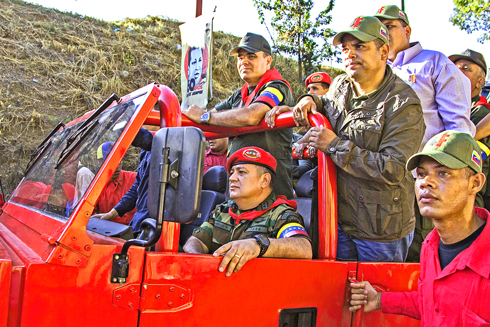
Due to low prices for gasoline, Karakas streets are filled with barely walking, sneezing and smoking the sky with scrap metal. A car without doors and a roof passes in the central Avenide of Independence, with holes in the back and without seats. A stool is crucified in the center of this miracle, on which the driver-neiger is sitting, and a purely Russian ear hat flaunts on his head.
It is easy to imagine what scope such a difference in prices for local smugglers who transport barrels with gasoline through a jungle to neighboring Colombia at night, where fuel costs $ 1.20 per liter. Even a few canister will be enough to pay for transportation and bribe border guards, if they, of course, meet in the way.
The difference between the official course and the Black Market Course is used by foreigners who come to the country. “It is stupid to pay a credit card,” a journalist of one Spanish publication, with whom we were registered together at the hotel, taught the NT correspondent. “Now you see, in five minutes I’ll change dollars on the street.” After some time, he brings a stack of oiled small banknotes received from the street seller of the hot dogs to the hotel rack, and the cashier counts them for about half an hour. “Well,” the colleague says with a satisfied tone when the money was accepted. “You paid $ 125 in the hotel in one day, and I spent less for two -week accommodation.” 
The Spanish journalist Emily Blasko describes today's Venezuela as a “narco -state”. In his book “Boomerang Chavez”, he claims: the drug trade was an integral part of the “Bolivarian project” of Chavez, in which, in addition to Venezuela, there were four more participants - Cuba, the Lebanese group “Hezbollah”, Iran and Left Columbia rebels from Farc (“Revolutionary Armed Forces of Columbia”).
Blasko, the Washington correspondent of the Madrid newspaper ABC, for many years studied the phenomenon of the Chavez model and came to the conclusion: the drug trafficking was used not only to enrich the country's military and political elite. In it, he saw a certain geopolitical axis that helped to create the so -called Alba block (alianza bolivariana para los pueblos de America), the initiators of which were Karakas and Havana, as well as to establish ties with such friendly countries as Iran and controlled by extremist groups.
The Spanish journalist gives as an example the meeting of Nicholas Maduro, at that time, Venezuela vice-president, with the leader of Hezbollah, Sheikh Hassan Nasellla-she took place in 2007 in Damascus. During the acquaintance, the parties discussed important details of the relationship. So, Maduro promised to give the Venezuelan passports to members, to share the experience of transporting drugs with them and put large batches of weapons. Blasko calls some of its sources, others who are agents of the American drug fighting department ( Drug Enforcent Administration, Dea - an agency in the US Ministry of Justice. - NT ), they appear anonymously. “Boomerang Chavez returned to Venezuela,” Blasko writes in his book, “the glass was behind which the father of the Bolivarian Revolution was hiding, and showed the true essence of his regime.”
The problem, however, is that the American law enforcement agencies will have to deal with this "essence" for a long time. Just American newspapers The Wall Street Journal and The New York Times have published extensive investigations that indicate: today the main “watching” for drug trafficking and laundering of dirty money is the second person in Venezuela, the chairman of the National Assembly Diosdado Cabel. It is he, according to the American media, is the head of the Cartel de Los Soles drug cartel (“Cartel of the Sun”). Now the Cables of Cabel are closely involved in the Federal prosecutors of the United States and the DEA agents.
One of the Americans's informants was Liemcy Salasar, a former cable guard chief. Now the Salasar is reliably covered from prying eyes, thanks to the witness protection program, but he had already managed to tell the investigation in detail that the cartel was created 16 years ago, immediately after the first election of Hugo Chavez for the presidential post. And its name comes from the medal in the form of the Sun, which awarded senior Venezuelan generals: Cabel - just one of them. “Diosdadado is the main person behind the scenes, the main coulovod, he is absolutely necessary to support his“ ecosystem, ”Miami Bruce Bagly, professor of political sciences of the University of Miami, tells NT . “Diosdado has more power than Maduro, and the latter has no choice but to support him.”
But what is said about the Venezuelan elite in the recently published report by the American consulting group Stratfor: “Generals and government officials work together to organize the transportation of cocaine from Colombia through Venezuela, they jointly use mechanisms for buying currency and wild foreign currency controls.” According to the authors of the report, this criminal activity is one of the main causes of a catastrophic deficit in the country: products imported from abroad are in the warehouses of corrupt officials, and they either simply throw them out or supply them to the black market. In order to avoid collapse and a popular uprising, Nicholas Maduro is believed in Stratfor, it is necessary to remove the cable and the associated drug addicts from the authorities and rely on a significant part of the supporters of the ruling “Unified Socialist Party of Venezuela” who were disappointed in the elite of the country. And every day there are more and more. “Independent party members, united in the Marea Socialista group, are striving to break with the Chavists,” says NT analyst at the IHS Insight Scientific Center Diego Moya Ocampos. “This is a rather powerful movement inside the ruling party, it gradually gains strength.”
The problem, however, is that, having broken with the top of the party, unpopular in the country and does not have real power, Maduro will inevitably turn into political kamikaze. So the real alternative to the growing crisis has not yet emerged.
Photo: Fernando Llano/ Ap Photo, Marco Bello/ Reuters