
Translated material
A controversial audience
The main source of information for Russian -speaking residents of the Baltic countries, according to surveys, are Russian federal television channels*. Therefore, at the end of last year, the question arose in Brussels about creating an alternative - in the same Russian language. Whether it went further than the words - I found out The New Times
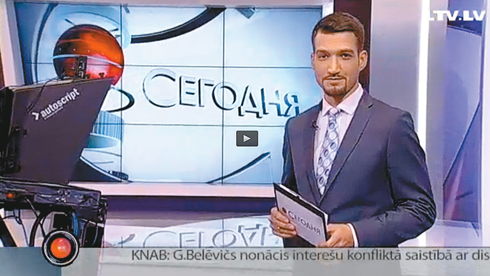
Screenshot of the Russian -language information program "Today" on the Latvian television channel LTV
The question of independent Russian -speaking television on the territory of the European Union sounded especially acutely after Russia joined the Crimea and got involved in the war in the Donbass: both Moscow motivated the protection of the Russian -speaking population - they say, "we do not surrender their own." The war in Ukraine erupted at a time when Latvia, the country with the largest proportion of Russian -speaking in the EU - more than 30 % of the two millionth population - was preparing to accept the powers of the country - the chairman of the EU Council ( for six months, from January 1 to July 1, 2015 - NT ). The fact that not only millions of Crimeans and residents of Donbass, but also, as the studies about the attitude of the audience to Ukrainian events have shown, a huge number of Russian -speaking residents of the Baltic countries were completely trusted in the invectors of the Kremlin television and propaganda - for European politicians was an unpleasant surprise. The elementary projection of the situation in the Donbass on the Russian -speaking cities of Estonia and Latvia, such as Narva and Daugavpils, spurred the tops of the European Union to urgent searches for the information antidote.
Media -Ukrainian
Before the events in Ukraine, few were ready to admit how launched the situation was. For two decades after the fall of communist regimes in Eastern Europe, the Baltic states not only did not support the development of Russian -speaking media, but sometimes prevented this. For example, in Latvia for a long time there were quotas for broadcasting in non -state languages. When the Constitutional Court in 2003 lifted this ban, due to the indifference of the state, almost all the Russian-speaking media space occupied the pro-Kremlin structures.
However, the adviser to the Minister of Foreign Affairs of Latvia, Viktor Makarov, does not agree that the Russian -speaking Latvians are easy to manipulate. For example, their views on, say, the Ukrainian conflict is very different from the views of Russians - only about 40 %unequivocally support Moscow in this matter. But the actual absence of an alternative cannot but affect the minds. “People either do not believe anyone, or they tend to believe in what it is convenient to believe in: Russia is the power of good,” says Makarov.
Latvian public television, LTV, now broadcasts in Russian only 16 hours a week-on a channel, mainly devoted to sports. This leaves him no chance in the competition with the daughter of the Russian Channel One - the Baltic Committee, which is recovering programs from Moscow with local news and propaganda by sharpened political comments in the style of Mikhail Leontyev. The result of the indifference of the authorities to the problem was the complete segregation of the country's media space on a linguistic feature. “The five most popular channels are absolutely different for the Latvian and Russian-speaking residents of Latvia,” says Rita Rudusha, publishing LTV editor. 
In the wake of Ukrainian events in Riga, Brussels and other European capitals, a violent discussion unfolded, the culmination of which was the statement of Foreign Minister Latvia Edgar Rinkevich about the desirability of creating a Russian -speaking television channel in Europe. In an interview with BuzzFeed, he said that this is not about an alternative source of propaganda, but about an alternative, normal European television channel with entertainment programs and news, but with virtually faithful news. ”
In January 2015, when Latvia had already taken over the reins in the EU, four countries-Denmark, Great Britain, Lithuania and Estonia-made a joint statement in which Brussels called to create an action plan to create alternative sources of information for the Russian-speaking population. Almost at the same time, the Government of the Netherlands, dozens of which were killed in the Boing Malaysian Boin, which died in July 2014 in July 2014 in July 2014, was vocational to finance the research work to expand the Russian-language broadcasting in Europe and the Eastern Partnership countries, which include Ukraine, Moldova, Belarus, Georgia and Armenia. The study was instructed to conduct a study by the “European Fund in Supporting Democracy”, which was based in Brussels, which called on the help of dozens of leading media experts and researchers of the post -Soviet space.
The preliminary results of the study were published on the eve of the EU summits and the Eastern Partnership, which took place in Riga on May 20–21. There are few reasons for optimism.
According to the participants in expert discussions in Riga, almost from the very beginning of the exchange of views it became clear: the dreams of a full Russian -speaking pan -European television channel were not destined to come true. Brussels simply does not have the opportunity to spend such a lot of money on this project that spin in Russian television. The official budget of Channel One in 2013 amounted to more than € 0.5 billion for comparison: the annual budget of Latvia does not exceed seven billion. But there are still equally powerful “Russia” and NTV. Not to mention Russia Today (RT), which, already in many languages, spends 300-400 million rubles a year. What is there information and propaganda! The budgets of Russian channels would be more than enough to solve the economic problems of Russian -speaking Europeans - so that they would never look back towards the Kremlin and Vladimir Putin, which, as it seems to many of them, confidently leads Russia to world leadership.
As a result, experts came to the first and main conclusion: it is inappropriate to develop a new television project on a single platform. Instead, they propose to create a “content factory” where programs and other materials for television and other types of Russian -speaking media would be produced. In addition, in the list of expert recommendations - the creation of centers of information and training of journalists. The fund will be financed by the funding of all these projects in which funds from various donors will accumulate, which will help to provide assistance not only by state, but also to the commercial Russian -speaking media, as well as any startups.
In the final form, the study will be represented by potential donor countries in June. After which they will already decide whether to allocate money for new projects or not. However, the longer the relative lull lasts in the east of Ukraine, the more enthusiasm in the European capitals relative to Russian -speaking media projects subsides - their prospects are still unclear. 
Feeling the most vulnerable in the face of the Kremlin propaganda of the country of the Baltic, they are forced to act independently. Estonia, who intends to launch its own Russian -speaking television channel, expected to run the forward by September of this year. The famous Russian musical critic Artemy Troitsky, who moved to this country, has taken part in its creation.
In Latvia, the process stalled. In the wave of initial enthusiasm, the public television regulator proposed creating a full Russian -speaking channel based on LTV. But when it came to the discussion of the specifics, the project was suspiciously synchronous attack from both the Prochrevsky Russian -speaking media and Latvian nationalists who do not want to hear about the return of the Russian language to the public sphere, and as a result was pushed back for an indefinite period, that is, actually buried. “In the midst of media professionals, serious frustration has accumulated due to the indecision of the government on the issue of the Russian-speaking channel,” says Rita Rudusha, releasing LTV editor.
... Meanwhile, in Ukraine, the events around which the EU countries prompted to think about new Russian -speaking media projects, the same topic found its original reflection: in the wake of the Maidan and the war in the Donbass in the country there was an explosion of Russian -speaking (not television) journalism and blogospheres. Most new media are born on the Internet, many of them grow from an unprofessional civilian environment. “A new free Russian -speaking discourse is born here, and it is attractive not only for Ukrainians, but also for residents of Moscow, Riga and London,” is convinced by the Ukrainian media expert Evgeny Glibovitsky, one of the creators of the Ukrainian fifth channel and Gromadska TV. According to him, “it remains only to accumulate a critical mass” in matters of quality, volume of content and editorial standards.
True, the war and the economic crisis leave little hopes that this will happen in the near future.
* In Lithuania for the “spread of misinformation that humiliates the country”, they will now be punished with a fine of up to 3 % of the monthly income. Amendments to the law were adopted in addition to the April decision of the Sejm on a three-month ban on the relay of the programs of the RTR-Planeta television channel. Latvia introduced the same ban. Earlier on the territory of Latvia and Lithuania, the broadcasting of the NTV-MI channel was suspended. In addition, in 2013, Vilnius introduced a three -month ban on broadcasting programs of the Russian Channel One.
** ---
Reference nt **
In the general list of languages used on the territory of the European Union, the Russian occupies the seventh place: according to the sociological service of Eurobarometer, out of the 507-millionth population of the EU 1 % of citizens considers Russian family, another 5 % on it say more, for example, than native speakers of Turkish or Arabic languages.
Photo: ltv.lsm.lv