
Translated material
Met, smoked a cigarette, dispersed
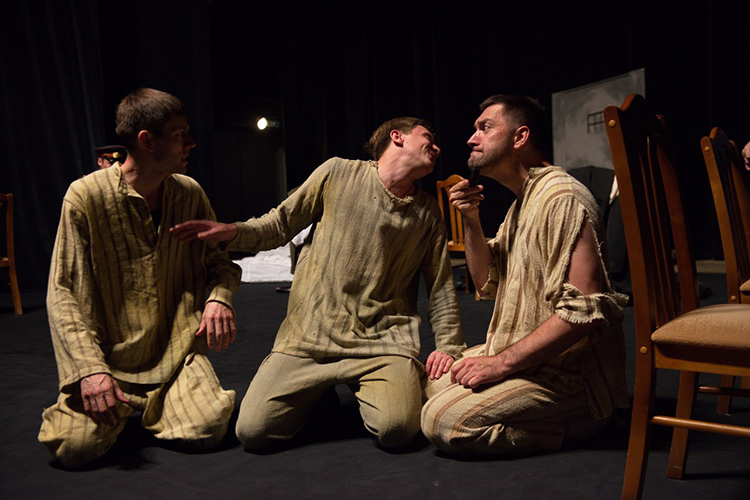
In Kazan, the festival “City. Art-preparation " . Project participants, Swiss directors Miriam Walter and Katarina Kromme, who already have experience in Russia, shared their impressions. Walter is working on the script for Jim Jarmusha “Outside”, Katarina Kromme - over Harms. Alexander Dunaev spoke to them.
Miriam Walter
Formally, I am here at the invitation of the festival, but I must say that Russia means a lot to me. This laboratory is not a “next adventure”. It may sound stupid (it is difficult to explain some things rationally), but I feel some kind of connection with your country. The plane lands in Moscow - and that’s it, I am at home.
Before the appearance of Kazan in my life, I did not imagine what kind of city it was; It is all the more important for me to be in it, breathing it with air. They told me that the city is Muslim, but I do not feel it. Rather, “less Russian” than Perm. Perhaps the point is the mentality of people - it is really different. This is especially noticeable in national places like the Kamal Theater, where I work.
Initially, the choice of material was due to me politically. Prison - Escape - A reaction to escape - this is a political story. In addition, I am very attracted to the story of a stranger. Jarmusha has Italian Bob, played by Roberto Beninya, invades the reality of two random prisoners and completely changes it, makes people look differently at each other and at the environment. It seems to me that this very vividly reflects the situation that Russia and Europe have been experiencing the last year. Gathering in Kazan, I, however, did not think to strongly load the actors with politics, I wanted to disassemble this thing in a more emotional, psychological way, but everything turned out even more amazing. The artists did not see at all in the play with ties with today, read it as a sweet, funny story.
We met, smoked a cigarette, dispersed-very in Dzharmushevsky.
I must admit that for me this work was a serious test, which was aggravated by the difficulties of translation. Maybe they have the whole problem, because we must translate from English into Russian, and then from Russian to Tatar - the text from the stage will sound in the national language. How to find mutual understanding with actors in a situation where you are not listened to at all, but listen to two translators? This crisis in mutual understanding led to the fact that today I decided to completely change the concept, to turn everything upside down - and the main performers understood me, fell into the wave of Dzharmushev humor. So today it was finally really great. By the way, not all artists watched the film - only those who wanted. Together we looked at the first ten minutes and the last episode, because, according to my concept, the plays from the film will begin and end the performance - we, as it were, “jump” into the stage narrative through the cinema and also leave it. Now everything is going on correctly.
It turns out a story, in some ways, similar to the “bus” (the play by Lucas Berfus, on which Miriam worked in Perm.-Ed. ) People who are at an impasse, in a closed space of their problems, from whom they cannot get out, meet another who helps to resolve the situation. Together they go a difficult path and part in order to never collide in this life again. We met, smoked a cigarette, dispersed-very in Dzharmushevsky.
I wonder what will turn out as a result of our searches. This laboratory will become the end of the whole page of my life - since September I am starting to study jurisprudence and will pause in directing. For at least a year, but maybe forever. Nevertheless, my goal is the struggle for cultural policy and art, and a new specialty should help in this. But if I return to directing, I will certainly come to Russia again.
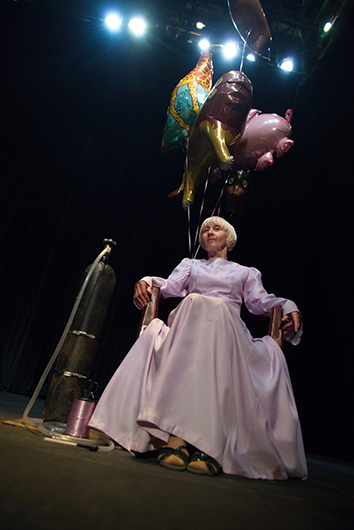 © "City. Art-training ”scene from the play“ Harms. Vaudeville in 24 actions "
Katarina Kromme
The production of the play “Bus” (Katarina made her version of the play of Berfus. - Ed. ) In Perm it became for me just amazing experience. I really hoped to return to Russia, to work here again - and now it turned out. Harms I discovered for myself before invitation to the laboratory. This author simply struck me at first, and then my colleague Lucas, with whom we usually create performances. We read it with hard, aloud, discussed a lot. In these texts there is some kind of strangeness of being, the dualism of the tragic and comic, which is very difficult to decipher. I am always looking in the texts precisely this combination of lightness, game, humor with deep tragedy, melancholy. It was scary to offer to the laboratory of this author-it seems like we Europeans can say something new about him? But they put Chekhov, Tolstoy, Gorky around the world - so we decided to try with Harms. And they were not mistaken, it seems to me. From conversations with artists, it became clear that in Russia they put him very little - perhaps because he did not write specifically for the theater. In our performance, several texts are used - “Adam and Eve”, “Cases”, poems. We mixed all these texts and divided into small monologues, which called “Cases” - according to the title of one of the writer's books. I hope that we managed to find this path: from lightness, entertainment deep into the Harmsa world - to wild longing, melancholy sadness. With this concept, we came to the laboratory, it was offered. It is important for us that the search does not go unilaterally, but with the actors. This is one of the main components of the project, it seems to me - an exchange of ideas, opinions, experience, which we have quite different. So that both sides, as a result, learn something from each other-well, have fun too.
Deep into the Harmsa world - from ease of wild longing.
I have experience working with Russian artists in Perm and now here in Kazan, but, despite this, it is difficult for me to draw conclusions about the Russian school as a whole. What I see clearly is that Russian artists are hunting for tests. The level of dance, vocal, speech with those with whom I work is high, and they are very organic on stage. They also always surprise me with their flexibility, openness and that they do not really need discussions. This is important to me, because in Switzerland I, as a rule, spend more time on discussion. But, on the other hand, the process of working on the performance there differs from the current laboratory format. Six weeks - usually so much time I have for production in Switzerland, Germany or Austria. Perhaps we have more time here, I would build rehearsals differently. But now we can work very clearly, concentrated and without losing the spirit of the experiment.
Ideally, I do not want the resulting performance to dictate some one-dimensional reading, I like the possibility of prospects more. We do not have many methods of communication, but all of them are visually expressive. Lucas and I try to look for this expressiveness and use in our work through movement, sensation, atmosphere. Yes, it is atmospheric, I would like to achieve a special “Harms” view of the world in this work first of all.