
Translated material
Tool for survival
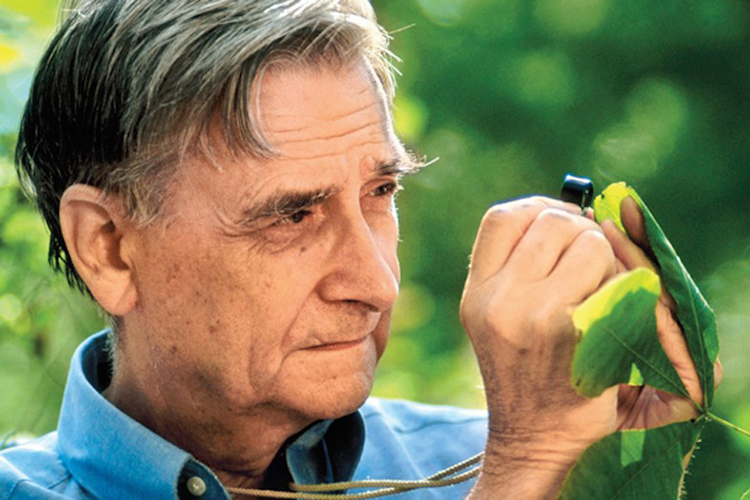
86-year-old professor-emerit Harvard University Edward Wilson-researcher Muravyov, a theoretician-ecologist and one of the creators of sociobiology. He was twice awarded the Pulitzer Prize in the category “For non-artistic literature”: in 1979 (for the book “On the Nature of Man”) and in 1991 (for the book “Ants”). And for scientific merits-the theory of island biogeography, which explains why there are less species variety on some islands, and more on others-Wilson in 1990 was awarded to the Crafford Prize, the most prestigious reward in those areas of science that is not awarded by Nobel.
In his new book “The meaning of the person’s existence”, the Russian translation of which is published by Alpina Non-Fixes, Wilson tells why science is still trying to withdraw the behavior of modern man from evolutionary biology-despite the fact that we have civilization, culture, state and system of norms that they seem to affect us much more than everything that related to the ants of the ants. and monkeys.
COLTA . Ru publishes the head of "Instinct."
* * *
The French writer Jean Bryuller (who worked under the pseudonym Verkor) was on the right track, starting his 1952 novel “People and Animals” with the statement: “All misfortunes on Earth are because people have not yet understood what a person is, and have not agreed among themselves what they want to see him.”
In this part of our journey, I propose to return to the starting point and with the help of general biology try to explain why human existence remains such a great secret, and then to speculate on the ways of its solution.
The evolution of human intelligence did not go as if some external power pushed him onto the path of either purely rational or emotional development. Intelligence has always been and remains a tool for survival, and this implies both the mind and feelings. Our brain has acquired a modern look, having made many large and small steps through the labyrinth and choosing one of a million possible ways. Each of these steps was made as a result of a mutation or under the influence of natural selection acting on alternative forms of genes (alleles), which determine the type and functioning of the brain and sensory organs. After many random oscillatory changes, our genome became what it is now. At each of the intermediate stages, the evolution of the genome could turn into a particular path, predetermining the features of our brain and sensory organs. And the chance to achieve the human level of intelligence with each step decreased sharply.
A concrete combination of reason and emotions that we today call “human nature” is just one of the many possible combinations that could develop in the presence of such a brain and such senses that a person has.
That is why our idea of ourselves as a biological form is always distorted by deep prejudices and errors, or “idols” of superstition and deception, as Francis Bacon described them four hundred years ago. There are innate features of perception, the great philosopher said, they are not imposed on us by culture, but "inherent in the nature of the mind itself."
It was always so. There were always plenty of confusion. For example, back in the 70s of the last century, sociologists were oriented mainly on humanitarian knowledge. It was believed that human behavior is mainly or even completely due to culture, and not biology. "There are no instincts or nature of man!" - exclaimed especially categorical of them. But by the end of the 20th century, sociology was significantly close to biology. Today it is generally recognized that in human behavior there is a strong genetic component. The instinct and nature of man is a given, although how deep and strong they are still an open question.
 © Alpina Non-Fixes
It turns out that both views on human nature are true in something, and in some ways are erroneous, at least in their extreme manifestations. There is a paradox, which is called either “nature against education” or “sociogenesis against biogenesis”. The modern interpretation of human instincts, described below, helps to resolve this contradiction.
In principle, human instincts do not differ from animal instincts. But human behavior is not predetermined by genes, in contrast to the hardly programmed behavior of most animals. A textbook example of this type of instinct is the protection of the territory by males of a three -legged string. The priest is a small fish that lives in fresh and sea water throughout the northern hemisphere. During the wedding season, the male to Kolyushka seeks to “stab” a small territory along with him, where he does not allow other males of their species. During this period, the abdomen of the male acquires a bright red tint. He attacks all the “red-haired”-that is, on the male rival,-swimming on its territory. By the way, such a reaction is even easier than an attack on “other fish”. For its operation, it is not even required to recognize the fish as such. The relatively weak brain brain reacts simply to the red abdomen. When the experimenters threw pieces of wood and other objects that are dissimilar to fish in shape, but with clearly visible red spots, the male was just as violently attacked these models.
Once I kept in the laboratory of lizards anolis, studying their territorial behavior. Anolis live on different islands of the West Indies. These small reptiles in the size of a human finger in abundance are found on trees and bushes, where they hunt insects, spiders and other small invertebrates. An adult male threatens his rivals, unfolding a special skin fold in front of them on a neck called the “throat bag”. In each type of anolis, a throat bag has a characteristic color: as a rule, red, yellow or white. Males of a certain species react only to “their” color. It turned out that to verify territorial behavior I need only one male, not two. I just put a mirror against the wall of the terrarium, where the Anolis lived. Noticing his own reflection, the male-Anolis showed his property to the “enemy” (each time it all ended in a draw).
In all cultures, there are the same behavioral predispositions, even if they sometimes seem irrational, and a person has many opportunities to act differently.
Newborn sea turtles appear from eggs buried in the coastal sand with their mothers. An adult sea turtle goes ashore for the only purpose - to lay eggs. Each turtle is released from the sand and immediately crawls to the sea, where it will spend the rest of his life. But the cubs are not attracted by some special species or smells. He crawls to the glare of light, reflected from water. When the experimenters turned on an even brighter light next to the turtle, the baby crawled to it, even in the opposite direction from the sea.
People and other organisms with a large brain are also guided by inherited key stimuli and instincts, but these instincts are far from so hard and straightforward as in lower animals. On the contrary, people rely on a special complex of acquired rules, which is called in psychology preparedness or predisposition to learning. Qualities are inherited to learn one or more alternative behaviors from many possible ones. The most pronounced of such behavioral predispositions are found in all cultures, even if they sometimes seem irrational, and a person has many opportunities to do otherwise.
For example, I'm a little afraid of spiders. Sometimes I tried, but could not force myself to touch the big spider sitting in the web. At the same time, I know that the spider will not bite me, and if he bites me, he still will not be poisonous. I have been carrying this unreasonable fear in myself since the age of eight, when the big spider-cross, which I met in the garden, was frightened. I got to this monster (yes, then the spider seemed terrible to me) in order to take a closer look at him while he was sitting with gloomy calm in the center of his web, and shuddered from his unexpected reaction. Today I know the scientific name of this spider, I understand well in its biology - which is not surprising, because for many years I worked as a consultant to entomology in the Museum of Comparative Zoology of Harvard University. But I still cannot touch the big spider sitting in the web.
A similar disgust for many people develops into a serious phobia. Phobia is accompanied by panic, nausea and complete inability to think about an object that causes fear. So, since I talked about some rejection of spiders, I must admit that I have a real phobia. Under no circumstances, I can not allow my hands to be tied or covered with something. I clearly remember when I had this fear. Being an eight -year -old boy - just that year I ran into a spider - I suffered an unpleasant eye operation. I was done anesthesia in the spirit of the 19th century: without explaining anything, they laid back on the operating table and, holding their hands below, put a napkin impregnated with ether on the face. I yelled and pulled out. Somewhere deep down, I printed: "I will never survive this again!" Until now, my eyes are facing the image. An imaginary robber holds me on the fly and says: “Now I’ll tie your hands, and I will put a bag on my head.” In this nightmare, I always answer (I have no doubt that in reality I would react in the same way): “No need, it is better to shoot me right away.” Indeed, I will better die than to transfer such a mockery.
Volunteers from different countries were offered to evaluate photos of various places. The ideal landscape is very reminiscent of the African savannah, where the evolution of primates proceeded for millions of years.
Getting rid of phobias requires a long and complicated treatment. But for the formation of phobia, one strong experience is enough, which I and many others have repeatedly convinced. For example, if you suddenly see a long wriggling object on the floor, you may well develop a pathological fear of snakes.
How could such an excessive reaction be an advantage? The point is in the objects of our fears. We are mainly afraid of spiders, snakes, wolves, current water, closed spaces and crowds of strangers. These were the oldest dangers that threatened our ancestors-Primates and the first prehistoric hunters and collectors for millions of years. Our ancestors constantly risked to cripple or even die if they were too close to the edge of the cliff in the pursuit of the game, or inadvertently stepped on the poisonous snake, or stumbled upon the field camp of the enemy tribe. In such cases, a person had to study very quickly, remember the event brightly and for a long time, to act decisively, without hesitation.
Today we risk perishing much more in a car accident, from a knife, from a pistol or because of excessive salt and sugar consumption. But we have not developed an innate tendency to avoid these dangers. Probably, too little time passed by evolutionary standards, and such a saving fear has not yet managed to take root in our minds.
Phobias - extreme, but any behavior due to preparedness for learning, which ensured adaptive value in the process of evolution of our species, is part of human instincts. Nevertheless, the majority of behavioral mechanisms from generation to generation are transmitted through culture. The social behavior of a person is based on readiness for learning, but the severity of deviations - as a result of evolution in the course of natural selection - in different cases different. For example, people are born gossips. We are very interested in stories from the life of other people, we can endlessly delve into the details of such plots. Gossip is an art that helps us learn to communicate with people, as well as form our social networks. We are fond of novels and plays. But we are much less interested in stories from the life of animals - if only people are not involved in them in one way or another. In our stories, dogs love their neighbors and yearning for the house, owls reflect, snakes are very snoky, and the eagles revel in freedom in a huge sky.
People by nature are musically susceptible. Small children almost involuntarily experience awe and excitement, listening to music. However, a thrill (and even delight) in relation to higher mathematics, if it arises, is much slower and later. At the early stage of the development of human society, music raised people and exalted them emotionally - and theoretical mathematics never served these goals. Mental abilities allowed the ancient person to absorb mathematical subtleties, but not to love mathematics. Only evolution and natural selection can create prerequisites for deep instinctive love.
Qualities are inherited to learn one or more alternative behaviors from many possible ones.
The driving force of natural selection directed the development of cultural convergence in different societies around the world. Based on the materials of the “regional cardboard of inter -human relations”, there are 67 cultural universals, including the following (given in random order): athletic sports, body decoration, decorative art, etiquette, family feasts, folklore, burial rites, hairstyles, inheritance prohibition, jokes and sacrifice of supernatural creatures.
We call “human nature” the whole combination of our emotions and a predisposition to learning, over which the same emotions dominate. Some writers tried to reduce human nature to its complete denial. But human nature is real, noticeable and reflects the processes occurring in certain structures of the brain. Decades of studies allow us to conclude that human nature is irreducible to genes that predetermine emotions and readiness for learning. It is also not determined by cultural universals that are its final product. Human nature is a set of hereditary patterns of our mental development, which set the cultural evolution, a certain direction, in the opposite of others and thereby forming the connections of genes with a culture in the brain of every person.
Among the most important hereditary predispositions are the preferences of people when choosing places of residence. Adults reach for places where they grew up and formed, experiencing the most significant life impressions for them. Mountains, coasts, steppes and even deserts can be perceived by us as places that give us a sense of family and comfort. For example, my childhood passed near the Gulf of Mexico, so I most comfortably feel on a flat low plain, which smoothly descends to the sea.
However, laboratory studies of such “panoramic preferences” on a smaller scale, as well as experiments with the participation of children who have not yet managed to become carriers of a certain culture, showed another picture. A group of volunteers from different countries with very dissimilar cultures was selected. Subjects were offered to evaluate photos of various places and fantasize where they would like to live. The selection included a variety of landscapes - from a dense forest to the desert, and there were a lot of intermediate options. It turned out that the choice was determined by three factors: the ideal point of view, which is located on a hill, from where the lowland is clearly visible; view of the park area where the meadows are interspersed with groves and copses; The proximity of the reservoir, whether it be a stream, a pond, a lake or ocean.
This archetype is very reminiscent of the African savannah, where for millions of years the evolution of primates and ancient people proceeded. Is it possible to assume that the preference of certain habitats inherited by us from distant ancestors? In this so -called suvanna hypothesis there is nothing supernatural. All animals that are actively moving - from the smallest insects to lions and elephants - instinctively gravitate to such habitats, which are biologically most adapted. Otherwise, it would be more difficult to find sexual partners, the necessary food, and also protect themselves from unfamiliar parasites and predators.
Currently around the world, the rural population is gradually pouring into the cities. The city dweller is much easier to access good markets, schools and medical institutions. In addition, the city has much more opportunities to provide itself and its family. But if there is a choice, ceteris paribus, would all we really like to live in cities and suburbs? Since life in cities is characterized by intensity and dynamism, and human life is largely determined by urban ecology and artificial habitat, it is impossible to answer this question. Итак, чтобы определить, что на самом деле предпочитают люди и к чему стремятся, располагая абсолютно неограниченным выбором, стоит обратить внимание на очень обеспеченных респондентов. Любой ландшафтный дизайнер и опытный агент по недвижимости скажет вам, что богатые клиенты предпочитают жить на возвышенности, откуда открывается вид на низину, чтобы местность была умеренно лесистой, а поблизости был водоем. Ни одно из этих свойств не имеет практического значения, но хорошо обеспеченные люди готовы платить немалые деньги, чтобы жить в таком месте.
Несколько лет назад я был приглашен на обед к одному заслуженному состоятельному другу. Оказалось, что мой приятель глубоко убежден, что наш мозг — чистая доска и не обременен никакими инстинктами. Он жил в пентхаусе, оттуда открывался вид на Центральный парк Нью-Йорка. Мы вышли на террасу, и я заметил, что по ее внешнему краю высажены деревца бонсай в горшочках. Мы смотрели на видневшуюся вдали лужайку в глубине парка, где красовались два пруда. Несомненно, замечательная панорама. Будучи гостем, я воздержался от неудобного вопроса: «Почему же этот вид так прекрасен?»