
Translated material
Russophilian | Colta.ru
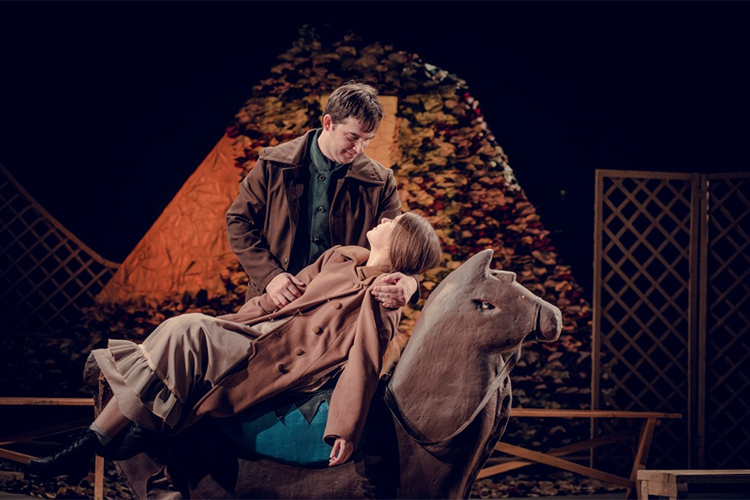
I don’t know for whom, but for me, every visit to the festival of theaters of small cities in Russia is a kind of meeting with the country, evidence of its viability and potential. Of course, you can just go to the plane and go to the theater in Siberia, to the Urals or in the Volga region, but when you watch a dozen performances from different ends of the same homeland with a capital letter within a week, which has recently begun to include different crooks in all cases, you get a more confident impression.
How would this impression in short words describe? It seems that at the turn of the century, something important happened in the Russian theater, which gave him an impulse if not to rise, then at least to a confident movement forward. The "windows" of large metropolitan theaters with their special budgets and pretentious spectators are not as indicative here as modest groups from small towns. By the way, the artists of the Benefis Theater from a tiny Yelet could well have a master class with troupes of a number of famous theaters of both capitals-in order to train them to play calmly and without strangle, not to yell and do not spit into the air. What Yuri Melnitsky is generally difficult to describe in this theater in this theater. Its “for what you go, you will find” according to Ostrovsky - not a rich comedy at all, as is customary, but an extra -armed, search company. This somnambulic, insinuating performance seems to be listening to itself, then silent, then flashing with a series of unforgettable poetic images. Ostrovsky here rhymes with Dostoevsky, then - unexpectedly - with Kipling, Dymkovo toys grow into human height, and the widow of Belotelov is a modest and unhappy woman of middle age. In this performance, Melnitsky is not even so important “what”, how much “how” is a strict experience of the sacrament of the theater, so strong that the performance completely pulls the viewer out of everyday life, placing it in a space of distilled culture.
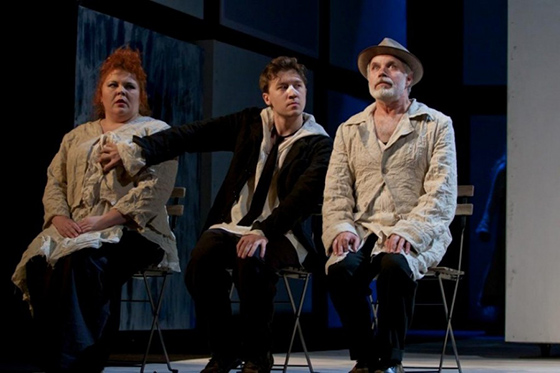 © Novokuznetsk Drama Theater Frame from the play "Ivanov"
Having received the Grand Prix among the performances of a large form of “Ivanov” from Novokuznetsk (director Peter Sheleshevsky) is also an exrasis from the field of Russian classics and also cleanses the vulgar stamps from a textbook play. The director laid Chekhov on modern rhythms - from Psoi Korolenko to Damon Albarn - and placed the play in the play in his free space surrounded by video screens: either the skull of Ivanov, or the purgatory. Shereshevsky, as always, managed to impress the audience with a series of stage metaphors like red balls, like bloody sputum falling from under the grates at the time of the death of consumption of consumption of consumption of consumption. But more importantly in this work was an acute, almost expressionistic interpretation of Chekhov’s images, bringing them closer to the audience of the 21st century. The passionate dedication of the actors (first of all, Andrei Kovzel and Ilona Litvinenko) made the performance completely irresistible.
The Russian artist is a very separate topic: he is alive and full of strength. Even in frankly failed performances (there were few of them in the festival program) there were strong, smart, attracting eyes of acting. In competent directing, the actors bloom. Very complex tasks are on the shoulder. For example, the Brecht removal in the play “The Golden Dragon” based on the play by Roland Shimmelpfennig, staged in the theater of the city of Serov by German director Andreas Mertz-Raykov. The performance of an unusual theatrical uniform, created on the basis of a phantasmagoria with a powerful social charge, successfully goes on a provincial stage, refuting the idea of the audience-arches that reject serious art. In Serov, there were fewer such fools than in the capitals: apparently, the scale of the dulling here is not so serious?
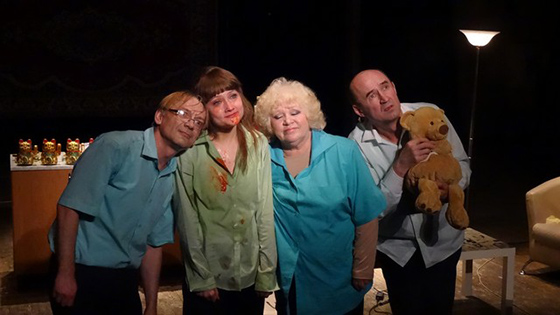 © Serovsky Theater of Drama named after A.P. Chekhov Frame from the play "Golden Dragon"
The actor sometimes even manages to draw out some mistakes of directing. In the performance of the new General Region of the Lysvensky Drama Theater Artyom Terekhin, “Save the Cam-Junker Pushkin” traces of dizziness from success are visible: in the first part, the director managed to find a bright comic reception. The monologues of the protagonist were layered by witty acting sketches (Varvara Utbin, the actress of a slurry comic talent is especially successful), the action moves from reprise to reprise, but closer to the tragic denouement begins to slip. The performance remains afloat largely due to the gift of stage presence, which is possessed by the leading actor of Pitunin Kirill Kerevov (prize for the best male role). Playing on a strange junction of two roles - a neurasthenic and a social hero, he creates a convincing image of an “intellectual from the people”, a person whose fate - love and death - mystically, against his will, was connected with the fate of Pushkin.
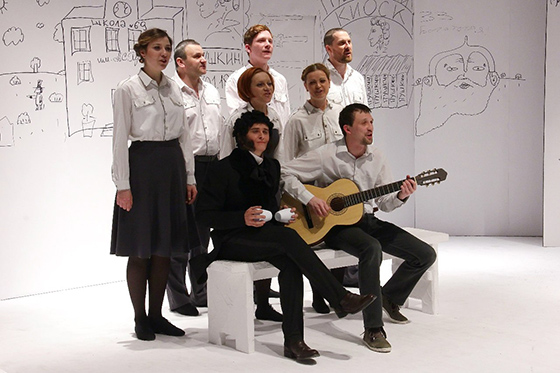 © Lysvensky Drama Theater Artyom Terekhina Frame from the play "Save the chamber-junction of Pushkin"
The performance of the Prokopyevsky Drama Theater “This is all of it” largely took place thanks to the charisma of actress Svetlana Popova (the best female role of the festival). The chamber action, which is performed on the stage of the theater - in the circle of chairs, where the artists are mixed with the actors - invented (and largely successfully) director Semen Serzin as a modern analogue of ancient tragedy. The spectacular play by the Belarusian playwright Andrei Ivanov tells of a mother who, in search of lost contact with her son, invents an alter ego - a young girl, a fictional computer character, and contains many traps, oozing wild, indecent melodramaticism. In some of them, the director Serzin pleased: in the number of tragic music per unit time, the performance threatens to become a record holder. Perhaps, with another actress, the enterprise could have failed, but Popova managed to give the scale of the personality of the heroine, to play her metamorphosis, the separation from reality, to outline that line when she turns from an worried mother into a criminal, a woman who intended to regain her youth. The everyday story is painted with a mystical halo, and the tragic pathos no longer seems inappropriate.
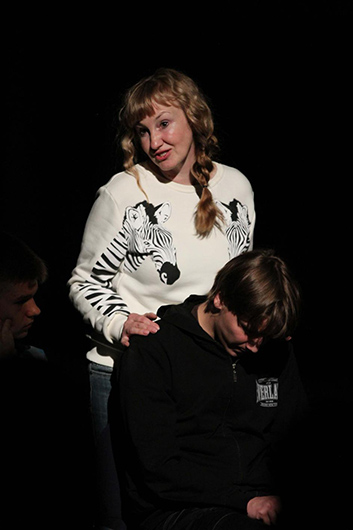 © Nikolai Fedorinin / Prokopyevsky Drama Theater Frame from the play "This is all she"
It also happens that entire theaters are born and stronger before our eyes. Such is the author’s theater Denis Bokurdze, working in Novokuybyshevsk. He is now in that excellent age (and excellent form) when it is not possible to share the creative contribution of the director and artists. They are charmingly unanimous, spent and very in harmony with each other. The Theater Studio "Fine" lives its tense inner life, in which acting trainings assigned the same important role as performances. Bokurdze, it seems, set a goal on his own experience to test and feel different theatrical styles and eras. His last year’s performance on Sartre resembled the best examples of the Georgian metaphorical theater, the current Tanya-Tanya (the Grand Prix in a low uniform) with the cult text Olya Mukhina refers to the nineties. However, unbearably charming artists “Glass” manage to saturate this vintage with such energy that we are talking about old -fashioned even blasphemous. The performance collected on the principle of a jazz ensemble first seems to be a scattered sum of bright acting sketches, however, to the final, it acquires a rigid structure of images and relations, growing as if from nothing, without a directing hand, in pure acting “butter”. In this particular case, the visible absence of directing is a certificate of its high class.
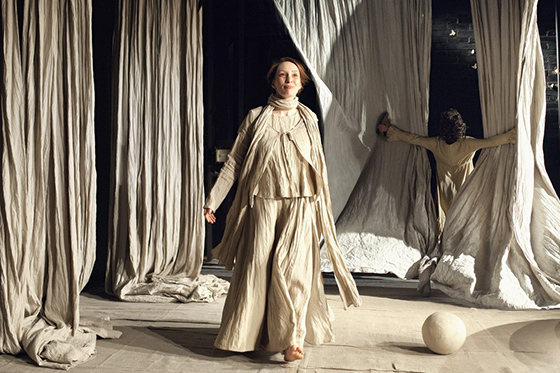 © Theater-Studio "Fine" frame from the play "Tanya-Tanya"
All these - and others - performances are created for small budgets, sometimes not so much thanks to it, as contrary. Small cities give hope to the country. If our uncultural and greedy officials suddenly make the genocide of Russian culture inadvertently (which they seem to have already begun), one hope is on Novokuybyshevsk, Prokopyevsk, Yelets. They, God will give, survive and again teach our descendants to go to the theater, read and speak Russian.