
Translated material
A long conflict
In the near future, the relationship of Russia is the West, if it changes, then for the worse
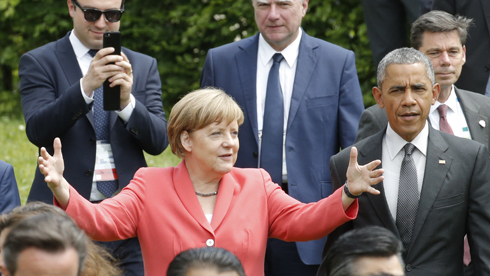
The G7 summit in Bavaria (in the picture: Angel Merkel and Barack Obama) showed: the West will not loosen pressure on Russia, Garmish-Partenkirhen, June 8, 2015
The May visit to Sochi Secretary of State Kerry and his conciliatory mood gave rise to many rumors and speculations regarding the “softening”-in relation to Putin Russia of America. Yes, and a visit to Moscow-in hot pursuit of the Sochi visit of Kerry-Victoria Nuland, assistant Secretary of State in Europe and Eurasia, also, apparently, was designed to demonstrate the pragmatic and constructivist approach of the State Department to Russian-American relations. For example, Russia has been proposed an active role in solving the Iranian problem, as well as membership in the coalition of 67 countries, ready to fight the Islamic State, which today threaten not only the Bashar al -Assad regime in Damascus. After all, it must be borne in mind that thousands of militants from the post -Soviet space are fighting in the ranks of IS, who, upon returning home, are quite capable of lighting the jihad flame in their homeland, that is, next to the Russian borders.
However, it is useful to pay attention to other facts.
Kerry was at Putin on May 12. And on the 27th, a few days before the summit in Bavaria, the US Vice President Joe Biden, speaking at the Brukings Institute, harshly warned the Kremlin: Russia needs to fulfill the Minsk-2 agreement, which, among other things, provides for the termination of participation in the Donbass of the Russian military and the restoration of Ukrainian sovereignty over the region, that is, the complete control of Kyiv over the borders. At the same time, the vice president outlined the scenario of a tough confrontation between Moscow and the West. And one more detail: Biden’s statement was almost no different from the comments of the President of Barack Obama, quite sharp addresses to Russia in his recent conversation with NATO Secretary General Jens Stoltenberg, who was in Washington on May 25–27.
All this gave rise to speculation that John Kerry, demonstrating a conciliatory position in Russia, did not agree on it with the US National Security Council (SNB) and the White House.
A week ago, more or less clarified. Elmau Castle in Bavarian Garmish-Parthenkirhen, a city known during the Cold War as a headquarters of German foreign intelligence, and today-as a NATO college, including cadets from the countries of the former USSR, has become a place where the G7 countries (USA, Germany, Japan, Great Britain, France, Italy and Canada) decided to continue to put pressure on Russia for the sake of resolving conflict in Ukraine. In this case, the key method of pressure, in general opinion, still remains sanctions. Moreover, in Elmau, they clearly sounded the threat of “deepening and expanding” them if Minsk-2 agreements are not executed. 
Today's relations of Russia and the West can be described as a protracted conflict. Russia has come to him for more than 10 years. Since 2004, after Beslan, twisting of nuts within the country began. In 2005, Vladimir Putin called the collapse of the USSR “the largest geopolitical catastrophe of the twentieth century”: not the First World War, which entailed the collapse of the three empires-the Austro-Hungarian, Russian and Germanic, not the second world war, which brought the USSR 27 million victims-namely the collapse of the USSR. In 2007, in Munich’s speech, Putin, in fact, voiced new ambitions-to restore the sphere of Russian influence within the borders of the USSR. In 2008, a war with Georgia happened ...
In domestic policy, a choice was made in favor of the confrontation model “Fortress Russia”, which the author of these lines wrote in The New York Times back in 2012. Huge military budgets are overtaken under this model, more than $ 2 billion of Russia Today and other propaganda channels are inflated, but the Solovyovs are filled under it and the fight against “foreign agents”, such as the Transparency International, the “liberal mission” Evgeny Yasina and is gaining momentum. "Dynasty" of Dmitry Zimin. Finally, under the same thunderous refrain in Russia they repatriate assets, “build” the oligarchs, shine through officials, unite the rows and walk together.
And abroad to the homeland, the Kremlin began to create the “Fifth International” - to fight the West. It includes all anti -Western elements: from ultranationalists to the extreme left. And the Kremlin supports all financially and information. German National Democrats, ideological heirs of the Nazis, Greek Golden Dawn, French National Front Marine Le Pen-all of them have one common line: hatred of America. And this is an important element in the Putin strategy for shaking Europe, corrosion of its post-war liberal-democratic rod.
And of course, Putin has another big hope - for the split of NATO, erosion of the transatlantic union. This hope is not as groundless as it might seem at first glance. At last year's summit in Wales, the Alliance proclaimed the goal: military allocations of member countries should reach 2% of their GDP. The problem is that this is not a compulsory ceiling, but a wish. As a result, both the purely military problems of NATO countries and the political background were aggravated. For example, Great Britain continues to reduce military allocations, including its own fleet, and we see how the Great Marine Power disappears from the geopolitical map of the world ocean. 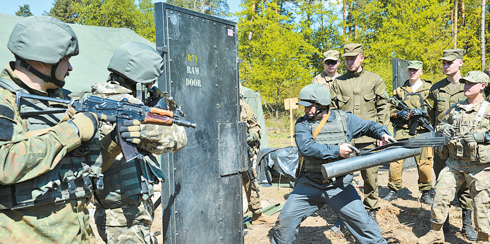
An example before my eyes
The support of the enemies of an open society and corrupt politicians is an attempt to repeat the political struggle of the twentieth century, from the Comintern to the movement for nuclear disarmament. From the secret friendship with terrorists from the Baader - Minehof and OOP group to the Red Brigades and the supply of weapons of the Irish Republican Army (Ira) through Libya. The Soviet leadership, just like Russian now, relied on a split in the western camp. The West German "Ost Politician", from Willy Brandt to Helmut Schmidt, weakened American positions in Europe. The French, from Georges Pompidu to Zhiskar d'Esten, kept a course for discharge with Moscow. The “struggle of the century” cost the USSR in tens of billions of dollars of that time. But how did it all end?
The prolonged aggression of the USSR in Afghanistan and Ronald Reagan’s coming to power radically changed the vector of Western foreign policy. The targeted West course on sanctions against the USSR, multiplied by a drop in oil prices, stagnation of the Soviet economy and its bankruptcy - all this eventually led to the sunset and collapse of the Soviet Union.
Can the same script be repeated today? It largely depends on the United States as a leader of the Western world. 
Today in Moscow there is an opinion that already next year Ukraine can fall apart economically, and not only. And in this way, to withstand sanctions and eat the Poshekhonsky Parmesan to wipe his nose to America and Europe is a good, patriotic matter. Moreover, in America, the presidential election is not far off, but how the new president will behave - the grandmother said in two more.
But these calculations are erroneous.
The most visionary American politicians and analysts from both political parties understand: by occupying and annexing the Crimea by untied the conflict in Ukraine, Russia made an attempt to revise the norms of European security, developed in 1943-1945, that is, Stalin, Roosevelt and Churchill in Tehran and Potsdam. The principle of irregularity of borders in Europe was enshrined in Helsinki agreements (1975), in the Paris Charter (1990), and Ukrainian sovereignty was also in the 1994 Budapest memorandum. Putin wants to receive for Russia the status of the USSR of the 1945 model. But he forgot: that status was bought by the blood of millions of dead, and Soviet tanks stood in Berlin. Today, such ambitions are fraught with the prospect of a new war in Europe, which can soon become nuclear. Then everyone will lose. And - finally.
Therefore, the task of the United States and allies is to return to the status quo ante bellum (before the war) so that the boundaries and sovereignty of Ukraine are completely restored. That's exactly what is completely. Because if before the fights in the Donbass, the West could still “swallow” the annexation of Crimea, which, by the way, was spoke of the author of these lines in the geopolitics of Zbignnev Brzezinsky, and senior officials from the office of the Federal Chancellor of Germany, today the situation has changed dramatically.
Analysis of the statements of all serious applicants for the post of US President - from Hillary Clinton to Jeb Bush, Scott Waker, Marco Rubio, etc. - He says that after Obama, the US policy towards Moscow will become tougher. The only exception is the Libertarian Rand Paul. But his chances of the election are very small.
All this means that sanctions as a method of pressure on Moscow will remain in the political arsenal. Moreover, we can talk not only about the disconnection of Russia from SWIFT, but also about the restoration of control over Russian export of military and double technologies - following the example of the Cocom system during the Cold War. The very probable pressure tools should include the expansion of the list of sanctions against Russian companies, the arrest of Russia's assets in the West as part of the Judicial lawsuers of the Yukos, a lawsuit against trillion dollars in compensation for damage to Ukraine for the Donbass and the loss of Crimea.
But that's not all. NATO, as recently, the head of the Joint Committee of the Chiefs of Staff Martin Demink said, will consider the issue of basing the average radius missiles in Europe - in response to Russia's violation of the agreement on the elimination of medium and short -range missiles, signed by Mikhail Gorbachev and Ronald Reagan in 1987.
In other words, now the question is not only in the possible outcome of the Ukrainian conflict. The escalation of the conflict between Russia and the West is fraught with unprofitable consequences of a global scale. The time has come to retreat from the edge of the abyss and return to rational analysis and balanced decisions. And the sooner the better.
Photo: Christian Hartmann/Reuters, Oleksandr Klymenko/Reuters