
Translated material
"Do good from evil"
The Great Charter of Frequences from the point of view of the institutional economist
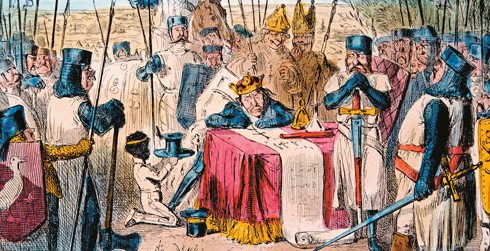
"Signing the Great Charter of Frequences by King John" The eyes of the British cartoonist of the 19th century John Lich, 1875
How are the rules for which society lives? Many people think that these rules arise thanks to wise legislators who wish the benefits of the state and are trying to best arrange life. In fact, everything is wrong. I want to remind you of the famous phrase of Robert Penn Warren (poet, writer, author of the novel “The whole royal army.” - NT ), who was later repeated by the Strugatsky brothers in our Russian literature: “Make good from evil, because there is nothing more to do from it.”
Where did the principles of the great charter of liberties come from, which have not lost their relevance so far? The crazy king robbed and hung barons, who were also clearly not angels. These rude and illiterate barons, uniting among themselves, decided to defend themselves from royal arbitrariness with the help of a certain agreement. Thank God there was a competent archbishop of Canterbury, which helped them in this. It is little like the story of good reformers and wise legislators. The great charter of liberties, like everything in this world, arose from the blood and mud of life. But in this blood and mud there was a sprout of a new, very effective set of rules. What is its effectiveness?
There is a mystery why 25 countries of the world are unusually successful, and the remaining 175 or no longer differ in such significant results in the economy. To solve this riddle, three Western scientists-the Nobel Laureate in Economics Douglas North, historian John Wallis and the famous political scientist Barry Wyngast-several years ago conducted a detailed historical and political study, as a result of which the book “Violence and Social Order was published. Conceptual framework for the interpretation of the written history of mankind ”(M.: Publishing House of the Institute of Gaidar, 2011).
Based on examples of three successful countries - England, France and the USA - the authors formulate the three rules, the observance of which leads the countries to success.
First: in successful countries, laws are adopted by an elite for themselves, and then apply to others (an example of this is a charter of liberties), while in unsuccessful states the laws are written for others, and the elite makes an exception.
The second rule: in successful countries, the created organizations are not personalized, and in the unsuccessful they are created for a particular person, they are sick and die with him.
And finally, the third: in successful countries, the funds of violence are controlled collectively, and in unsuccessful elites divide control over the means of violence on the principle of “you are military-air forces, and I am a secret police”. These are three so -called boundary rules of open social order.
Now back to the great charter of liberties. The rules that were created by barons for themselves - for example, a principle according to which no one can be convicted otherwise than a court of equal to himself - after several centuries became the rules for a broader circle of an Englishman, and then for an even wider circle. Laws gradually began to extend not only to their creators, but also to other members of society, and this provided England with a tremendous economic rise in the course of historical competition with Spain. 
The Great Charter is interesting for an institutional economist also because this is a rare example of a social contract in explicitly. Usually, a social contract is not a document, but a “exchange of expectations” between society and the authorities, which begins with the elite pact regarding the basic rules of property and freedom. Sometimes this is the draft constitution, and sometimes the Convention, signed by a narrow group, as was the case with the Great Charter of Frequences.
It is curious that Spain, which in the Middle Ages, lost the competition of England, in the 20th century, was forced to accept something very similar to the great charter of liberties - the so -called Monkloa Pact of 1977, which was nothing more than the Elites of post -francist Spain. In October 1977, at the request of King Juan Carlos I, representatives of various parties gathered in the government residence of Monklo - from the Communists to the Francoists - to agree on the rules of reforming the country. And they agreed. However, it is not enough to agree-we need a guarantor that ensures the reliability of mutual obligations: after all, the rules can be recorded and issued on paper-for example, in some legal code, but not act. Therefore, a mechanism guaranteeing compliance with the agreements should be developed. In the case of a great charter of liberties, such a guarantor was the Archbishop of Canterbury, in the case of the Monkloa Pact, it became the king of Spain, that is, moral authority (and not power), which all parties to the agreement recognize as such.
Photo: Shutterstock