
Translated material
Eight hundred years with the right of correspondence
800 years ago, on June 15, 1215, Magna Carta Libertatum was signed between the king of England and his vassals - the Great Charter of Frequences. “Modern democracy was born here,” it is now written on a plate before entering the Running Med memorial complex, where the absolute government agreed to be limited a century ago
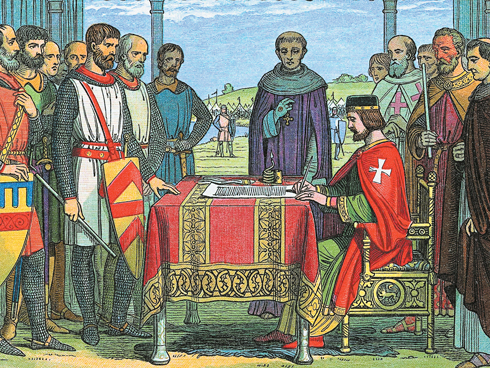
The engraving of E. Evans based on James Doyle “King John and Baron” (1864), the memorial complex Running Mede
Lust, love and howl-it is they, according to the novels and ballads of that time, ruled England of the 13th century. However, as showed by the Anglo-French war of 1202–1214, the fourth variable came to the forefront-money-money.
King John Larkland ( John Lackland ) loved to fight with the French king. Or depict a war, sometimes, under the pretext of conducting hostilities, collecting money from the barons, and for evasion of service even taking the land in favor of the crown. Property taxes sometimes reached a quarter from the value of property itself. The new tax, introduced after the defeat of the Royal Army near Buvin on July 27, 1214, finally infuriated his Majesty: they demanded, in modern language, a report on expenses. It all ended that the king’s vassals considered himself free from the oath of the sovereign (John promised to sign the demands of the barons and deceived them) and on May 24, 1215, they triurized with troops in London. The sovereign realized that he was losing power and was forced to enter into negotiations with them. So, on June 15, in a meadow specially designed for collective discussions ( Running Mede, or Runny Med , from the Saxon Runne - advice), on the right bank of the Thames, not far from the royal castle of Windsor, negotiations with John were held. The obligation to observe the coordinated charter was fixed by the mutual oath of the king and barons.
The document was regulated, as now, of very specific issues of relations within the elite of England of the 13th century. However, the principles laid down in the Great Charter of Frequences, as it turned out, were of timeless importance. Moreover, they formed the basis of the subsequent development of many democratic principles on which today's Western civilization rests. According to the definition of Soviet historical science, the adoption of the Charter testified to the “victory of the feudal reaction”, but in a strange way this victory helped to introduce such fundamental norms as restricting absolute power, protecting the rights of property rights and human rights, immunity of the individual. The introduction of these principles and the struggle around them stretched for centuries. 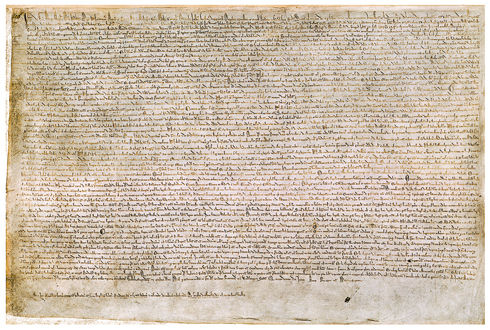
Centerbury stories
John the landless did not do anything that the rulers would not do before him even after: he identified himself and his personal needs with the country. Well, maybe a little more than was accepted in England of that time. For example, six years before the Charter, he quarreled with the Pope and was excommunicated from the Church, in response to which he confiscated the church lands, having run into the actual strike of the clergy, which means, to the suspension of everyday life, consisting of the consecration of births, marriages and deaths.
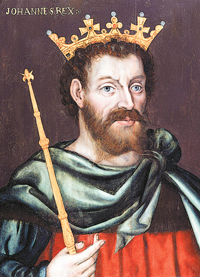 |
| Portrait of King John the Land. The work of an unknown artist, 1590–1610, London, National Portrait Gallery |
A few years later, the holy throne promised John that in case of continuation of atrocities, he would be deposed by the French king Philip Augustus and replaced by his son Louis. The “world government” in the person of Pope Innocent at that time was effective, and John the landless publicly recognized his mistakes. The Archbishop of Canterbury Stefan Langton removed the excommunication from the king, but John had to compensate for the damage - naturally, taxpayers were supposed to pay for him again. Starting from the end of 1214, the barons and knights tried to convince the king that he was wrong, and demanded the restoration of Status quo , in particular, the former liberties of Henry I, the youngest son of Wilhelm the conqueror and the king of England (1100–1135). The intellectual and PR part of this process was accompanied by precisely the Archbishop of Canterbury - he was responsible for the romanticization of the good old orders of the times of Henry I. As a result, the narrow -minded demands of the barons acquired the meaning of a national program. What was confirmed at the very moment when, after the king’s refusal to satisfy his opponents' requirements, London citizens joined the rebellious “elites”: the social base of protest expanded sharply, and John actually lost power. And he was forced to agree to negotiations.
Agreeing to accept the charter, John soon refused its performance, the struggle continued, he died at its height. On November 12, 1216, the first confirmation of the action of Magna Carta and its first insignificant edit followed in Bristol. From this moment and at 1416, the action of the Charter was confirmed 32 times. Almost always, the subject of disputes were attempts to kings to collect taxes on military expenses. And in these conflicts of kings and nobility, English democracy “cracked”.
In the work “Property and Freedom”, historian Richard Pipes notes that “these concessions have long been recognized as historians as milestones in the way of education of fundamental guarantees of private property in England ... in the absence of his own means, he ( king. - NT ) could not effectively exercise power without the consent of his subjects. This principle was firmly established before the mid -fourteenth century. It is this principle that this dependent position of the king served as the origins of the impressive career of the House of Commons. ”
The right to an uprising
The distribution of more fair “weights” of the authorities of the king and barons is the meaning of the struggle around Magna Carta . The Charter, which John Hasless accepted, but, as it turned out, did not think to fulfill, significantly limited the royal power.
The General Council of the Kingdom ( Commune Consilium REGNI ) and a committee of 25 barons (including the mayor of London) stipulated by the charter could be evaluated as a certain proto -Parliament that could force the monarch to certain actions or to refuse to actions. In the event that the king violated the agreement, the vassals received, in fact, the right to an uprising - the occupation of royal lands and castles, up to the satisfaction of their legal requirements. (This is the law that suffered by life - if the sovereign encroaches on the life and property of his submitted, then they have the right to remove him from power by constitutionally, that is, through elections or even violence, that is, to raise the rebellion, in the 17th century it became the most important position of the “two treatises on the rule of the philosopher John Locke, the teachings of which the teachings of the most essential way affected the documents of the new world.) The king and his family remained inviolable in such a situation.
The possibilities of the financial and fiscal arbitrariness of the king were limited. The requisitions that were not provided, as they would say now, by the current legislation, could be established only with the consent of the vassals. The possibility of arbitrary fines was limited. The “shield” money (in simple way, a bunch from the service) could be charged only with the consent of the general council of the kingdom. Limitated were also limited by the rights of the relationship between the vassal and the overlord. the king (for example, the rights of custody, the right to marry widows and orphans).
London and other cities returned their traditional city liberties. The Charter approved the freedom of movement and departure necessary for trade and fishing, including foreign merchants.
The principle of proportionality of punishment of the deed was approved. Justice, according to the Charter, extends to everyone - no one can be denied it. The main thing, according to the famous 39th article, is that no free person can be arrested, ruined, disadvantaged, declared outside the law, except by the court verdict (“sentencing himself equal”) and in accordance with the law. This article stands on a par with another principle of English law - Habeas Corpus , according to which any detained person can submit a petition to issue a decision that orders him to deliver him to the court along with evidence of the legality of detention. 
Despite the complex fate of the Charter as a tool for the struggle of feudal lords with the royal power, Magna Carta, which was then also called Magna Charta, predetermined a kind of “rut effect” in the democratic development of England and the western civilization itself. “The effect of the ruts” - in a good way, when generation to generation is not inferior and disadvantages, but on the contrary, the pluralistic principles of the state and legal structure that contribute to development. In 1265, only half a century after the emergence of a charter of liberties, the first elected parliament was established in England. More and more estates were drawn in decision -making, and the restriction of royal power became an axial structure of English history.
According to American economists, Daron Ajemoglu and James Robinson, Magna Carta established the "basic institutional foundations of constitutional rule." Moreover, the Charter has become a symbol of movement in this direction. The chartist movement, which began in the 1830s the struggle for the expansion of electoral rights, in its name and in the methods of its struggle symbolically inherited the Great Charter of Frequencies. Ajemoglu and Robinson consider the development of such institutions the most important source of success of states. In their opinion, in England and France, where the glorious revolution (1688) and the Great French Revolution (1789) took place, "laid the traditions of parliamentarism and the division of power that referred to Magna Carta in England and to the meetings of notabers ( noble people who advised the king. - NT ) in France."
The Charter itself owes its birth not only, expressed in Marxist, “ripening of conditions” for a more democratic structure of government, but also by the fact that the monarch brought to the handle the country and ruined relations with the elites, which demanded from it the most freedoms and better quality of management.
As Francis Fukuyama notes in his work “The Origin of the Political Order”, due to the fact that the barons demanded from the king the establishment of the principles of the judiciary and the protection of the rights of citizens of London and some other cities and burgers, it turned out that it turned out to be a representative of the interests of a wider community. What distinguishes Magna Carta from another important document of the era - the golden bull of 1222, granted to the Hungarian king Andrash II. In terms of content, Bull was like a charter of liberties, but did not become the basis for the development of Hungarian freedoms. The reason, according to Fukuyama, lies in the fact that if the English barons protected the interests of “all” from the abuses of the royal power, then the inspirers of the gold bullla - the Hungarian petty chivalry, royal soldiers, representatives of the castle garrisons - defended their “narrow -face” interests exclusively. As a result, Bull, unlike the charter, turned out to be a dead end branch of the development of rights and freedoms.
In order for modern democracy to be born in the meadow among Thames eight centuries ago, it took a kind of “coercion to freedom” by the advanced layers of society. Historical progress was not pushed by white, but literally iron gloves. And they moved the barons not elevated ideas about the image of the desired future, but quite mercantile, mundane interests. It turns out that not only a free market is born out of selfish interest, but also a political system. Democracy is, first of all, it is convenient and profitable, and historical development is a history of involvement in the management of increasingly wider segments of citizens. The plots that the World History tossed after 1215, to that guarantee.
Photo: Wikimedia.org