
Translated material
Choice of Britain
Interaction with the current Russian leadership is hardly possible - officials in London are already talking about this.
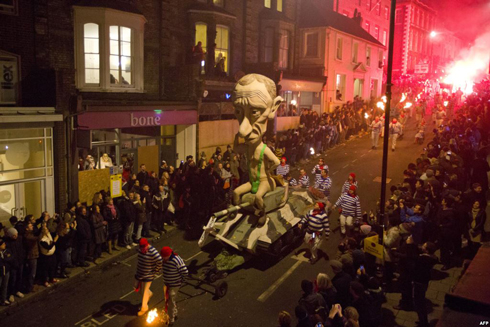
During the traditional celebration of Night Guy Fox, which, in addition to Known as a night of bonfires on foggy Albion, activists and participants of the event carried a stuffed Russian president, who was put on a fake tank with a green swimsuit dressed on him.
The official London concluded for himself: since 2014, Britain and the EU have dealt with a new Russia unusual for them, and the Western strategy will have to be built from scratch. “Previously, we thought that we could become strategic partners, that we have common values and interests against the backdrop of growing world threats. The events of 2014 (the annexation of Crimea, the war in the Donbass. - NT ) completely overturned these ideas, ”said, speaking in the UK parliament, organized by the Henry Jackson Society Research Center, Director of the British Foreign Ministry and Central Asia, Michael Tetham. According to him, the West now deals with Russia, which adheres to "fundamental opposite values."
Lessons of Georgian and Soviet
A similar conclusion, according to the official of the office of the office, is based on two observations. The first concerns the obvious narrowing of political rights and civil freedoms in Russia itself, the second is Russia's politicians in relation to its closest neighbors from among the countries of the former USSR. “We (the West) consider them (CIS countries) as free, independent states that choose their future,” said Michael Tatem. - For Russia, as shown by the events of last year, we are talking, first of all, about the "sphere of influence." The neighbors of Russia should still demonstrate their complaisance, otherwise they receive a military invasion in response-as in Ukraine last year or in Georgia in 2008. The Soviet Union also resorted to the same methods, forcing the countries of Eastern Europe - in 1956 (in Hungary) and 1968 (in Czechoslovakia).
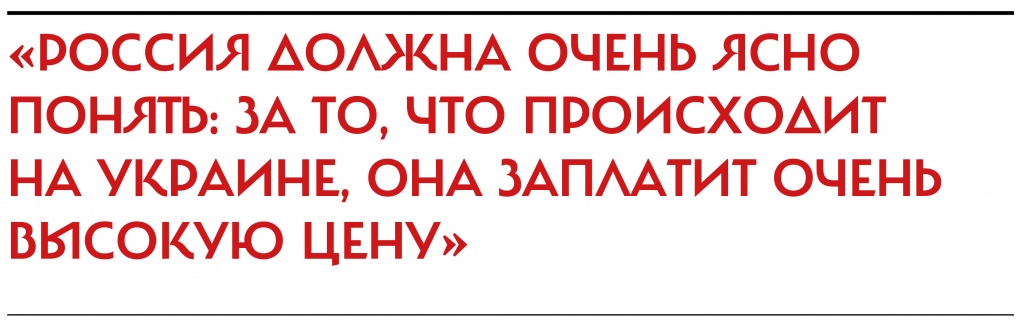
The British diplomat recalled that in 2008, after the war in Georgia, Russia's relations with the West quickly returned to their previous channel. Meanwhile, the West would have to extract a lesson from those events. If, for example, the Western reaction to events in Ukraine will not be fundamental enough, then Russia will decide that now, as then, in 2008, everything slowly-and-aimed to a foal will suck and return to its circles. “Russia should very clearly understand: for what is happening in Ukraine, it will pay a very high price,” Tatem said.
The policy of the EU and NATO in relation to Russia should be unified and coordinated-“we must multiply the efforts of each other”, so that in Moscow they do not have illusions regarding the possibility of splitting the Western Union, whether it be a regime of sanctions in relation to the Russian Federation or the application of the “one for all and all” principle in case of aggression against one of the NATO countries. “The Russian leadership should have no doubt that the alliance members will strictly adhere to the principle of collective defense,” the diplomat emphasized.
However, despite the lack of common values, the isolation of Russia is at least unreasonable, Tetham believes. “There are still areas where it makes sense to work with Russia, responding to general challenges: Iran, non-proliferation of weapons, the fight against terrorism, Syria ... A realistic view of things tells us: Russia should be part of an international response to these challenges.” In addition, the official made it clear, in the context of deteriorating interstate relations, one must try to maintain cultural and humanitarian contacts with Russia to the maximum.
How to be? No way
In expert circles, Michael Tatem’s performance was described as almost software and “installation”. In addition, it sounded only a week after the report of the British Institute of International Relations (Chatham House) on relations with Russia was published in London. The countries of the European Union, emphasized in the report, underestimated the danger emanating in recent years from Russia. At the presentation of the document, his authors emphasized that they aimed at “helping the West to understand the way of thinking of the Russian leadership” and public sentiments prevailing in Russia: “What are the reasons for such dramatic changes? What's happened?" This is all the more important that only a few years ago Russia was considered by the European Union as an equal partner.
It seems that British experts and officials already have an answer to another key question: how to further behave the West with Vladimir Putin and his environment? The answer is extremely laconic: no way. Of course, just in case, it is better to keep the doors for interaction with Russia open, but really such interaction is possible only after the change of leadership in the Kremlin.