
Translated material
Reserve greatness
Inflationary targeting in Russia, as it turned out in May 2015, has its own national characteristics. In addition to reducing inflation to 4% in 2017, the Bank of Russia now has another goal - buying a currency by $ 150 billion at the least until 2020. For what?
Most likely, the idea is imposed on the Central Bank: the replenishment of reserves to the pre -crisis “comfortable level” of $ 500 billion will not necessarily reduce the reduction of the ruble and accelerate inflation, but sharply increases the risks of any projects in Russia that do not have an export prospect.
Intrigue
By definition, frequent news from the Central Bank is bad. The main product that the Central Bank trades is the belief that nothing will happen to your money, and the news is useless here. However, when from May 13, 2015, the Bank of Russia suddenly began to acquire $ 200 million a day in the open market, this caused only analysts to grumble: again they were afraid of something, and, as always, at the wrong time. The dollar rate then fell quite quickly and even “touched” the level of 50 rubles/$, and the market was rather glad: the unexpected strengthening of the ruble, of course, is better than unexpected weakening. In principle, it is even good that the Central Bank fulfills it in September 2014, in the transition to “inflationary targeting”, a promise to prevent sharp jumps in the course. Of course, it would be better if this obligation were manifested in February-March 2015, when the ruble fell, but so good.
Analysts said gloomily: no, this is some kind of profanity. When the Central Bank buys $ 200 million a day in a row in a row - this can hardly be called a free swimming ruble. Yes, we know that, according to the Autumn Report of the IMF, out of dozens of central banks of the world, announcing that they are now busy only stabilizing inflation, and who provided the national currency in relation to other currencies more or less freely (all this is called “inflationary targeting”), only ten, in addition to the Fed, do it quite honestly. From developing countries on this list is only Poland and Mexico. All the rest in one way or another carry out currency interventions. Even the homeland of “inflationary targeting”, New Zealand, intervenes in the work of the currency market as necessary. But we said in Alfa Bank, and in Sberbank, and in ING, we see: not the case at all.
Only on May 27, the first two deputy representative of the Central Bank, Dmitry Tulin and Ksenia Yudaev, speaking in the State Duma at the ordinary meeting of the relevant committee, unexpectedly confirmed: well, yes, the wrong case. No, the Bank of Russia does not at all abandon the policy of the floating course. May operations to buy currency were not called upon to influence the ruble exchange rate to the dollar and euro. They are needed to replenish the international reserves of Russia under the management of the Central Bank. Wait a bit and we will tell you all.
About a dozen performances of the head of the Central Bank Elvira Nabiullina and her deputies in the following days (mainly at the banking forum in St. Petersburg in early June) confirmed that there is the news. The policy of the Bank of Russia in relation to the exchange rate of the ruble is changing again, although everything will be done to pretend that there are no changes. 
There are two reasons for the transition to inflation targeting. In recent years, most of the countries choose a floating course, trying to curb inflation. A smaller part chooses it forcedly: when the country for some reason ends with international reserves, that is, reserves of currency and gold that can be sold to maintain the course, there is no other option. The collapse of the course in this case is still inevitable, and the curbing of future inflation is possible only with a floating course - default on state debts is also an option, but obviously losing.
It is difficult to say which option in September 2014 chose the team of Elvira Nabiullina. In theory, it can be assumed that the Central Bank already in the summer of 2014, after Russia's annexation and international sanctions, foresaw that when the previous policy continued, there would not be enough reserves to withstand the alleged outflow of capital when maintaining a course at the usual level of 30 rubles/$. But formally, the first option should be chosen: the reserves of the Central Bank then amounted to $ 450 billion, which according to all criteria is more than enough. According to Ksenia Yudaeva, the IMF methods suggest that Russia, with its low external state debt and the current amount of GDP and involvement in foreign trade with a floating course of the ruble, is enough of $ 188 billion reserves. However, Ms. Yudaeva states, this level for Russia is “uncomfortable”: the country is “used to” the level of reserves of $ 500 billion and therefore intends to restore its reserves to this figure.
Dmitry Tulin also adds a temporary parameter to this: if in early June the reserves amounted to $ 350 billion, then he intends to bring them “for three to five years” to $ 500 billion. Another deputy head of the Central Bank, Sergey Shvetsov, supplements this formula with another condition: the Bank of Russia will implement this program in moments when this does not interfere with monetary policy. The main goal is to reduce inflation to 4 % by 2017 due to the long -term restriction of the growth rate of the money supply (M2). An increase in reserves by $ 150 billion by 2018–2020 is a secondary goal in comparison with the main one.
In theory, this is also inflationary targeting. However, the purchase of a Central Bank from $ 2.5 billion to $ 4 billion per month with the release of the equivalent volume of rubles (at the rate of 1.5-2 trillion rubles a year) is an important amendment to ideas about the future monetary policy of the Bank of Russia.
This can be called "free swimming with a strong underwater course." The guaranteed acquisition of the Central Bank of the currency revenue of Russian companies by $ 30-50 billion per year, perhaps, will not change the nature of the monetary policy of the Bank of Russia. But it will inevitably change the structure of the market itself. 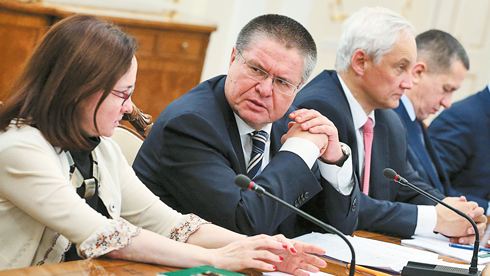
Goals and means
From the explanations of the Central Bank, several possible ideal scenarios for the implementation of the Two Targets policy follow: $ 500 billion of reserves no later than 2020 and 4 % of inflation no later than 2017-these are precisely two equal goals of monetary policy. At the same time, to increase reserves by 10 % per year even with a trading balance (which in the conditions of a floating course will never be too large) is possible only if the country retains some stability of the financial system - a decreasing or at least stable inflation is a necessary condition for the implementation of such a program.
As of May 2015, the money supply in Russia amounted to 32 trillion rubles, the annual rates of its growth were 6.4 % per annum. In 2015–2016, according to the forecasts of the Central Bank, this indicator should grow (in the basic version) by 7 % maximum per year. In 2017, at the intended strong recovery growth of the Central Bank, it suggested an increase in the money supply by 16–20 %. At a smaller growth rate of the economy (1-3 % of GDP per year) in order to maintain inflation at the level of 4-5 % per annum (in 2017–2020), the Bank of Russia cannot increase the amount of money in the economy faster than 12-15 % per year.
At the same time, for the Central Bank, purchase a currency on the market at an average rate of 50 rubles. For $ 1, one way or another means providing sellers with an equivalent amount in rubles is 1.5 trillion rubles a year in the scenario, when the Central Bank provides a “comfortable” level of international reserves by 2020, and 2.5 trillion rubles - if $ 500 billion is required to have 2018 for the presidential election. Accordingly, in the CB cash program, 5–7 % of the increase in the money supply is reserved under the replenishment of reserves. If the calculations of the Central Bank are correct, then the provision of rubles per dollars in 2015-2016 should completely abulfate the “natural” increase in the money supply, and in 2017 it should reduce it to the level of 2014.
It doesn’t matter where the Central Bank will come from from these rubles. With such large-scale purchases of currency and while maintaining the purpose of inflation, such a policy will mean the constant deficiency of ruble (and not foreign exchange) liquidity of the entire economy, except for exporting companies. Any other business will be in the flight: lending to the domestic market for the sake of inflationary purposes will be reduced exactly by the amount for which the Central Bank considers it necessary to increase reserves.
Ruble vs $ vs barrel
The idea of “comfortable reserves” should not be particularly affected by the ruble exchange rate to the dollar. Obviously, the constant, monotonous and predictable ruble interventions of the Bank of Russia for three to five years will not allow the ruble to strengthen. With a sharp rise in price of oil and the ruble attempts to strengthen the Central Bank, it will simply execute its program ahead of schedule, and with a strong drop in oil prices, apparently, a change in the currency regime in Russia, the introduction of restrictions on the export of capital, the rejection of the convertible ruble, etc. But in general, the idea of the Elvira Nabiullina team looks like a ruble rate, as well as inflation, more or less neutral.
What cannot be said about the economy as such: in Russia, in recent years, it has been oriented to ensure that liquidity in the banking system was always slightly redundant. 
The amount of the outflow of capital during the currency crisis of 2014-2015 from September to May is definitely no accidentally equal to the amount that the Bank of Russia intends to buy in the open market - $ 150–160 billion.
The question is not only what they are afraid of, but also who is afraid. Attacks on the ruble are quite possible, and reserves in a half-trillion dollars will really make it possible to withstand almost any “attack” on the national currency of Russia even in that fantastic case, if such attacks occurred to not the leadership of any particularly untied hedge, but, for example, the government of Saudi Arabia, Australia or Switzerland (“power” of Denmark, Poland or Mexico enough). Let us leave on the sideline the question of which rugs all of the above countries would take the destruction of the domestic monetary market of the Russian Federation, but we note that if the US Federal Reserve, the European Central Bank, the National Bank of the Chinese People’s Republic, will immediately take such an attack on such an attack, then $ 500 billion in the reserves of the Bank of Russia to repel such an attack is still not enough.
The assumption is more rational that the “comfort” of reserves means a guaranteed opportunity to pay for the external debt of Russia, including the corporate sector, in case of intensification of sanctions from the OECR countries. True, this explanation is a little slyly: it is quite obvious that with such sanctions the authorities of the Russian Federation is cheaper and easier to prohibit companies to repay external debt (which, we note, was the only intelligible threat to the European economy from Russia in the midst of the crisis of 2014-2015 - and this issue was discussed in the EU with all seriousness).
It has to be assumed that Elvira Nabiullina and all her deputies have nothing to do with it: the idea of “comfortable reserves” seemed to be launched on Neglinka from above, from the Security Council of the Russian Federation, which has recently been glorious by such decisions, if not directly from Vladimir Putin. That is why the Central Bank cannot publicly discuss the rationality and the need to build up reserves-especially since more recently the Central Bank stated that this year its reserves will be reduced by $ 50 billion, in the next one-not to change, and in 2017 they will grow by $ 30–40 billion.
And this means that in the coming years the pressure on the leadership of the Bank of Russia will increase many times, and everyone will put pressure on it - not excluding the president.
The luck of the Central Bank will mean some support of export, including non -resource, low inflation in 2017, the ruble at the current course and, alas, the continuation of the concentration of the public sector in the economy and state banks in the banking system. The failure of the Central Bank will turn into a transition to inflation at the level of 10 % per year and above, guaranteed by the reducing of the ruble even with stable oil and direct negative impact on economic growth.
I would like to wish good luck to the Central Bank, but in this case it is very necessary for us all.
Photo: Anton Belitsky/ITAR-TASS, Ekaterina Stucina/Press Service of the Government of the Russian Federation/TASS