
Translated material
Konstantin Sonin: "Propaganda works when it falls on the prepared soil"
The “tragic belief of history”-so once experts characterized Germany from the time of the Third Reich. How will historians describe the present Russia? How to explain why the country again chose the path of confrontation with the civilized world?
It is known: the democratization process is directly related to access to information when people get the opportunity to evaluate and choose alternatives. That is why, with the advent and widespread spread of the Internet in Russia, it seemed that there could be no serious rollback back: either the authorities would cover the network, or people would wake up and be horrified from the perspective to be behind the iron curtain. But what happened in our beloved Fatherland seems completely inexplicable. There is access to the Internet, alternative information, but the country, clinging to the television box, swallows the rushing from the screens, without even trying to check the contents for its adequacy of reality. The Internet lost television propaganda. How can you explain this?
The last year it exactly makes us think that information is not such a simple object as it seems. And the ability to receive it is by no means equivalent to dispose of it. The economists have long noticed this. It would seem that all financial markets are explored, information for players in these markets is full, but what and how people sell and buy is not always adequate to this knowledge. Sometimes there are some simple, momentary incentives and patterns.
The same here: the experience of 2014 showed that the fact that the information is available does not mean that it will be somehow used. Firstly, the same information means different for different people-depending on the picture of the world that has already developed in their heads. Secondly, receiving new information, people build such an image of the present and the future that corresponds to their preferences. The information itself, like bricks for construction: what is suitable - we take, the rest is rejected.
But this does not mean that everything can be planted through the TV. Let's try such a model as an intellectual experiment. Imagine that the same resource that was spent on promoting war in Ukraine and the accession of Crimea would be spent on giving the Rostov region to Ukraine. Would we give the Rostov region to Ukraine? I am sure that they would not give it. This means that propaganda works when it falls on the prepared soil or on some previously unclaimed, but living preferences.
Propaganda acts when it falls on the most “chipper” beginning of mass consciousness. I think that in any country, a politician, if desired, can begin to exploit an aggressive beginning in a person. But not everything is going to hold the authorities for this.
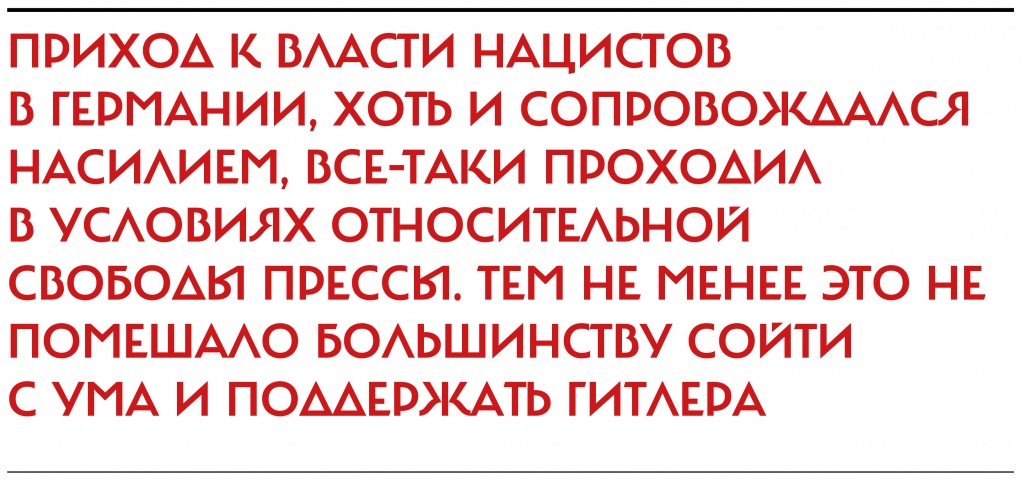
It seems to me that we have to reconsider the importance of physical access to the obscene sources of information, to the free press. We now see that there are things deeper than that. And they could have understood before. For example, the coming to the power of the Nazis in Germany, although accompanied by violence, nevertheless took place in conditions of relative freedom of the press. Nevertheless, this did not prevent the majority from going crazy and support Hitler.
However, the study of Catherine Zhuravskaya with colleagues showed that when the Nazis gained control of the State Radio, this gave them an increase in 1.2 million votes. And when the radio was not yet at their disposal, Goebbels published 22 thousand records with the records of Hitler's speeches: obviously, verbal propaganda is easier to “read”, remembered, penetrates into the subcorta.
I'm afraid that I will express a consideration that may seem trivial. We grew up in the conditions of information closed the USSR, and therefore the discovery of access to information seems to us a particularly significant fact. But apparently, the regime was not closed. And perhaps the role of publicity in his destruction is exaggerated. Perhaps other, parallel processes led to this.
Pandora's box
Remember the Arab Spring. The media wrote: at first there was a word, and this word was Twit.
Mass performances, spontaneous uprisings took place long before the invention of the Internet and even before the invention of writing. Twitter facilitated the access to Tahrir Square, but not the fact that crowds of people would not have gathered there without him. I would not even overestimate the role of social networks in the collection of protesters in Bolotnaya or on Sakharov Square. And without Internet mobilization, it would have come no less. It is enough to recall the grandiose rallies of the late 1980s: leaflets were laid out into the mailboxes, printed on writing machines under a carbon copy, and hundreds of thousands of people were collected-and much more than today using the Internet.
We put forward a bold hypothesis that publicity was not related to the fall of the Soviet regime. Perestroika - yes, the law on cooperatives and unsuccessful economic reforms - yes, economic stagnation - yes. But publicity - no.
I have the feeling that the people missed propaganda. The large-scale celebration of the 70th anniversary of Victory caused an explosion of enthusiasm, everyone watched old films, listened to old songs. And what prevented it from doing this before? I went, bought a disc with a movie or a song and celebrate yourself! No. I wanted this to be transmitted on TV. So with propaganda. It is implicitly her current topic corresponded to expectations: how everyone does not love us, and we, too, are especially crests and Americans. And all Jews and liberals are to blame. And this very well fell into the political goals of the country's leadership.
I think. What if, for example, to Alexei Navalny or Vladimir Ryzhkov give full access to the TV, then they will be able to achieve universal approval on such a topic as "let's condemn and plant Yakunin with his fuckers." But if you give the whole prime time to justify the need for a legal society, that is, a fair and independent court, compliance with parliamentary procedures when adopting laws, ensuring real competition in the market-all this will go into the void and no propaganda resource will help.
Moreover, today's regime with his frenzied propaganda opened such a Pandora box, full of hatred that it would not be possible to close it with the subsequent regime. We had a conversation with Mikhail Borisovich Khodorkovsky on this subject. I say: “Imagine that you will come to power under the slogans, suppose, the fight against corruption. The people will demand from you to plant all corrupt officials. Will you plant? " “No, everything will only be through the court independent of me,” Khodorkovsky answered. “But the people will still want you to decide who and how much to plant,” I objected. “And your arguments about the court will be perceived as weakness: the people want an immediate punishment, and you offer an adversarial process.” We have an unpleasant situation: any subsequent leader will turn out to be a hostage to the current preferences and expectations to some extent.
We return to the old discourse of political philosophy of the XVII - XVIII centuries: a person is inherently bad or good. Well, yes, bad, wild beast, if you do not scoop it with flags. But humanity learned to cope with this, building institutions. As Kant said, "the republic can consist of devils, if there is a law."
The wild start is not the main thing. We also need politicians, we need an elite that can decide to exploit this savagery, or may refuse it. And my thesis is that many politicians just want to play this wildness. But we know examples when something stops politicians-even with all their desire to seize or maintain power. For example, Great Britain did not fight for lost India. Although it is easy to imagine an alternative story: the forty -fifth year, the British army, trained in six years of the war with Hitler, is going to conquer lost resources. Churchill - he could go to the elections of the forty -fifth year with this slogan (which he lost): “We will not give the heel of Indian land, sprinkled with blood of British soldiers of three generations!” There was an opportunity to wake up a variety of feelings: they would say that India was a “fifth column” in the anti -Hitler coalition, that Raja secretly supported Hitler, etc. 
A crafty figure
This seems very important, it is useless to lament about whether the people are good or bad, enlightened or dark - it is necessary to appeal to the enlightened class, to the elite. But here's what is curious: among the ardent supporters of Putin, “Crimean”, wars in Ukraine are a huge number of those who do not pay taxes and easily receive a salary in envelopes. It would seem: a strong army requires a lot of money, support your favorite power, pay taxes. In response: “What is the point? They will still steal everything anyway. ”
This is one of the mystical things-the constantly emerging figures of the great support of Putin, and at the same time, in the reality of these disinterested fans of his politics is not so easy to see. In my environment, there are also those who support Putin, but - for money. In general, sometimes it seems to me that this support is some kind of imagination. How much Putin can collect for a rally if he simply turns to people on TV, without an administrative resource, without all these buses, which supposedly bring his ardent supporters! I suspect - a thousand.
But then what do we call popularity? Our President’s popularity is such a specific popularity. If sociologists ask a person, whether he supports the president, he replies: yes. In all other relationships, it most often does not support. Complains about life. Scolds officials. He cannot stand the deputies. He believes that everyone is stealing in power. In a word, in everyday life - solid "no", but during the hundredth care "yes."
The beneficiaries of the regime
Every regime has its own StakeHolders - beneficiaries. Who are the beneficiaries of the current regime?
I would say that these are quite wide circles of all those associated with security and the military-industrial complex.
That is, we are witnesses to the revenge of those forces who lost power in 1991, right?
When you say “revenge”, it turns out that we are talking about some kind of decorated power. But here it is more likely to talk about the social group, and these are quite large beneficiaries of the regime. Plus, now we are growing another largest beneficiary-a new military-industrial complex. For him, 2014 was a “holiday that is always with you”, and this holiday will continue.
Recently, I saw a figure in the news feed: 4 million Russians received recommendations at work not to go abroad on vacation. The upper level of the bureaucracy plus special services plus the military - this is 4 million. This ban on departure is the identification of a group of beneficiaries. Add families - you get almost a tenth of the voting population. This is a lot.
But I would like to draw your attention to another fact. Look, the most important decision on the accession of Crimea was made at a small meeting, without the participation of representatives of the economic and financial bloc. This is a sign of dysfunction, a malfunction in the public administration system. As a result of this dysfunction, we fell into a very difficult situation, which has an unpleasant internal logic of development.
We actually have an army leading military operations, plus we still have, apparently, some kind of super-supervision building that this army looks like it is not an army. A huge number of people and even more money are involved in what is happening in the east of Ukraine. And even more-busy in preparation for some fantastic big war. And how to get out of this binding - it is not clear.
Can you estimate how much in rubles that we have been in Ukraine have been in Ukraine for the past year and a half?
I can't. And I can’t even call order. But I think that this is somewhere half a percent of GDP.
So, there was a failure in the public administration system. But why was the results of this failure to disperse? The beneficiaries of the regime and without war in Ukraine felt quite well, did not?
Shortly to all people who are in military production, this situation is beneficial. Military production is even more profitable than Olymppromstroy: you can steal more from it, because there are always some layers of secrecy. And besides, all these people received additional argumentation, why they need to give more money.
In addition, the decision -making system at the very top was even more evolved. Now, as I understand it, the main decisions are made by a very narrow group, in which security forces and military are represented absolutely disproportionate. That is, instead of resolving all issues in some body where the most economic and economic ministers have a greater weight, now everything is decided by security forces. But if you are a hammer, everything around you looks like a nail. So for the security forces - they have all priorities only to finance the war even more.
In the eighties in the Soviet Union, economists very poorly understood what was happening, but no one doubted one - an abnormal amount of money and resources was spent on military spending. Nobody ever made decisions on their reduction. In state authorities, the political weight of the military -industrial complex and the military was too great, and they could not decide on their own destruction. For them, this decision was made by 1991 - the collapse of the entire system.
And today, wait for someone from the security forces will say: no, guys, we cannot spend so much on military expenses, distract resources from consumption is naive.
Well, but there is an economic elite: the capitalization of their companies has fallen significantly, do they lose tremendous money?
Or maybe they simply transferred part of the assets abroad, and therefore now they personally have a calmer situation? See how much time our richest businessmen spend in Russia now - significantly less than two years ago.
Military expenses inevitably lead to cutting social articles with all the ensuing consequences - and among those who are now applaising Putin.
When we talk about the budget, we are dealing with metaphors, but in reality the budget is partly rubber, and priorities play a very large role. You can make even more tanks, spend even less on education and healthcare, spend even more on propaganda and double the military expenses. The material will resist, but it will not force Rogozin to bounce to the side. Rogozin will crush. Moreover, he will not make the consequences. As it was, for example, with the Soviet Minister of Defense Ustinov. He crushed and rested, and the consequences later the whole country was shed, which, as a result, collapsed. Now our budget can be pulled like that, so reduce investment projects, so reduce health and education costs that the military budget will double. If you triple, then the teachers will go out into the street, the light will go out in the hospitals - but this is possible. It probably will not be possible to account for accounting. But in this direction you can move for a long time.
And here we need propaganda: the enemy at the gate.
Exactly. That's why I love the example of Slobodan Milosevich. When he was the president of Serbia, the country was reduced by half in size, the standard of life of the Serbs fell twice, more than in our worst points of the 1990s. And in his last elections he scored almost 36% of the vote. Propaganda worked. The exploitation of nationalist aspirations can make people justify big problems and serious sacrifices.
The hysteria associated with the Crimea has subsided, the Novorossiya project seems to be closed ...
I would not say that. There are a lot of stakeholders at the continuation of the Novorossia project. Its beneficiaries are military and military-industrial complex, in addition, there are people for whom this is a way of maintaining popularity. It is obvious that many want to continue the banquet.
Nevertheless, new flights are needed to support a patriotic bonfire?
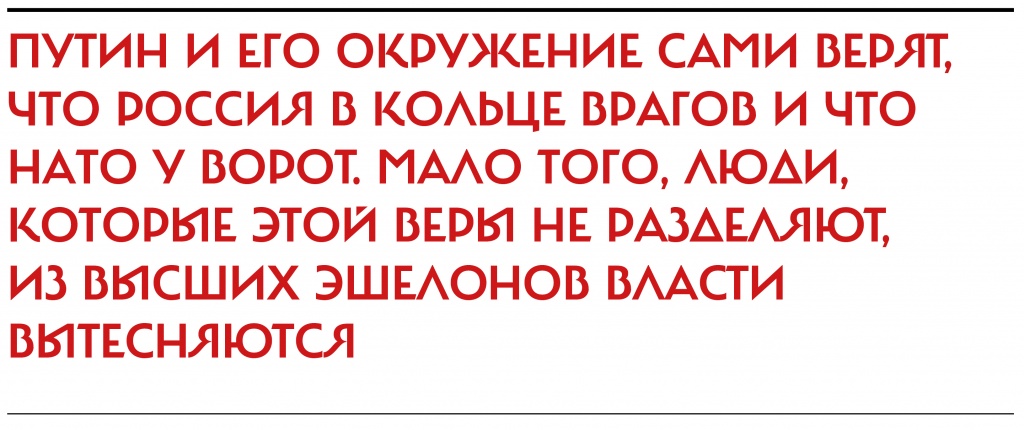
It seems to me that you overestimate the grandeur of plans. I suspect that there is no idea to deceive the population inside the authorities. Putin and his environment themselves believe that Russia is in the ring of enemies and that NATO at the gate. Moreover, people who do not share this faith are replaced from the highest echelons.
In a sense, this effect explains the successes of Dmitry Kiselev. Putin, apparently, is really closer to the average person of Russia than Yeltsin was.
Not only: the more they see that there are enemies around, the more their own stay in power is justified. Like, we are in the trench, we fight against the enemy, and if we leave the trench, the enemies will take our territory. The same motive justifies 10 years of leadership by the state corporation. Huge money is plundered, everything is terribly ineffective, but the main thing is that I am in the trench. Such argumentation allows you to justify everything that happens to me and allow cognitive dissonance regarding what you hear to yourself. And if I leave, then everything will collapse. This model works today. 
Forecast for tomorrow
Which scenario will continue to be implemented?
If there are no extraordinary political solutions-go to Mariupol, Kharkov and Kyiv, which seemed impossible two years ago, and now they seem only unlikely, then the current state in the economy can last another 5-10 years and-without special problems. And then there will be a repetition of the 1991 crisis, a budget crisis and a political crisis. But in significantly smaller proportions. Я не вижу особых оснований, скажем, для развала страны. Но все это будет сопровождаться стагнацией и деградацией политического режима.
Предсказывают, что нас ждет демографическая яма, поскольку в 1990-е родилось мало детей и должно сократиться число работоспособного населения. Но это означает, что активно работающие сегодня будут сталкиваться с еще меньшей конкуренцией, и следовательно, их уровень жизни катастрофическим образом падать не будет. Так что в каком-то смысле даже демографическая ситуация успокаивает ситуацию политическую.
Поэтому вы и решили переехать в Чикаго, что не видите здесь перспективы в ближайшие 5–10 лет, так?
У моего отъезда много причин: и возможность поработать в совершено замечательном университете, и те прогнозы, которые я вам дал, и то, что XXI век дает возможность эмигрировать, не эмигрируя. Я буду жить в Чикаго, но я буду по-прежнему работать в Высшей школе экономики, приезжать, читать лекции. И те люди, которые ценят меня по блогу, газетной колонке и публичным лекциям, возможно, вообще не заметят моего отъезда.
Но пять лет назад вы бы не уехали.
Конечно, не уехал бы. Но если бы выбор стоял по другому: уехать навсегда или остаться, может, я бы и остался. Но поскольку можно ездить и работать и там и здесь, я выбираю отъезд.
Фото: Александр Ермолин