
Translated material
Rustam Ibragimbekov: "In my country, corruption and totalitarianism"
The screenwriter of the cult film “The White Sun of the Desert” Rustam Ibrahimbekov acted as a producer and screenwriter of the new painting “Caucasian Trio”, the theme of which was the relations of the peoples of Transcaucasia. In an interview with The New Times, he told why he took up this topic and how he became an outcast in his homeland, in Azerbaijan
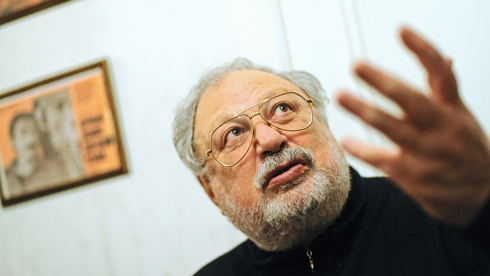
He worked with such star Soviet directors as Vladimir Motyl (“White Sun of the Desert”), Nikita Mikhalkov (“Urga”, “Tired of the Sun”, “Siberian Barber”), Roman Balayan (“Keep me, my talisman”). The classic of Azerbaijani cinema, he has become Persona Non Grata in his homeland since he began to take an active part in politics. In recent years, he has not removed anything, and now - an unexpected return to cinema. At the end of June, work ends on the new film "Caucasian Trio". This is the co -product of Georgia, France and Russia, the director - Eldar Schengela, known in Russia for the film "Blue Mountains, or an implausible story."
Father and son
They say that the film has a character like you. Is that so?
To some extent. This is a friend of the father of the protagonist, who believes that Azerbaijan is building his policy incorrectly, sits on the oil needle and that when the reserves are dried up, everything can collapse overnight if it is not to compete competently to competently build a post -string economy.
What is behind the name "Caucasian trio"?
The trio is an Armenian, Azerbaijani and Georgian. Three friends who are united by a common childhood and youth.
The topic is risky in the present time ...
Many in Azerbaijan do not like my point of view, but I am sincerely convinced that we are not enemies with the Armenian people and sooner or later we will definitely make peace. The peoples of Armenia and Azerbaijan are not to blame for what happened. And I am against aggressive rhetoric from both side.
The film was based on the real situation?
Yes. One of my friends actress married the Azerbaijani and took his last name. She had a son from her first husband, Armenian. The stepfather adopted the child, gave him his Azerbaijani surname. He grew up, became an actor, arrived in Moscow and already in adulthood met and even made friends with his father (he is played by Yuri Stoyanov), who persuaded him to return his real, Armenian surname. It is clear that a terrible buch began. The Azerbaijani mother is outraged: “Everyone knows that your father is an Armenian,” she says to her son, “but no one ever said an offensive word to you, and now you put us all in a difficult position!” Unfortunately, this is true - such a situation in Baku can significantly complicate the lives of people. But the Armenian father insists on his own, not wanting to understand that his desire, with existing realities, can lead to tragedy. This is a purely family conflict, but sometimes the desire to decisively achieve what seems correct, can have much larger scale. For example, the recent history of the accession of Crimea. Like any person who read Sevastopol Stories in childhood Tolstoy, I consider Crimea Russian land. In the days of Khrushchev, he departed to Ukraine. Yeltsin did not solve this issue, although when the Soviet Union broke up, it could have done it quite simply and conflictly. Then for a long time for some reason no one was particularly worried. And now they suddenly quickly resolved this issue, not taking into account the features of the geopolitical situation. As a result, people die. 
How were the relations of artists on the set? Did you play Armenian and Azerbaijani artists?
No. The prototype of the protagonist - as I said, is an artist. I wanted him to play himself in the Caucasian Trio, but relatives banned him. They said: in no case, you will shoot in this film - you will not be able to come to Baku. For the same reason, Georgian artists starred in the film. Several Azerbaijanis participated in the volume, but anonymously. They do not want to bring trouble.
Is it really so scary for Azerbaijanis to cooperate with you?
Until 2007, I had a normal relationship with the authorities. But there were problems with the nationalist press that attacked me for statements about Karabakh. After my story, “The Addition of the Waves”, where the painful problems of Azerbaijan were presented, the authorities also considered themselves offended, they began to pour mud on me, call the enemy of the people, and indefinitely accused of economic abuses. They closed the popular festival "East-West", which I have been engaged for many years, stopped the construction of the festival center. In 2012, I wrote an article “for whom the bell calls” - that in my country corruption and severe totalitarianism around, and more political prisoners in Azerbaijan are more than throughout the post -Soviet space. Then he headed the National Council of Democratic Forces - simply because he could not not do this. I was set by the condition to become a single opposition candidate in the upcoming elections of the President of the country, but due to the fact that I am a Russian citizen, I, fortunately, was not allowed for the elections, and the wonderful historian Jamil Hasanla was nominated in my place. Of course, the former president Ilham Aliyev officially won as a result of falsified elections. Now the situation is such that it is dangerous for me to go to Baku. Once for four hours they kept at the border at the entrance, then two hours away, and I realized that the next time they might simply not let out.
Do you follow Russian cinema?
Yes. There are tough, truthful, strong paintings. I am close to the Leviathan Andrei Zvyagintsev, the “fool” Yuri Bykov, “Gromozeck” by Vladimir Kotta. I liked the film by Vera Storozheva "9 days and one morning." A lot of good things are done, but this is all in spite of. Today, again, as once, cinematic power helps a little to make an honest movie, more often interferes. The most powerful impression is “it is difficult to be God” by Alexei Herman. He does not look like a single film seen before. It will be obvious that the circumstances of life can easily rip off a thin civilizational shell from us, turning into the most terrible creatures on Earth. Herman’s fearlessness delights, but I still profess another cinema that gives hope.
Photo: Valery Sharifulin/ITAR-TASS