
Translated material
Patriotism as a formula for a split
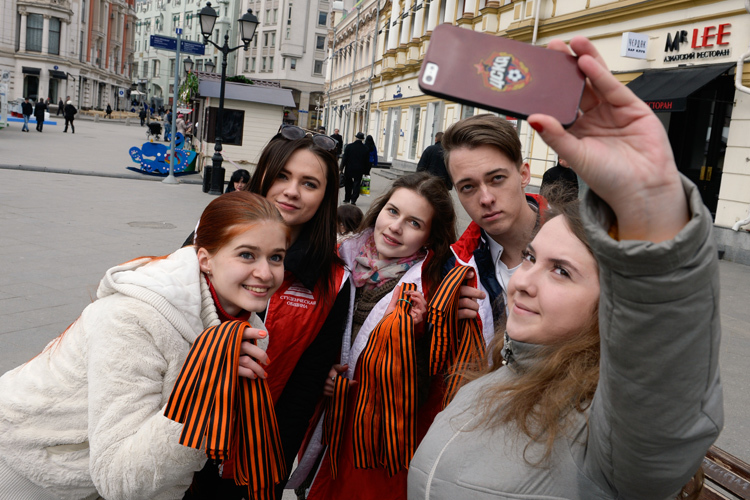
The official course for import substitution, the growth of anti-Western moods, the large-scale celebration of the 70th anniversary of the Victory, the discussion of a single history textbook-all this today talk about the formation of the ideology of "patriotic isolationism." What this wave of a patriotic upsurge in society signals and what it means in the long term, the publicist Denis Dragunsky and political analyst Mark Urnov discussed as part of the Paradise project Yegor Gaidar. We publish replicas of the participants in the discussion.
Denis Dragunsky
writer, publicist
Of course, I have more questions than answers. But, you know, we are now in a very interesting situation. Patriotism in the form in which he is present today is either a rather elementary compensatory reaction to some social, life failures of an individual or group of people, or the state of failure imposed on the whole society. Because in order to tell society that we are patriots, first we need to say that we are on the knees and now we are getting from them. In order to tell society that we are so wonderful, I must say that everyone considers us very bad. And in order to say that everything is fine now, I must say that the whole previous story was a chain of some clams, cliffs or punctures, and only the current leader showed us. Lenin the Great illuminated the path to us. This is the same compensatory reaction as ethnic mobilization or, perhaps, social and class, which also sometimes happens in life.
Totalitarianism is a society of developed social services, where there is free education, medicine, children's pioneering camps. This does not threaten us.
But I am interested in this case in this case. In general, patriotism is what the nation should rally. Not an ethnic group, but a nation, so to speak, Nation State , all political and civil society. But now, in the presence of various parallel means of mass communication - not the mass media, but primarily the Internet, social networks and other things - we see a reaction to these movements of power and the propaganda apparatus. Therefore, now such a rare case when patriotism did not rally the nation, but, on the contrary, it was very sharply disarmed by, because when there is no such powerful concept that would gather people together, then, in general, all people live slowly, all friends, all friends. And here - the White Nerders, the St. George, “our Crimea”, “Crimea is not ours”, friendship breaks up, in families scandals, people do not give hands to each other. Ideological polarization occurs. It turns out such a paradox that patriotism did not rally, but disconnected the nation, even even into such very unequal parts in terms of a well -known ratio of 80 to 20, 4/5 to 1/5 - it does not matter. But in our, so to speak, company 110 million adults are still 1/5-this is a rather noticeable number of people who need to somehow pay attention and who can significantly, say, spoil the lunch.
If you make a forecast, what will happen next, then, I think, ultimately, in forty years, there will be no national idea at all, in principle. This will be over. Ideas will be class, first of all, group, professional, religious, maybe. But the national idea in the sense of the sovereign territorial state, despite the fact that the sovereign territorial states will certainly not be preserved. And of course, we are not threatened with totalitarianism. Not even because there will be no idea. The fact is that totalitarianism is a society of developed social services, where there is free education, medicine, children's pioneer camps. All totalitarianisms that we have seen are societies of developed social services. Here it is not necessary to cite China or Cambodia as an example - this is a completely different parsley. They exist outside our measurements of totalitarianism. And we not only have no idea, but there is also no dough to send all children to the pioneer camp for free, where the flag will hang. So it does not threaten.
Patriotism did not rally, but disconnected the nation.
Mark Urnov
political scientist
If we are talking about patriotism, then I would distinguish a certain deep phenomenon and what it is called. What is the basis of patriotism? Well, of course, in normal populations - a certain sense of community. In each individual person, these are components of identity, without which, in general, society does not live. Patriotisms, as you know, are different. Here is my beloved Prince Vyazemsky at one time described three types of patriotism: patriotism is normal, kvass patriotism and sivuye patriotism. Here is the patriotism of Sivushny - he is so sedimentary, self -affirming, not seeing anything except himself, rather, really such a compensation for the feeling of inferiority.
What is happening with us now is a very complex, multilateral, contradictory phenomenon. On the one hand, if we want to survive as a society and as a country within its current borders, we must feel a kind of community with each other from Moscow to the very outskirts. Therefore, when, say, in the Far East, people have much more friendly associations causes Beijing than Moscow, I can’t say that it was great. When in many of our Muslim enclaves in the Volga region, for example, part of Muslim youth ceases to meet with the so-called Russian-speaking young generation and ethnic nationalism increases, in my opinion it is bad. When there is a powerful wave of warlike Russian Great Power Nationalism, which, in fact, was called the prince of Vyazemsky Sivular patriotism and which begins to push off the small nations living in our territory, this is very bad. Does this mean that patriotism is generally bad and it needs to be smoked? No, in my opinion.
The most serious problem of Russia is the monstrously low quality of the elite.
One of the tragicomic circumstances of our history is that when the state took on the initiative of the forced formation of patriotism, something unusual, noted by Saltykov-Shchedrin, always turned out, and now we all see this. A rough, very ineffective, narrow-minded, aggressive attempt to form patriotism as a synonym for isolationism, self-affirmation and sitting in proud loneliness in the fortress surrounded by the enemies, which now prevails in the mass consciousness due to the wave of monstrous emotional-modal poison, daily collapses from television shutters-this is one conversation. The fact that all this in no way removes the problem of creating a healthy, calm sense of community in people living in this country is completely different. But the ongoing planting of any horror destroys naturally begins to form a feeling of attachment to the earth and culture.
In this sense, I absolutely disagree with Ortega-i-Gasset, saying that the whole thing is in an average person. It is all about an elite that sets moral values and vision of the world and enriches most of the population with these values. If you asked me what the most serious socio-cultural problem of Russia today is the monstrously low quality of the elite, which is neither in value orientations, nor in education or in the dictionary practically no different from the rest of society. And this means that in society there is no reference group that can pull the rest. Thus, there is no internal impulse for changes in the country. And in order to form an elite, you need a lot of time. This is a generated process, and at least in the third generation with a calm, favorable situation, a high -quality elite can be developed. Today we are very far from this.
But this is what this anti-Western paratriotismism is still dangerous. To date, in Russia, according to the official estimates of Rosstat, approximately half of the equipment in industry has become obsolete morally or physical terms. And according to independent experts, up to 70%. In order to make a technological breakthrough, foreign investments are needed, and not some, but direct, high-quality, and we have them today-0.3% of the gross domestic product. That is almost nothing. Sanctions block the receipt of new technologies, and, apparently, this is a long time. This means that at the level of confrontation, with the help of which I wanted to ensure consolidation around the current elite, we are actually doomed to actually for about 10-15 years, or even 20 technological lag in a rapidly developing technological world. Direct road to the third or fourth world.
According to the official estimates of Rosstat, approximately half of the equipment in industry is obsolete morally or physical terms.
Another aspect. This kind of tension provokes our military elites very much. This is not only with us, it is in any other country: if a tense situation has developed, people want to get more money. Well, they will receive them. But we are in a state of constant reduction in the population. Talking that it begins to grow is absolute mythology: such outbursts of birth rate on a decreasing trend. The population of the population is simply monstrous. Now I have no numbers in my head, but one is surfacing: we have mortality from tuberculosis 17.5 times higher than in developed countries. We have much more suicides than in developed countries, and, unlike other countries, we have more suicides among the young generation than on average throughout the population. What is suicide? According to experts, 90% of suicides are performed because a person suffers from a serious mental illness. Here is such an indicator of a bad state. So, we must somehow crawl out of this. It will not work to crawl out of this with investment, because even if we want, say, to ensure the same per capita costs in healthcare, as in developed countries, we would have to swell into medicine, but this will not happen. Now we have about 5 or 6%go there. In developed countries - 12.5%. But even if we had 12.5%, we would still have a per capita of the population about a third of the fact that now has the West. And the roots of the disease, in fact, in the culture of being. We drink badly, we eat not that unsportsmaning, sitting, evil. It is necessary to change the culture of everyday life, and this is a generated process. So, isolating ourselves from the developed world, we are not just weakening the tension of the problems, but also aggravate them.
The totality of these very long -term, very complex, very complex factors does not allow to soften the current situation. There is a great danger that instead of “we want to be a serious power, we want to be in advanced positions” in the future of about forty, we will not even regional country. In the best case, a country that manages to somehow be on the periphery of the developed world. That is, one of the countries, perhaps, is large territorially, but economically, intellectually and in many other parameters, quite peripheral. But certainly we will not have any serious influence on the policy of our neighbors.