
Translated material
"The profession of the director is secondary"
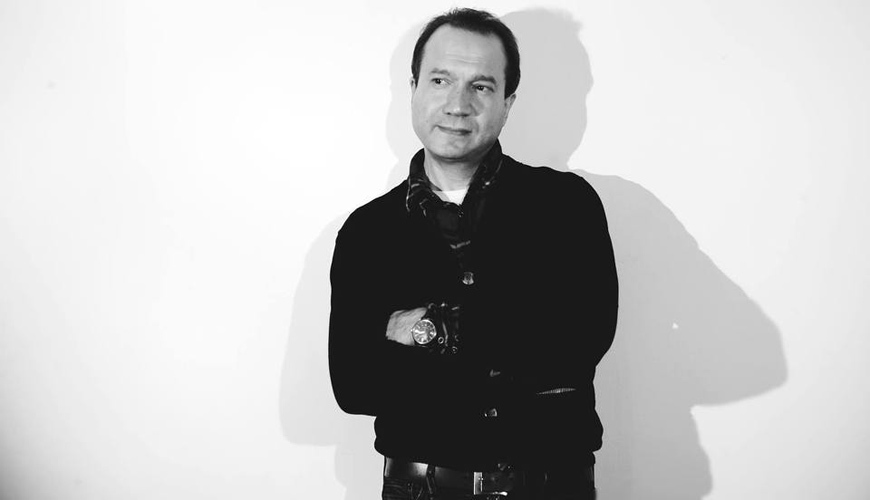
The Moscow Art Theater produces the premiere of "Illusions" by Ivan Vyrypaev in the production of Viktor Ryzhakov. A month ago, one of the leading directors of the modern Russian scene showed in Tsim the preview of the play "Sasha, make garbage!" Based on the play by Natalia Vorozhbit, having handled a 55th anniversary between the premieres. Ryzhakov made his debut in Moscow with Vyrypaevsky oxygen at the beginning of the zero, and today puts in the main drama theater of the country, leads his own workshop at the Moscow Art Theater School and leads the experimental theater center. Elena Kovalskaya talked with him about the search, method and future.
- At the end of the week - the premiere of your "illusions" in the Moscow Art Theater. There are already "drunk" . The main drama theater of the country came with you by the innovative drama of Ivan Vyrypaev , with whom you introduced us in 2002 when you released in the Theater. DOC " " oxygen " . Ivan says that his texts are not philosophy, as it might seem, but something like instructions for using the actor; He is an unconditional person on the stage, a person as he is, and not a character and an actor that has gotten into the image. Therefore, he writes texts leading the actor to such a state in which he reveals himself. I assume that this type of theater is what exactly you infected him as a director. What do you say to this?
- Well, not quite so. Our dialogue with Ivan about the theater is most of my professional life. And it began many, many years ago. We had a period of active interaction, now communication continues in a different form, while we may not see ourselves for a long time, for months. Nevertheless, everything continues-both my dialogue with Ivan, and the thoughts of the “ideal theater”, which we once had a half-playfully-seniorly dreamed of him.
- What did you dream of?
- About the "Theater of Miracles." After all, if a person came to the theater, a transformation must necessarily occur with him. Here he is freed from something, becomes happier, or he ceases to hurt something, or, conversely, begins to hurt, but already differently or about another-but be sure to hurt. The theater that will make us more perfect, or something, is more sensitive to this world, in which we will be surprised at ourselves and our unlimited capabilities, in which we are able to change the quality of life itself.
- New Catharsis technology?
- Well, if you do not be afraid of pathos, then maybe this is so. Such an endless game, which is sometimes even very cruel, sometimes gambling, but always changes your idea of peace and oneself. Changes yourself. All the texts of Ivan are as if the continuation of our reflection on this imperfect human world. The playwright Vyrypaev always offers some new moves in this endless theatrical game-provocation for both performers and spectators. It is important to tighten the viewer into such a game when he himself becomes both a character and at the same time as an artist in his “Inner Theater”. This is the theater of complicity. After all, the theater does not work out on the stage, but in the auditorium, and what we do, we do so that the performance begins its existence in the heads of the audience, and maybe in their hearts. Mikhail Chekhov, when he was asked about the secret of his acting, spoke approximately the following: everything is simple - five minutes before entering the stage, I cause an incredible love for people in the auditorium. But since he was a great cunning, the main secret of Chekhov, of course, did not reveal: how to achieve this very love? Love for people five minutes before the start of the performance ... This secret of philanthropy, along with Ivan's texts, became such a provocation that it is necessary to subject himself to constantly and without which it became impossible for me to exist. Everything that we do seems to me a big game that we were started by us many years ago and suddenly became life itself. Ivan became a recognized author, a figure in the theater world; I watch him and endlessly rejoice at our continued dialogue, dispute; He is the greatest value of my inner labor.
“I ask about this dialogue.” In this dialogue you are a teacher, because older and more experienced, right?
- No. Every time I work with the text of Ivan, it seems to me that now I will grab something, I will understand the adult way. And, as always, I do not have enough patience, strength, mind, or, perhaps, simple knowledge, to grab it all. Sometimes I walk in a circle; I open some things and, turning around, see that they are already open. Nevertheless, I open the “bicycle” and, like a fool, I joyfully swing on it. Then I understand again: I miss something, as if I can’t embrace some simple thing. Now, working with the text of Natalia Vorozhbit, I understand that he went the same way. The theater, created by the drama of Vyrypaev and discovered this very infinity, allows you to let in Natasha there and the play by Sergey Medvedev, the “hairdresser”, and Griboedov’s poetic text “Woe from Wit”, which suddenly sounded in my head in the same way, as well as the texts of Vurypaeva. As if some key to the sound of texts had been determined, and this sound came to me with the texts of Ivan.
If a person came to the theater, a transformation must occur with him.
This began when we only met on the Kamchatka unique land, where I had the opportunity to lead the dramatic theater, and conceived work on the text of Griboedov. Vanya and Sveta Ivanov, who were invited by me to the troupe, played Chatsky and Sophia. They arrived there with a small Gena from Magadan, where they worked for a year, graduating from the Irkutsk Theater School. These holy artists dreamed of a large, real theater. And then our story began. For a year we rehearsed “Woe from Wit” and never released this performance, realizing that we need another, some new, special text. What we sought and searched, we could not comprehend through a classic textbook play, overgrown with our frustrated ideas about the existing theater - despite the fact that he incredibly helped us. Perhaps our experience has become one of the impulses to ensure that Ivan began to write independent texts. We even, indulging, published our handwritten magazine, which ironically called “Bird and Grim”, where texts from our games in Burim and endless collective compositions were born. Ivan was, as it were, our editor -in -chief, which collected very “funny” texts from these absurdities and pampering. The process was irreversible, Ivan went into this world, unknown to me by mystical ways, and the same, inexplicable for me, the ways to it began to come at all “funny” and already serious texts. We parted, he returned to Irkutsk and created his own theater there, where he set his own play “Dreams” with his one-year-old actors. At the same time he entered the Schukin Theater School - we agreed that he needed to continue education, and this became a new turn of our relationship. Still finalizing in Kamchatka, but often coming to Moscow, we made a reading of his new play “Valentinov Day” in “Theater. DOC ”is a space that was only born and was already special and very important for me.
- Then Ivan with his guys moves to Moscow and begins to play in the Theater. DOC »Hallucinogenic" dreams ".
- Yes. And then a year later "oxygen" appears. 2002, end of August. Vyrypaev has several scenes of “oxygen” that violate my usual existence and understanding of theatrical life. We begin to rehearse. And on September 29, we collect the first big audience show. So completely unexpectedly, the text that we thought about and which we dreamed about, working on "grief from the mind" was born. He made it possible to speak openly in front of the auditorium about what worried us and that did not give us rest. Where it was not necessary to hide behind the usual character, but at the same time it was possible not to abandon the great illusion of the theater. All that the artists from the stage spoke about at a deafening pace and with undisguised drive and irony began to be born in the heads of people. Our idea has earned! All this was clothed in the form of a concert. We are like a small musical group. Ivan admitted to his dream: I want to sing. "Oxygen" gave an occasion to tell him: "So you will sing him." This was the final solution: this text must be singing. Then he began to sign up on paper in a special way as a poetic song text.
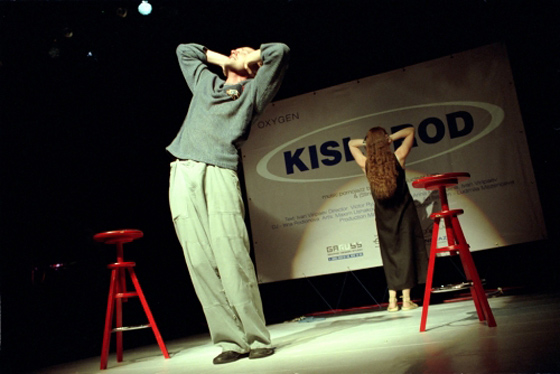 © "Golden Mask" Scene from the play "Oxygen"
- I would like to see a genuine person on the stage, but, on the other hand, not any genuine person on stage is interesting. Agree? Who are your actors?
- It's not about the fact that the actor puts himself on stage. He throws his thoughts about man and our so difficult to comprehensible world. In "oxygen" the story of Sasha and Sasha ends with a big question to the world and to himself - who am I? Both Vanya and Arina (Arina Marakulina. - Ed. ), And Sveta (Svetlana Ivanova. - Ed. ), When she replaced Arina in “oxygen”, were people who came to the stage right from the street, stripped right away, and without theatrical extensions and embarrassment literally shouted an endless series of questions, requiring a momentary answer. We just needed a public and certainly a whole -filled small hall, which then seemed huge to us. It was necessary to create this tension between the hall and us, consciously reaching the stage, in order to scream these important words. There are legends that it was impossible to get to “oxygen” from the very beginning. But there were moments when we called all our friends and friends of friends, we walked along the lanes and literally gathered the audience so that the hall necessarily had the feeling that the same troubled people as heroes gather here, through whom we voiced the thoughts and feelings of the human surrounding world.
- Remember, on the tour of the “New Drama” in Togliatti in 2003, tickets were not sold, and producer Nadia Konoreva took out a box of beer to students who walked at the fountain, and promised beer to those who would go to the performance. And there was a full house. Then the performance was looked at Klavdiev, who later said that after the “oxygen” decided: there is such a theater for which it was worth writing.
- Yes, of course, I remember, it was a very important performance. Slava Durnenkov was also at that performance and then admitted that “oxygen” turned his former life. I remember that we sat at night in the basement of Vadik Levanov for a long time.
- So in “oxygen” on the stage in the first person, the charismatic Vanya spoke - and you were endlessly close to his interests and thoughts. But does it work with other artists?
-In my opinion, it works because the person you see on the stage does not play some role, does not cover the character, but literally dissects himself. After all, it was no accident that our theatrical space has become our theatrical space fixed for a long time - both in “oxygen” and in “Being number 2” and “July”. We always asked ourselves the same question: why are we going out here, what will we play today? I remember once Ivan said: I realized why we pronounce this text - because we cannot but pronounce it. He said this as something scorched. And something happened for me. And then metamorphoses began to occur on the stage with him. Every time Ivan went on stage, he seemed to overcome himself, overcame what it was impossible to overcome in life; So some special, ideal space for an inner scream gathered for their most important thoughts and questions. And in some few minutes of his communications with the auditorium, the new Ivan Zarypaev was born. I saw this, in front of my eyes it happened. And with him I worried the same-some kind of inner endless construction. Despite the fact that I was already a fairly adult, not a naive young man, at least, but I was sincerely not just passionate - I lived it.
Vyrypaev is a great provocateur.
- “Illusions” also affect you?
- Yes, today the same process continues when I think about "illusions." This text is not one year old, and I have endlessly return to it, because it is still some important and even saving for me. For my beloved artists of the Art Theater, Igor Zolotovitsky, Dmitry Brusnikin, Yana Kolesnichenko and Sveta Ivanova, who today pours into the troupe of the theater, it seems to me that this is also an incredibly important and significant text. At rehearsals, we so selflessly and reverently turn over and grind our lives that we often do not even have enough time to rehearse. Most of the time we exchange some special information-the one that it would seem, went to our inner archives, but suddenly, according to some laws, it pops up and rethinks along with the momentary time. The text makes us survive something. To find this elusive “new sincerity”, it is important for us to sort through our everything, and more interesting rehearsals from the point of view of human knowledge and charm I do not know. It’s as if we are getting to know each other again, and I get in love with these exceptional, special people. We can be madly fun, insanely sad, but I always do not want these rehearsals to end. I’m going happy with them, we seem to be doing work.
- Once I read a report on the new drama at Princeton University at the Slavists conference and represented “illusions” there. Students had to read the play by roles. Having met her, they were unpleasantly amazed: “ And this is a vaunted Russian new drama? No, this is a Mexican soap! »This often happens with the texts of Vyrypaev. When you read them with your eyes, they seem with an ardent graphomania. But in your or his own performances there is a huge surplus value.
- No no! Ivan is a great provocateur. He came up with such a way of reproducing history when it does not open immediately and without arrogance. It is very important to recognize, hear its special intonation, it solves everything. I remember how Ivan was fascinated by the performance of Klim, who was played by artist Lykov -he pronounced the text so quickly and quickly, and at that moment something was born behind the text. As in opera singing. We hear not words, but something over them. The same happens with the texts of Ivan. Last year, Casimir Liske staged the play “Illusions” in New York, he was successful. I will not say that Casimir uses the same keys when working with the text, but I do not exclude this, because he is part of our laboratory: he was my student in an acting school, then he got to the laboratory of Ivan's integral theater; I think the performance that was born in New York is part of our common experience. Maybe this “key” is another illusion, but, it seems to me, it works. For me, the texts of Dostoevsky and Tolstoy began to sound differently thanks to the entire previous experience. The texts of Ivan the same nature. Sometimes, angry with his endless experiments in life and wanting him to be more focused on literary work, I suddenly realize that in his endless extreme, in throwing his own “I” into different dangerous zones and the nature of his work. And sometimes I don’t even understand how they are born to him, these texts. I read and think - well, how could he write it? There is some kind of secret. As if he hears something. If I get it from his texts, then he will hear it somewhere. Where? And I am only his relay. Indeed, for me, the profession of the director is secondary. Sounds funny?! But in the beginning there was a word ...
- Yes, but these texts themselves are closed tightly - for me, at least. I hear them only in your performances. I think there is an unusual connection between you. Another thing is the text of Natasha Vorozhbit. Everything contains everything before directing - its rare knowledge of a person. Irrational knowledge of a mindset person. Something like that.
-There was something mystical. I love this generation of playwrights very much. I recall the laboratory that Mikhail Ugarov gathered in Yasnaya Polyana, Nikolsky-Vyazemsky. Vadik Levanov, Glory Durnenkov and Misha Durnenkov, Yura Klavdiev, Maxim Kurochkin, Natasha Vorozhbit, Anya Yablonskaya - we met at the beginning of the zero, and I constantly follow them, read their texts and appreciate it endlessly. They are very important people for our culture. About Natasha thought: how talented she is! And she herself is a real Ukrainian woman: charming, magnetic, corresponds to her surname. But her texts have not yet opened for me. And this text. Arriving in Kyiv at the Festival “Actual Play” in December, I knew that, among other things, Natasha’s new text would be represented there. But on the day when they read it, I already had to leave. She says: "How sorry that you will not hear him, I wanted it so." And then I had a feeling that I seemed to be going on, so that she uttered this phrase. I ask her: "And you came out to me." She forgets, she has no time. Then he sends it, but not there. And I have no rest. A week later, I write to Natasha: "The text came out, in the end!" She sends it, and I, already reading him, understand that he comes to life, “sounds” in me, I hear him. And that I will certainly start working with him. So it was always with the texts of Ivan-when the text comes to life and it seems that it sounds somewhere in me.
“You know how to be practical, but sometimes you seem to be blessed, not from this world.” When you set the "drunk", a conservative turn began in the country. Or coup. Весной, когда ты ставил спектакль, были опубликованы тезисы из «Основ государственной культурной политики», где говорилось: долой толерантность, да здравствуют традиционные ценности, Россия не Европа. И тут твой спектакль. «Пьяные» с их критикой европейских ценностей прозвучали в унисон с заявлениями чиновников. У меня было в тот момент чувство, что ты нечувствителен к контексту. И говоришь всегда: театр про человека. Но ведь человек живет в обстоятельствах, в политической ситуации, в общественном настроении, мы же в театре их не сдаем в гардероб. А ты раз — и отрешился. Так же было и с пьесой Наташи. Я слышу в этом тексте, что настало время и даже мертвые встали на Украине защитить свою землю. Но от кого защитить? От Москвы. И мы в Москве эту пьесу играем. This is right. Вопрос — как мы эту пьесу представляем публике. Помнишь, я спрашиваю: «Витя , а что мы напишем в релизе, о чем пьеса?» Ты говоришь, не моргнув: « О любви» .
— Я не медиум, но и не только головой тексты воспринимаю. Например, могу думать, читая Макдонаха: «Как круто он пишет!» Или, например, Стоппард — моя любовь, читать могу его бесконечно. А сочинять его театральную версию даже не собираюсь. Не знаю как. Или просто не чувствую его звучащим на сцене. А здесь другое. Она как будто без границ, эта пьеса, — «Саша, вынеси мусор!» Знаю о ней только, что она про то, чего я не знаю. Она больше моего знания. Моего понимания происходящего в мире безумия и уж тем более этой разрушительной политической игры. Моих представлений о человеке. Думаю, Наташа и сама не до конца понимает, что ухватила в этой простой, казалось бы, истории что-то большее, чем просто сюжет для театральной пьесы. Там все же больше о какой-то внутренней человеческой силе, способной изменить мир. Понимаю, что театр почти всегда — вещь контекстуальная. Но чего хочется достичь мне самому — так это чтобы во время спектакля возникало то, чего мы не можем сами увидеть никогда, разумом осознать. Иногда тишина такая возникает в спектакле — и я слышу, как работает что-то в зрительном зале и что-то важное совершается.
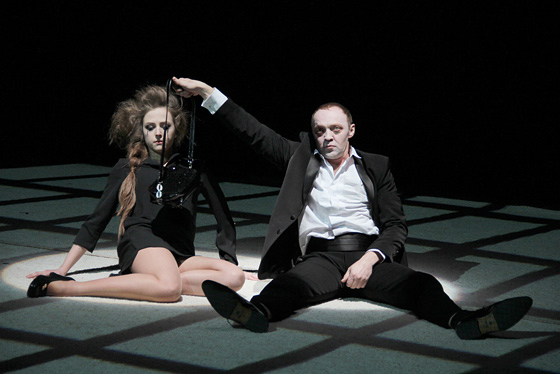 © Екатерина Цветкова Сцена из спектакля «Пьяные»
— Света Иванова сперва не хотела играть. Что ее убедило?
— Она прочла пьесу глазами, и та ее как-то сразу не поразила, не захватила по-крупному. Но после нами подготовленной читки пьесы для петербургского фестиваля «Пять вечеров» все изменилось, пришло необходимое и долгожданное очарование. При чтении текст летел и открывал нам какие-то другие миры и смыслы. По-настоящему значимый текст может изменить и самого актера. Это как у Иоанна Златоуста — «душа словом прирастает». Ведь когда человек произносит молитву, в нем что-то совершается. Пьеса Ивана «Иллюзии» тоже как бы одна большая мантра, в которой более тысячи раз повторяется «любил», «люблю», «буду любить» и так далее — и вдруг попадаешь в какое-то пространство, когда это важное и нереализованное чувство начинает чем-то наполняться. Человек начинает расти.
— Что — или кто — убеждает тебя, что ты не шарлатан?
— Ну, наверное, мы все же все немного шарлатаны, наш Король частенько остается голым, что скрывать. Но часто сами зрители, среди которых бывают и мои учителя, убеждают меня в неиллюзорности нашего строительства. Запомнился приход на спектакль «Июль» Петра Наумовича Фоменко. Он позвонил через час после спектакля, и мы с ним разговаривали больше сорока минут, он делился впечатлениями, не давая мне вставить слово, и я говорил себе: «Неужели это сам Петр Наумович так взволнованно и увлеченно со мной говорит, более того — делится теми же мыслями и мечтами о “театре текста”!» Вот тогда на секунду и поверилось, что мы находимся в едином процессе поиска той не обозначенной еще неведомой, невидимой энергии, которая возникает помимо нашей воли от соприкосновения театра с текстом. Тогда, в нулевых, были люди, одержимые этой идеей. Хорошо помню: в «Театре. doc » у Михаила Юрьевича (Угарова. — Ред. ) был такой термин — «обнуление актера». Cool! Хотя мне больше нравился термин Гротовского, говорившего о поиске «прозрачности» артиста. Но важно было, что мы постепенно приближались к пониманию нового театрального языка, новой модели театра, где может появиться место для по-другому звучащего слова.
— Когда в пьесе Ворожбит Саша возвращается в третьей части с того света, чтобы пойти на войну, то женщины говорят ему: нет, Саша, мы не потянем. И начинают ему какие-то меркантильные вещи объяснять: про то, что это дорого — снаряди тебя на войну, потом снова хорони, снова памятник ставь, а откуда деньги? Это самый важный для меня момент в пьесе: женщины обманывают мертвого, заговаривают ему зубы, говорят то, что его может убедить, — что его девочкам будет тяжело. А на самом деле они любят, хотят, чтобы все как прежде, но у него своя служба, военная, — а у них своя. Они на страже между жизнью и смертью. Они не пустят мертвое в мир живых — только так остановить войну.
— Да, по большому счету, это попытка расслышать тему, начатую древнегреческим театром. Новая «Лисистрата» — о том, что женщины могут изменить мир, остановить войну. Это самый важный момент в пьесе, ты права, и Света Иванова так тонко, так остро и круто это играет. Она впускает в себя этот текст, звучащий из уст этой украинской женщины, так, что возникает эффект присутствия уже совершенно другого, опаленного трагедией человека. У актрисы даже изменяется голос. Наши репетиции и здесь были для меня большим счастьем. Было трудно, больно, но счастливо. Артисты, с которыми я репетировал, — люди высокого профессионального достоинства и удивительных человеческих качеств. Тот же Саша Усердин — когда в третьей части его погибший персонаж возвращается к своим женщинам, приходит уже как какая-то гоголевская фантасмагория… И, может, уже помимо желания актера просыпается какая-то другая, потусторонняя реальность: «Девочки, что же вы делаете?!» И они такие: нет-нет, уходи, не пускаем, мол, пожалуйста, уходи. В этот момент и открывается унаследованный автором трагический гоголевский юмор. В пьесе Ворожбит вообще гоголевская атмосфера. Смешно, но совершенно нешуточные вещи совершаются. Выдающийся получился текст. Он больше чем про Украину, про любовь, мужчину и женщину. Он про что-то более важное. Может, это звучит и по-дурацки, но это про настоящее человеческое. Про то, что человек может быть искаженно некрасив, изломан, но интуитивно продирается к самому важному. Мамашка с дочкой и их Саша из пьесы Ворожбит — это все про меня. Они все во мне прорастают, в моей какой-то неосознанной памяти и моем существе.