
Translated material
The Encyclic of Pope Francis is released
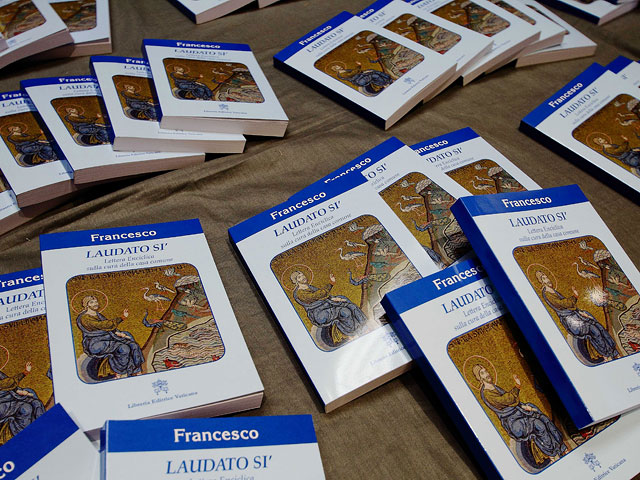
In the Vatican, on Thursday, the official representation of the second encyclical of the pope of the Roman Francis "Laudato Si '", dedicated to the "healing of the common house of mankind", took place. The main question raised in this message of the pontiff to the clergy and believers of the Roman Catholic Church is as follows: "What world do we want to leave for those who come after us - growing children today?"
Encyclic, which "emphasizes that climatic changes are one of the main problems facing humanity, and this is a matter of morality, requiring respectful dialogue with the participation of the whole society," was welcomed by the UN Secretary General Pan Gi Moon. This was stated by his official representative.
"The UN Secretary General emphasizes that in humanity there is a serious obligation to take care of our common house - planet Earth and protect it, as well as demonstrate solidarity with the poorest and most vulnerable layers of society, who mostly suffers from climatic changes. In this connection, the UN Secretary General calls the governments to put global interests above the national and approve of the ambitious, a wide agreement on the issue On climatic changes at a meeting in Paris this year, ”the statement of Park Guy Muna, the text of which is quoted by TASS, said.
The Radio Vatican website, which devoted a lengthy publication to the encyclical, called this message "long -awaited."
The publication gives the introductory words of the pope: “This issue concerns not only the environment in the strict sense, because it is impossible to solve the problem partially,” and this gives rise to further questions about the meaning of life and the values that underlie public life: “What is the purpose for which we have come to this life? Why do we work and fight? Why does this land need us?”
“If we do not raise these fundamental questions,” Pontiff emphasizes, “I do not think that our worries about the ecology will be able to lead to significant results.”
The name of the Encyclic, notes the "Radio of the Vatican", comes from the words of the hymn to the creations of St. Francis "Laudato Si ', mi' signore" - "praise you, my Lord ...". In this anthem, the saint of Assisi recalls that the Earth, our common house, "is also like a sister with whom we share existence, and a beautiful mother who takes us into his arms." We ourselves are "the dust of the earth. Our body itself consists of the elements of the planet, its air gives us breathing, and its water revives us and restores us."
Now this mercilessly exploited and looted land complains, and its moans join the moans of all the outcasts of the world. Pope Francis calls to hear them, prompting everyone - individuals, families, local communities, nations and the international community - to "environmental circulation", in the words of St. John Paul II, that is, "change the course", taking on the beauty and responsibility of the task of "concern for a common house".
At the same time, Pope Francis admits that "there is an increase in susceptibility to the problems associated with the environment and care of nature, and mature sincere and sad concern for what is happening with our planet," and justifies the gaze of hope that pierces the entire encyclic, sending everyone a clear message: "humanity is still able to cooperate in order to build our general home"; "A person is still able to act in a positive way"; "Not everything is lost yet, because people who are able to degrade to extreme can also overcome themselves, again make a choice in favor of good and revive."
Papa Francis, of course, turns to believers Catholics, echoing the words of St. John Paul II: "Christians, in particular, feel that their tasks within the creation, their duty to nature and the creator are part of their faith," but he offers "to enter into dialogue with all relative to our common house." The dialogue passes through the entire text and in the fifth chapter becomes a means for discussing and solving problems. From the very beginning, Pope Francis recalls that "both other churches and Christian communities - like other religions - showed deep concern and left valuable thoughts" on the topic of ecology. He highly appreciates their contribution, starting with the "dear Patriarch of the Ecumenical Bartholomew", which is widely quoted in encyclical. Further, the pope expresses gratitude to the defenders of the environment - both individuals and associations and institutions - recognizing that "the thoughts of countless scientists, philosophers, theologians and public organizations enriched the Church’s thought on these issues," and calls for everyone to recognize "the wealth that religions can offer for integral ecology and for the complete development of the human race."
The Encyclic program is divided into six chapters. In them, the situation is considered based on the best scientific achievements available today (chapter 1), in comparison with the Bible and the Judeo-Christian tradition (chapter 2), and the root of the problems (chapter 3) is detected in technocracy and excessive human self-sufficiency. The proposal of encyclic (chapter 4) is expressed in an integral, "integral ecology that would include human and social aspects" inextricably linked with environmental issues. С этой точки зрения Папа Франциск предлагает (глава 5) начать на всех уровнях социальной, экономической и политической жизни честный диалог, который сделал бы процесс принятия решений в этой сфере прозрачным, и напоминает (глава 6), что ни один проект не может быть эффективным, если он не осуществляется сформированной и ответственной совестью, подсказывая отправные точки для роста в этом направлении на образовательном, духовном, церковном, богословском и political levels. The text ends with two prayers: one of them for everyone who believes in the "god of the Creator and Father", and the other for those who profess the faith in Jesus Christ, and it is interspersed with the refrain "Laudato Si ', from which the encyclical begins and which ends.
Through the text passes several main topics considered from a variety of points of view, which give it a strong unity: “The close connection between the poor and vulnerability of the planet; the belief that everything in the world is interconnected; criticism of a new paradigm and forms of power that follows from technology; a call to look for other ways of understanding economics and progress; the value inherent in every essence; the human meaning of the ecology; the need for sincere and honest Debatov; a serious responsibility of local and international policy;