
Translated material
Cold blows from the Kremlin
Washington see Moscow nuclear threats as a declaration of Cold War
Why did the United States decide to place weapons in Poland for an armored brigade? Do Washington fear nuclear threats of Moscow? Can Russia afford the arms race?
We are discussing these and other issues with Angelo Codville , Honored Professor of Boston University, a former employee of the Senate Intelligence Committee; Daniel Gure , an employee of the Lexington Institute, a former high -ranking pentagon employee; Dmitry Gorenburg , employee of the CNA research corporation; Eric Shiryaev , professor at George Mason University, and Mikhail Burnstam , an employee of the Guaurovsky Institute.
Washington see Moscow nuclear threats as a declaration of Cold War
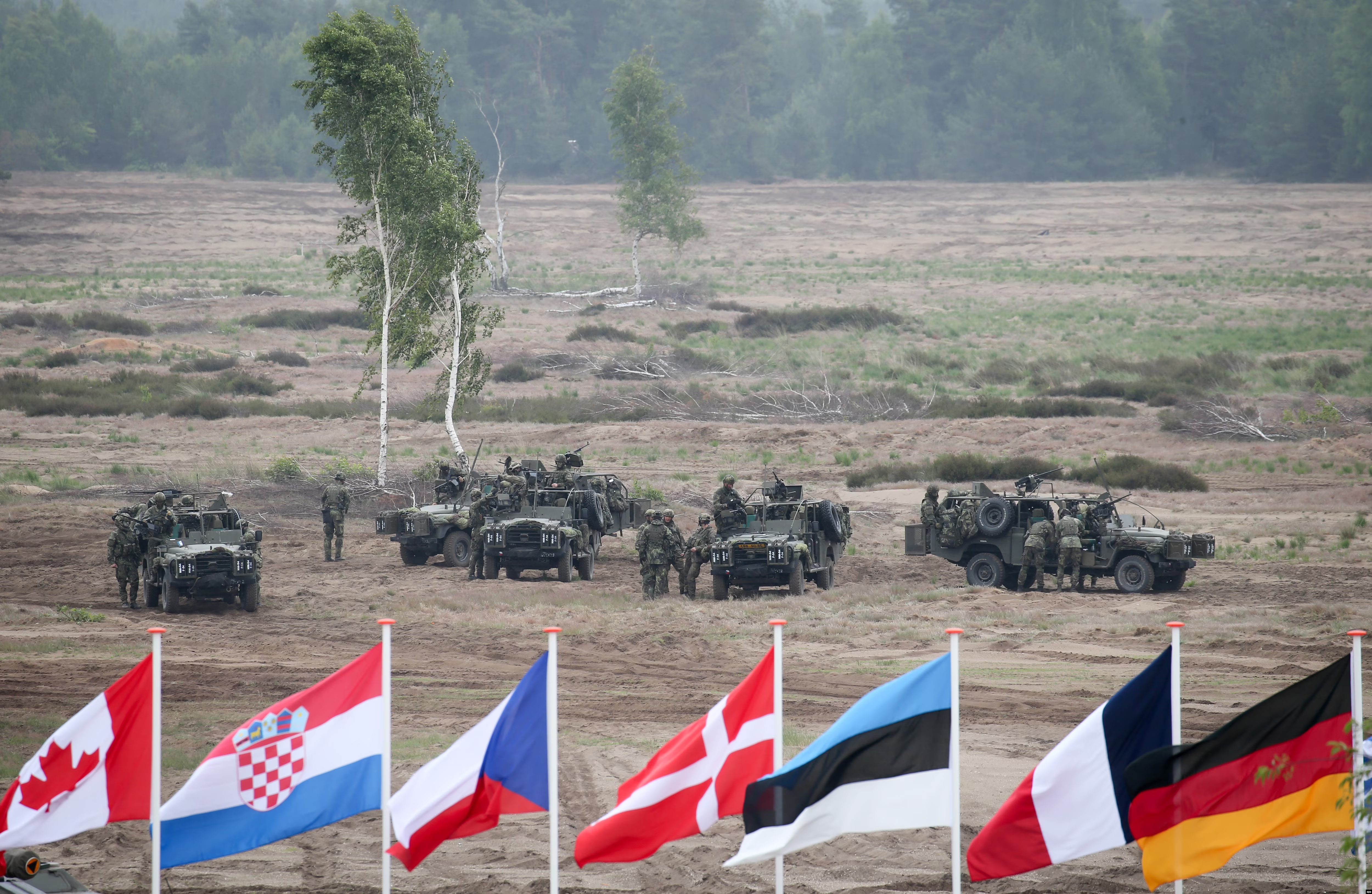
The message on May 14 on the readiness of the United States to place the weapons and equipment of the armored brigade on the territory of Poland provoked a series of statements by Russian representatives perceived by American observers, and not only by them, as an almost formal announcement of the Moscow nuclear confrontation with the United States and NATO. The first to react to this news was the representative of the Russian Ministry of Defense, who assured that Russia "would go to the return steps in order to strengthen our western borders." A day later, Russian President Vladimir Putin publicly announced that Russia will expand its nuclear arsenal by 40 intercontinental ballistic missiles and explained that if "someone threatens our territory, then we will turn our armed forces against this threat." The undisguised tone of Russian statements gave rise to the general secretary of NATO Jens Stoltenberg to complain that "the rattle of weapons from Russia is unreasonably, dangerous, such behavior destabilizes the situation."
The Western allies, according to The Wall Street Journal , have reason to take the statements of the Russian president with increased seriousness, since this is only one, but the most serious confirmation that Russia is a nuclear weapon in confrontation with the West. Only a few days before these events, a certain, closely connected with the Kremlin, the Russian analyst at a meeting in the Paris Research Center announced that Moscow has nuclear potential for confrontation with NATO in Europe. Such shocking statements from the Russians close to the Kremlin are not news, it was a surprise that it sounded a challenge, because only two days before these revelations were made in Paris, Washington made an official claim to Moscow, accusing it of a prohibited agreement on reducing missiles of a smaller test of a cruise missile.
If Moscow really decided to reinforce her, so to speak, hybrid confrontation with the West with nuclear threats, does Washington and his allies have adequate plans for the response to this challenge? The Wall Street Journal believes not. “Putin’s nuclear plan works,” the newspaper warns.
My interlocutor Angelo Codville is equally skeptical and, according to whom the dislocation in Poland is only one American brigade, and even in the event of a critical situation, does not have any practical meaning. This is a kind of checkpoint for reporting, staged by Washington. In fact, the West is still not ready to really resist the Kremlin:
“I believe that the American defensive hystblishment realized that all previous attempts to convince Putin that his actions were unacceptable, attempts to stop him, now he is ready to resort to the last instrument of power,” says Angelo Codville . - True, the essence of what is happening is that this is precisely a symbolic demonstration of power, and not real preparation for its possible use. The conversation is about the concentration of weapons and other equipment of the armored brigade on the territory of Poland, which will be used by the American military in the event of a crisis situation. That is, the conversation is that approximately the five thousandth American contingent should become a kind of quick response forces. It is difficult to imagine how such a small military unit can make any competition of the Russian army. It seems to me that the authors of the idea of this idea do not proceed from the fact that this team can actually take part in the hostilities, the purpose of this action is to make a warning to the Kremlin.
- The American press has assumptions that the White House can even consider options for placing their own nuclear missiles in response to Russian threats to use nuclear weapons. Does it sound believable from your point of view?
- I think that nuclear weapons will not be placed in Europe, we can say that I'm sure of that. But even if it theoretically assumed that this will happen, this will not change the fundamental principle in the US approach: these are measures designed to prevent rash actions by the Kremlin, and not for warfare. The US military will not open fire on Russian troops in response to provocations, no matter what these provocations may be. And all this is well aware.
- In this case, where do you think, limits, the intersection of which Moscow will cause a decisive answer from NATO?
- We simply do not know this. This is the danger. Moscow probably will not cause nuclear strikes on New York, Chicago or European capitals, but any actions that are not associated with undisguised military aggression may look acceptable to it. If the US readiness information is sent in the event of a crisis to this region to the armored team will be confirmed, then in any case, this does not mean anything from a practical point. This is a purely symbolic warning that will only take power if Putin believes that the United States is ready to support this small military union with all its military power if necessary, which, in my opinion, is impossible to imagine.
Supporters of this point of view in the United States in the minority. The White House repeatedly insisted that the United States and its NATO allies would do everything to protect the countries - members of the North Atlantic Union who were attacked. And Daniel Gure believes that the North Atlantic Union actually gradually leads itself to a state of combat readiness, in the event of a wide variety of provocative actions from Russia:
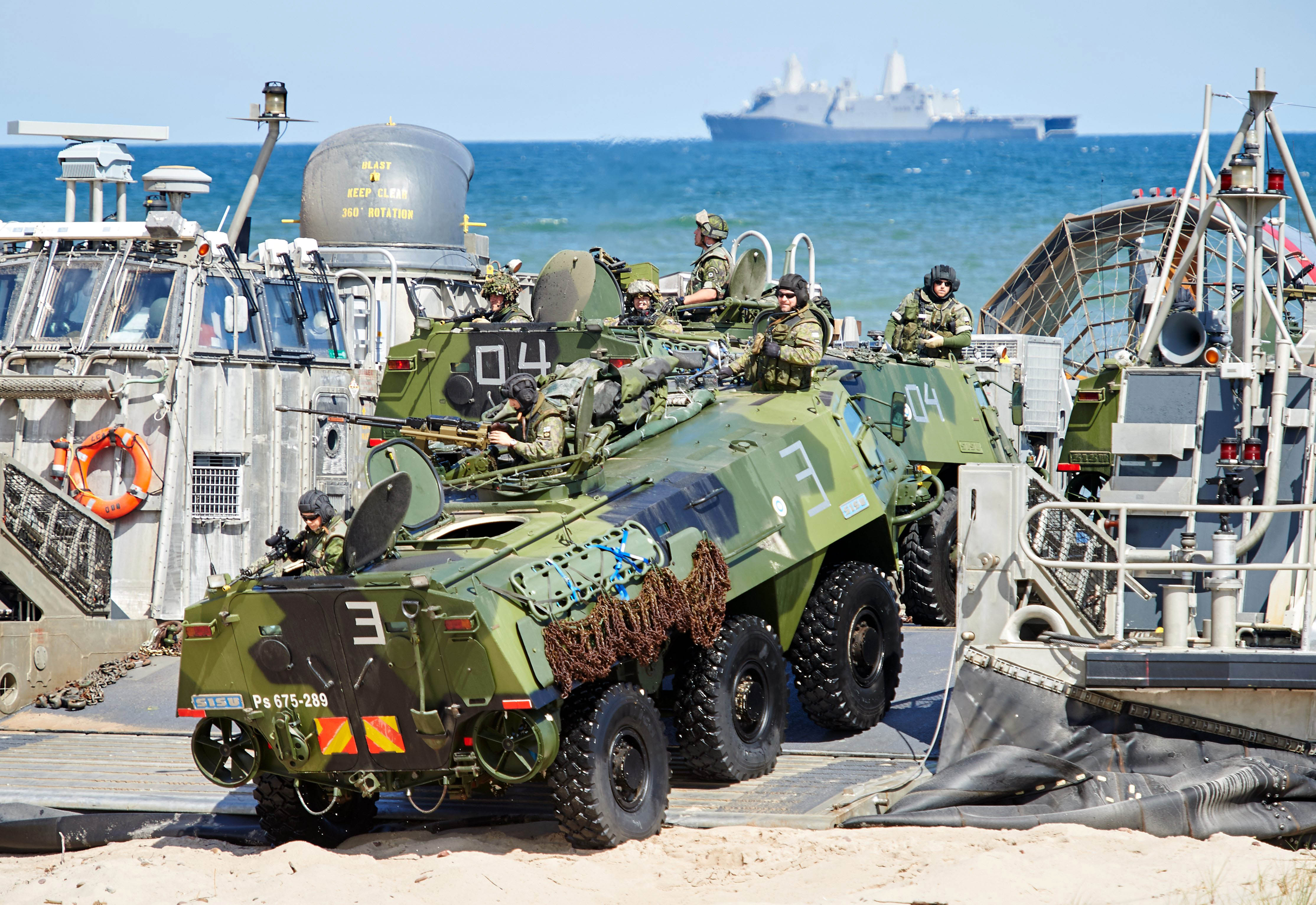
“In Washington, they are extremely seriously configured, because the United States and NATO are concerned not only to the capture of Crimea by Russia, its support for separatists in the east of Ukraine and the signs that some groups may try to destabilize the Baltic countries,” says Daniel Gure . - The United States cannot but pay attention to Russian statements about the use of nuclear weapons in response to the measures taken by NATO in Europe, or on the strengthening of the Russian contingent in Kaliningrad. I would say that in the headquarters of NATO and in most Western capitals there is a feeling of real anxiety. They are concerned there that Moscow can take a certain step, a miscalculation that will lead to a conflict. Therefore, in recent months we have witnessed, so to speak, experiments on the part of NATO allies trying to find the best response to the threat that they see from Russia. Last year, patrols of NATO forces began in the airspace of the Baltic countries, landing units from NATO countries serve in the Eastern European countries - members of the North Atlantic Union. Now the next step becomes obvious - a possible constant deployment in the region of significant military formations of the United States and other Western countries - one or two brigades. We can say that the new iron curtain begins to separate Europe again.
- But Angelo Codville says that all these measures will hardly be effective as a means of preventing the Kremlin, because, he believes, the West does not have a real military strategy for the confrontation of Russia, there is no desire to confront, and this brigade is not an opponent to Russian troops concentrated in the region?
- This, in my opinion, is an incorrect angle. For example, Western countries kept very small military formations in West Berlin during the Cold War. They had no illusions regarding the ability of these units to withstand the Soviet 20th Guards Army in the event of a war, the purpose of the deployment of these troops was another. They, so to speak, played the role of a trigger. The attack on them would inevitably provoke the entry into the conflict of the main forces of NATO. And the Soviet Union was well aware of this. I suspect that Putin has enough mind in order not to take risks, checking the determination of Western allies to protect themselves.
- What can be the answer of Washington to Putin’s statements about the increase in the Russian missile arsenal or threats that sounded from the lips of some Russian functionaries about the intention to abandon the agreement on the destruction of missiles of a smaller range in Europe?
Moscow now has an almost twenty -fold advantage in this type of weapons. Why do they need new missiles?
- In my opinion, Putin’s actions to increase the Russian missile arsenal fit into the trajectory of North Korea’s behavior and partly China, which demonstrate increased aggressiveness. And I assume that the response to this in the near future will be a revision of the regional strategy of the United States and their allies, the result of which may be more emphasis on nuclear weapons. It is especially significant in this sense of Russia's behavior in relation to an agreement on the destruction of missiles of medium and lower range. As far as I understand, the Pentagon has serious evidence of Moscow’s violation of this key Soviet-American contract. And it looks surprising when you consider that Russia now has a multiple advantage in tactical nuclear weapons. According to American estimates, about four thousand units of such weapons are at her disposal, while NATO has at the disposal of several hundred. That is, Moscow now has an almost twenty -fold advantage in this type of weapons. Why do they need new missiles? It seems that Putin deliberately provokes NATO countries to loud return steps. And these steps are outlined. It was impossible to imagine recently, but in the statements of the US Minister of Defense, the idea of the deployment of weapons in the European region began to slip in order to confront the Russian threat of, say, winged naval missiles. It is possible at all that as a result of these events, the United States will decide to increase the role of nuclear forces in the military doctrine.
- That is, you assume that the Russian president consciously tries to start the arms race, while Russia has more than enough nuclear weapons for defense?
It is possible at all that as a result of these events, the United States will decide to increase the role of nuclear forces in the military doctrine
- Yes, the question is, for what? This, of course, can be a natural fear, but I have the feeling that he is trying to recreate a cold war. And this is not only a subconscious traction, like a former KGB officer, this is a political calculation for the creation of an external enemy radio of his own survival. The United States has no choice in such a situation. They are forced to answer these steps, while Putin gets the opportunity to say: look, they surround us and do not allow us to live within our natural borders, ”says Daniel Gure.
- Professor Shiryaev, two different points of view: the West, NATO is not ready to neutralize the threat from Russia, these are all purely symbolic steps, the other - NATO actually rebuilds its strategy, preparing to resist Moscow. What do you expect from the Western capitals?
“ I so want to say that it is unknown, we’ll see, wait, but it seems that Washington and the capital of the Capital came to the line when Moscow politics is perceived as something serious and potential threats can only be eliminated with the help of the so -called demonstration of power and determination to stop what is happening today,” says Eric Shiryaev . - Two months ago, in April, I would say: most likely, this is a game of words, let's see, both sides are not interested in confrontation. Today, a more acceptable assessment is the one that occurs intentional, and from Washington in particular.
- Dmitry Gorenburg, how do you interpret the statements of NATO leaders? We can say that Moscow actually achieved the transformation of NATO into its real opponent or is it symbolic statements from Brussels?
- There are symbolic aspects too, I agree. But still, NATO has been looking for himself to do what to do. And now they found - to do what they always did: to confront Russia, what NATO was originally intended for, ”says Dmitry Gorenburg . - And here is the second point, why such serious performances. I believe that it is necessary to somehow reassure new members, partners who are on the border with Russia.
- The first line of defense.
- Yes. Partly performances are quite sharp because of this too.
- Various Russian representatives in recent months have made warnings about the possible use of nuclear weapons. Vladimir Putin himself, I suspect, amazed many in the West when he said that Moscow could resort to nuclear weapons in case of problems with the rejection of Crimea from Ukraine. From the point of view of the Western layman, it is difficult to inflict more severe damage to the image of Russia, they themselves build themselves into the image of the enemy. Do you have any idea that they, so to speak, think in Moscow?
-They understand that American and European, to some extent, armed forces are much stronger than the Russian ones, in such a way as to protect themselves, with their nuclear weapons they want to restrain the attack by non-nuclear weapons by NATO.
- But if such a logic exists in Moscow, it really becomes scary, because no sane leader in the West can bear such a thought. This is a complete absurdity.
- If we go to Moscow and talk with the generals there, then they believe that we, Russia, are not going to attack NATO, but they make all sorts of statements, and they surrounded us in this way that they will attack us. Maybe they won’t attack, there will be some coup.
- And this can be answered with a nuclear blow?
- Not primarily, but we do not know what they are really going to do. We only know how they speak to prevent such situations.
- Professor Bernsstam, the vast majority of Russia's neighbors see a threat in her behavior, our interlocutor believes that Russian generals can really perceive NATO as a threat to Russia. As they say, everyone can have their own truth, but, from your point of view, you can find in the post -Soviet era of the grounds for NATO suspicions in aggressiveness in relation to Russia?
Every time the West went towards Russia or made concessions to it, Russia answered with aggressive steps
- In 1998, in the year of the Russian default, Russia was so economically weak, its military machine was virtually destroyed that the West, if I wanted to take aggressive steps or present territorial requirements, say, hypothetically, Germany could demand the return of East Prussia Koenigsberg, ”says Mikhail Bernsstam . - In 1998, the military budget of Russia was in terms of today 20 billion dollars against almost trillion NATO dollars, against almost $ 600 billion. That is, at this moment the West could actually present to Russia any completely territorial and political requirements. But Russia was a friendly country, and the West considered Russia as a friendly country, despite some confrontation in the territory of the former Yugoslavia. The West extended his hand to help, continued to give Russia loans after default. That is, the experience showed that no complaints about the dismemberment of Russia, as they are talking about now, that the West somehow attaches to the sovereignty of Russia at the time of extreme weakness, at a time when the whole Cold War was not just lost, but Russia was already at the bottom, at that moment the West came to the rescue. And the second - this is when the new president of the United States, Obama, canceled plans to create strategic missile defense, although it was directed against Iran, and not against Russia, but since Russia was worried and perceived as a certain step against its safety, Obama went to meet her, and this was the center of reloading policy. What did Russia answer? It always exists, both in the mathematical theory of games, and in practice of relations between states, a very simple way to verify intentions: if one makes a concession, as it meets the other, concession or an aggressive step. It turned out that every time the West went towards Russia or made concessions, Russia answered with aggressive steps.
– Профессор Бернштам, в таком контексте как выглядит российский аргумент, заключающийся в том, что мы, дескать, должны вооружаться, потому что Америка нас обманула: она сильно увеличила расходы со времен холодной войны, что представляет для нас опасность?
– Конечно, ситуация несопоставимая, потому что Россия сегодня тратит сегодня максимум 14 процентов того, что тратят Соединенные Штаты на военные расходы, и всего лишь 9 процентов того, что тратит НАТО. Но, во-первых, в Америке расходы дорогие, потому что армия контрактная, солдат дорогой, у России солдат дешевый. Второе, что самое главное, Россия обладает, унаследовала у Советского Союза, колоссальным арсеналом ядерного оружия. Поэтому все эти военные расходы, все эти сопоставления относятся в основном к обычным вооружениям – танки, самолеты и прочее. Тогда как сейчас впервые за всю за всю свою историю, впервые с 1954 года, то есть впервые за 60 лет Россия изменила свою военную доктрину и говорит, что она будет использовать ядерное оружие. В этой ситуации уже кто сколько тратит на оборону не имеет большого значения.
– Тем не менее, Путин сделал ставку на дорогостоящее перевооружение России, его заявления рассматриваются как объявление холодной войны. А есть у Кремля возможность потянуть холодную войну или нет? Ведь, как вы говорите, экономический контраст между Москвой и Западом слишком заметен?
– Холодная война идет, потому что холодную войну можно определить двумя основными показателями. Первое – это агрессивная политика в отношении друг друга, а второе – военные действия чужими руками. В этой ситуации холодная война идет, так же, как она была между Советским Союзом и Западом, так же она идет и сейчас. Холодная война не зависит от военных расходов.
– Эрик Ширяев, мой собеседник Дэниэл Гурэ говорит, что НАТО, Соединенные Штаты попросту вынуждены втягиваться в противостояние с Москвой, поскольку Владимир Путин хочет превратить Запад в следующего за Украиной противника России. То есть ему нужна новая холодная война, внешний противник для удержания власти внутри страны. Как вам такая теория?
– Наверное, с точки зрения мотивов руководства в Кремле, это абсурд. Но как это воспринимается на Западе, воспринимается нами здесь, скорее всего да, безусловно. Поэтому я могу сказать, что нынешняя ситуация, как мой коллега сказал, что это холодная война, которая идет, действительно она идет, по мнению большинства специалистов. Нынешний вялотекущий конфликт, скорее всего, на руку Кремлю, потому что в этой ситуации можно достичь невероятного количества целей, которые намечены, внутренние и внешнеполитические. В этой ситуации, безусловно, условия международные на руку Москве, потому что Обама воспринимается как слабый президент в Москве, президент, который не будет принимать решительных действий по определению, по его менталитету, по его прежним действиям и по его идеологии. Сегодня Обама не интересуется Россией, поэтому в этой ситуации можно давить и можно устраивать кризисную ситуацию, которая будет восприниматься Западом как неприятность, как опасность, в этой атмосфере, безусловно, искать какие-то компромиссы. То есть Запад пойдет на уступки, пойдет на компромиссы, пойдет на какие-то одолжения, видя, что ситуация более угрожающая. Такая оценка ситуации мне кажется наиболее вероятной сегодня.
– Профессор Бернштам, может ли в принципе в данной ситуации Россия позволить себе гонку вооружений, если действительно Владимир Путин поставил своей целью эту гонку вооружений начать? Ведь некоторые российские экономисты предсказывают, что Россия сломит себе хребет в этой гонке?
Россия может выдержать гонку вооружений, но это ей ничего не даст, потому что она все равно будет отставать – масштабы несопоставимы
– В Советском Союзе с середины 1950-х годов по середину 1970-х годов был высокий экономический рост и пропорционально росли расходы на вооружение, одновременно Советский Союз вкладывал огромные деньги в науки и технологии, прежде всего военные. Таким образом он достиг паритета с Соединенными Штатами и со странами НАТО. Россия сейчас находится в совершенно другой ситуации. Она может провести гонку вооружений, если гипотетически в России будет экономический рост по 5 процентов в год, что невозможно, через 25 лет она сможет утроить свои военные расходы. Сейчас это 90 миллиардов, значит, это будет 270 миллиардов. Это будет меньше половины того, что сейчас тратят Соединенные Штаты. То есть Россия может в принципе включиться в эту гонку вооружений, догнать она не может, взять верх не может. Соединенные Штаты и страны НАТО очень далеко ушли вперед. Россия может действительно сломать себе хребет, если она попытается сделать больше, чем утроить свои военные расходы, потому что тогда она должна будет это делать за счет потребления рядового населения, и тогда, конечно, хребет будет сломлен. Рональд Рейган в начале 1980-х годов поставил задачу в Америке, что мы будем проводить гонку вооружений, на которой Советский Союз сломит себе хребет. И это получилось. Потому что в Америке ускорился экономический рост, Советский Союз тогда был на пределе, вот тогда это было возможно, и Советский Союз этого не выдержал. Россия может выдержать гонку вооружений, но это ей ничего не даст, потому что она все равно будет отставать – масштабы не сопоставимы.
– Вы считаете, что, вопреки предположениям в том числе некоторых российских аналитиков, Россия действительно может себе позволить, назовем это так, агрессивную политику?
– Она может себе позволить, особенно локальные конфликты, это она и старается делать. Стратегия очень простая на самом деле, с их точки зрения, это совсем даже и не глупо, с точки зрения математической теории игр, то, что они делают. А именно: сравнительно за небольшую цену, они не ценят человеческие жизни, и сравнительно за небольшую цену денежную они могут вести локальные конфликты, воевать чужими руками, всем угрожать и все время при помощи своей политической риторики угрожать ядерным оружием, что им ничего не стоит. Это они могут себе позволить.
– Дмитрий Горенбург, если, согласно профессору Бернштаму, вопреки предсказаниям некоторых аналитиков Кремль может позволить себе такую конфронтационную политику в обозримом будущем и даже в ближайшие годы, как может развиваться это противостояние?
– Мне кажется, что они действительно боятся наращивания сил НАТО в Восточной Европе, и идет блеф. Короче говоря: если будут какие-то угрозы, что, может быть, американцы испугаются, передумают. Как мне кажется, все эти действия, которые они предпринимают, например, с самолетами, которые подлетают близко к американским кораблям или самолетам, такое нагнетание обстановки, идея показать американцам, что у них намерения серьезные, еще лучше – договориться. Я надеюсь, что это останется на уровне словесных баталий. Но военные начинают думать о предотвращении во всяком случае случайного столкновения. Во времена холодной войны были договоры, как предотвратить случайное столкновение: если один самолет сбил другой самолет, потом с этого все начинается. То есть такие переговоры сейчас начинаются – это уже хорошо. Скорее всего, конечно, я думаю, дальше резких выступлений ничего не пойдет. Но, с другой стороны, я не ожидал, что Россия захватит Крым.
– Профессор Ширяев, ваши предсказания – что вероятнее: смогут западные столицы и Кремль договориться или противостояние будет развиваться по своему собственному сценарию?
Российская политика сегодня основана на беспредельном авантюризме
– Российская политика сегодня основана на беспредельном авантюризме. Да и вообще говоря, условия позволяют России такие условия ставить, вести себя авантюристически, потому что она может выиграть. Добиться таких условий, при которых Запад и Америка пойдут на переговоры и на серьезные уступки под страхом российского перевооружения, российских действий на Украине. Обама уже на подходе, так называемая "хромая утка", время хорошее, надо давить. Точно через два года, независимо, кто придет к власти в Вашингтоне, республиканец или демократ, скорее всего, будет человек, который будет более ястребиной наружности и поведения, поскольку настроения элит в Вашингтоне сильно поменялись в последние два года. Ведя себя как классный хулиган, каких-то концессий с Западом можно достичь, пока авантюризм – тот козырь, который сейчас разыгрывается. Потому что Запад в принципе разрознен, большое количество проблем существует экономических, политических, в этой мутной воде можно найти огромное количество преимуществ, и пока не поздно, это можно сделать сегодня.