
Translated material
On the walls of ancient Aphrodisiad
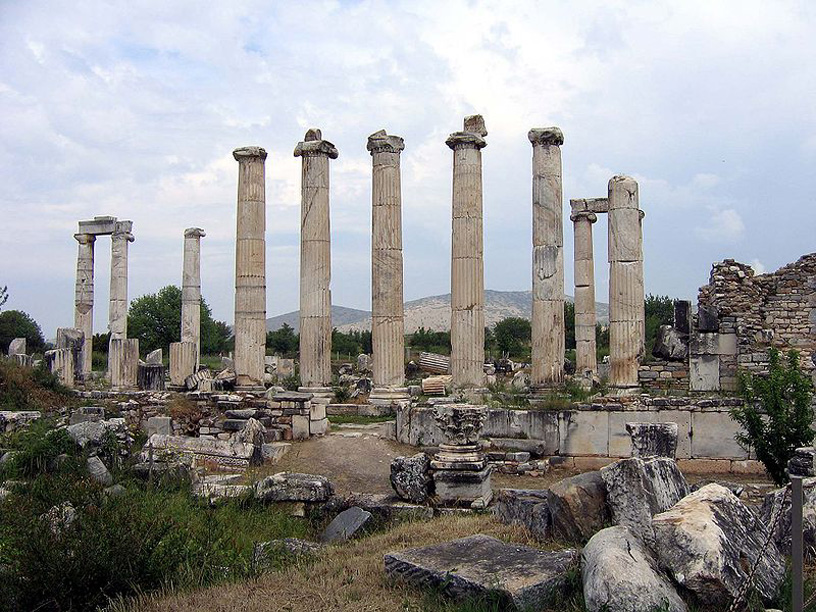
Several hundreds of ancient graffiti have recently been discovered on the walls of the city of Aphrodisiad in modern Turkey. A review of the finds was recently presented by a professor at the Institute of Advanced Studies in Princeton Angelos Haniotis in a lecture read at the Royal Museum of Ontario in Toronto. According to Haniotis, now the number of graffiti from Aphrodisiad is superior to the number of famous samples from all other cities of the Roman East.
Aphrodisiad (ἀφροδισιάς) was a relatively small city in Karia, the historical region of the Southwestern coast of Asia Minor. Now the ruins of Aphrodisiad are located near the modern village of Geyre, 100 kilometers from the coast of the Aegean Sea and 230 kilometers southeast of the Izmir. In ancient times, the city was also known as Ninoe (νινόη) and the city of Lelegov (λελέγων πόλις) - one of the pre -Greek peoples living on the Anatolian coast. Over time, the Aphrodisiad became part of the Roman Empire, where during the civil wars its inhabitants supported the winner - the future emperor Octavian, for which their city received privileges. A description of the life of the city can be found in the novel “The Herey and Kalliro” by his most famous native - writer Khariton Aphrodisian.
Two things glorified the city: marble and the cult of the goddess Aphrodite. Local marble was white or gray-blue, during the Hellenistic, Roman and Byzantine periods of the city’s history, he was actively mined in the surrounding careers. The presence of marble caused the heyday of the art of sculpture. The works of sculptors of Aphrodisiad not only adorned their hometown, but delivered along the most distant limits of the Roman Empire. They were found even in the distant city of Pax Julia in Luzitania (modern Portuguese city of run). One of the famous sculptures is the statue of a fist fighter (“Fighter from Sorrento” ), which sculptor Koblan from Aphrodisiada, is now located in the National Archaeological Museum in Naples.
Tetrapilon. The main entrance to the sanctuary of Aphrodite
The city center was the temple of Aphrodite. Initially, the local cult belonged to the local female deity, which the Greeks later identified with Aphrodite. Judging by the statues of the goddess, she was close to the goddess who was revered in Ephesus under the name of Artemis. Like Artemis, Ephesian aphrodite, Aphrodisian is dressed in a thick, hiding form of a tunic, making a standing body like a column. The goddess stands straight, her hands are extended forward. On a tunic in four rows, relief images are placed. There we see the permanent companions of the goddess - three charitn, in the classic poses that many centuries later immortalized Rafael in the painting "Three Grace". It also depicts a married couple, which modern researchers consider to be gay and uranium. Helios and Selena, separated by a column, a marine goddess into a monster, a group of erotes, are cut below. Under Tunika, Hiton, reaching to the ground, is put on. Aphrodite wore a crown, a wreath from Mirta, a necklace on her neck.
Aphrodita Aphrodisiad
Most of the inscriptions and drawings found by archaeologists on the stones of Aphrodisiad were made between 350 and 500 years. Sometimes it happened that the stone from graffiti after the destruction of the construction was used to build another. Among the graffiti, Angelos Haniotis identified three vast groups associated with gladiatorial battles, chariots racing and competition of various religions.
Gladiator battles appeared in Aphrodisiad in the Roman era. The townspeople depicted episodes of the battles they saw in the arena. Most often, the pictures are fighting for co-standers, armed with a trident and a network, with glandiators-sewers wearing a shield and a sword.
Image of fighting gladiators
There was no alien to the inhabitants of the Aphrodisiad and another popular antique sight - chariots racing. In the city there was a stadium about 270 long and 60 meters wide with 30 rows of seats, which fit up to 30 thousand spectators. The city had three permanent teams of the chariots who competed with each other. They were called by ancient tradition flowers: red, green and blue. Each team had a large fan club. Fans loved to gather in the market area in the south of the city, where there were a public park and porticoes. Perhaps there were special buildings belonging to the Fan associations. In memory of the passions that flared up around the races, there were numerous inscriptions: “victory red”, “bad years for green”, “the luck of the blue prevails” and so on.
Stadium in Aphrodisiad
There were three main religious groups in the city: adherents of polytheism and ideas of Greek philosophy, Christians and Jews. There are many official dedications to the Greek gods on the statues. Christians depicted where they could, the symbol of the cross and the abbreviation from the letters of Ha, Mu and the Gamma, meaning the phrase "Christ Maria Born." Sometimes these three letters were written right on the statues of officials who supported politicalism. The Gentiles in response painted their symbol - a double ax. It was considered an attribute of Zeus of Kari and was also portrayed on city coins.
HMG inscription on the head of the statue
The Jewish community of Aphrodisiad, as in other cities of Asia Minor, was quite numerous. In the temple complex abandoned by the 4th century, known as Sebastiion, Jewish merchants equipped warehouses. Many inscriptions have been preserved, where the offers made by people, who were called θεοσεβής “afraid of God” were listed. Comparing them with the inscriptions from the synagogue in the Sardis and the mention of this term in the New Testament (for example, chapter 13 of the Acts of the Apostles), scientists have long come to the conclusion that we are talking about Gentiles who separated the Jewish faith. In a certain period of the Roman Empire, Judaism became quite popular, and many Greeks and Romans began to read the Jewish God, follow the rites, make donations, but did not take the last step - formal acceptance of Judaism with the commission of circumcision. Such a person, for example, was Centurion Cornelius, with whom the Apostle Peter met. They were called "afraid of God." Apparently, there were many such people in Aphrodisiad.
Also, Angelos Haniotis mentioned the image of a hanucal lamp carved on a stone, perhaps the most ancient known to us.
Hanoucular lamp from Aphrodisiad
Some of the drawings may have been related to magical practices. These include, for example, the image of a person’s head with a snake wrapped around her. There were in Aphrodisiad the wall drawings on the topic popular for centuries: on one of the slabs built into the wall, you can see a large number of carved phalluses of different sizes.
The head of a man with a snake
The number of graffiti begins to be reduced during the period of Emperor Justinian (from 527). Justinian also forbade political and Jewish cults, and the city itself, instead of the name of Aphrodisiad, received the name Stavropolis (σταυρούπολις “City of the Cross”). In the VII century, the city was greatly destroyed by an earthquake, after which he fell into decay.