
Translated material
Long road to the stage
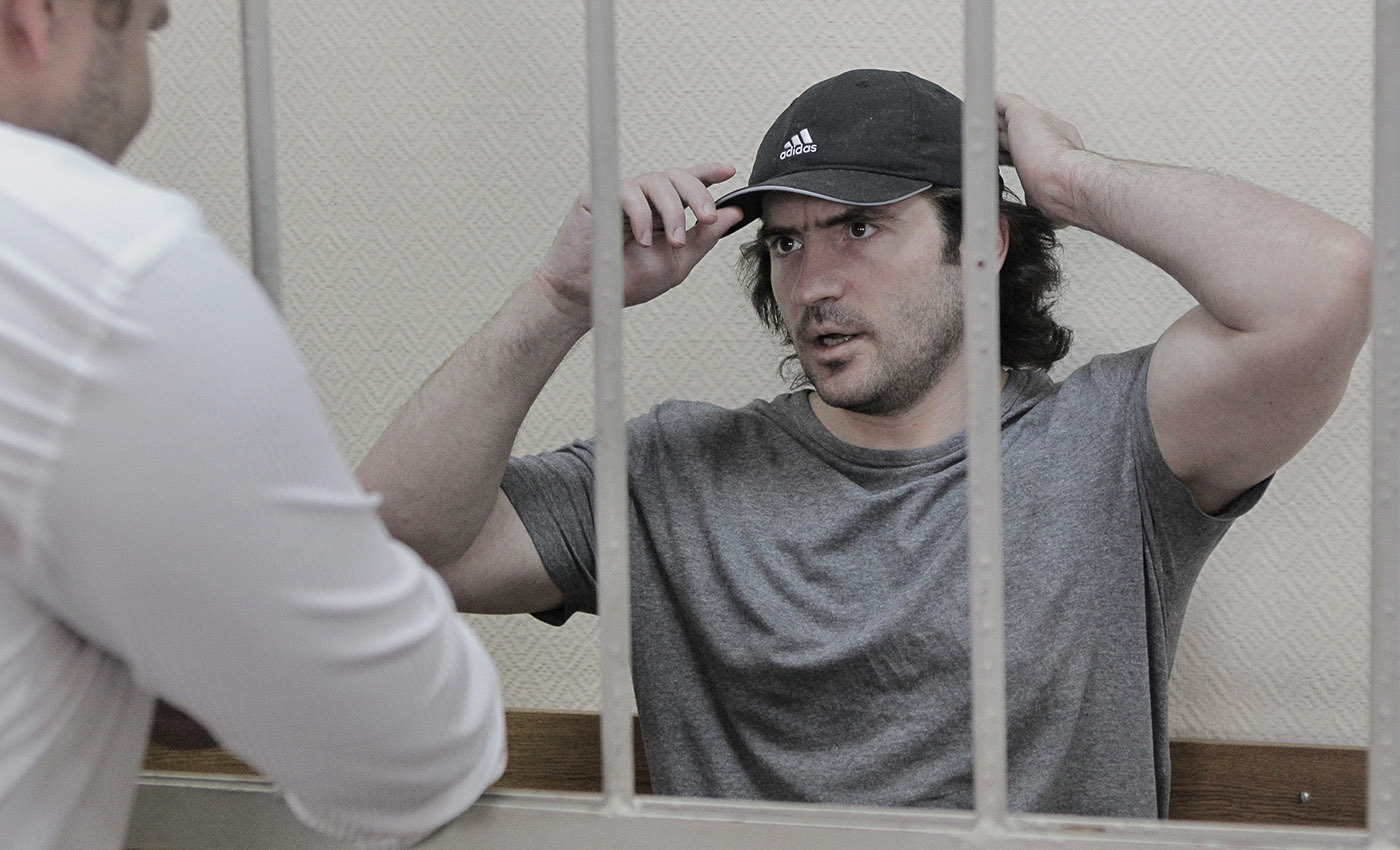
Former banking magnate Matvey Urin is setting a record for the number of debts and time spent in a pre-trial detention center: June marked the 56th month of his detention in Butyrka. While the Presnensky District Court of Moscow is preparing to pass a fourth verdict against Urin, Mediazona recalls the story of the collapse of the financial empire, which began almost five years ago with an unhappy meeting on Rublevskoye Highway.
A motorcade of two cars is driving along Rublevskoye Highway - a Volkswagen and a Mercedes. In the back passenger seat of the latter is a self-confident bald man in a leather jacket; in appearance he looks like the hero of domestic TV series about the “dashing 1990s”. At some point, a BMW approaches the motorcade, moving without security. The Volkswagen accompanying the Mercedes tries to stop the stranger's car with headlight signals. When the BMW finally stops, the driver is approached by several large men armed with bats and gun-like objects.
Someone hits the driver, someone hits his car. After the execution, the cortege leaves. The beaten man, deciding that his car had become unusable due to the blows from the bats, goes on foot to look for the nearest police station - fortunately, it is still light outside, and he managed to remember the license plates of the offenders’ cars. The police offer the victim hospitalization, but he refuses, confining himself to the emergency room. Surprised by his last name and foreign passport, the duty officer, just in case, reports the visitor to his superiors.
After the beaten driver contacted the police, not even half an hour passed before the bald, self-confident man and his companions were detained on Novy Arbat - not by ordinary patrol officers, but by FSO officers. A gray-haired man approaches the window of the Mercedes. Three years later he received the rank of colonel general. "Do you recognize me?" he asks the man in the leather jacket. He nods. “Then give me your passport,” the gray-haired man orders and takes the document in his hand. “I have his passport,” he reports over the phone. The passenger of the Mercedes, along with the driver and six guards, are taken to the Lefortovo detention center, formally transferred to the Ministry of Justice, but actually under the control of the FSB. In their cars, operatives find two Kalashnikov assault rifles, one dummy of this weapon and four bags of nasvay.
In the nearly five years since that incident—November 14, 2010—the bald man had grown long black hair, which he wore in a ponytail, acquired the habit of covering his face with a baseball cap, and then got rid of both. Now he, again shaved almost completely and even in a little more athletic shape than on the day of the conflict with the BMW driver, is standing in a cage in the hall of the Presnensky District Court of Moscow. On the T-shirt there are silhouettes of mountains indicating their height, and on the neck there is a cross. While the defendant is being led into the courtroom, he manages to say hello to his wife, mother, expensively dressed lawyer and a few friends. The scars on the faces of some of them speak of a past full of adventures. The defendant reacts to the presence of the only journalist in the room with surprise and some disbelief. Before the judge enters the hall, he manages to introduce himself through the bars and ask what are the reasons for the interest in his fate.
— Witnesses do not appear at the court hearing. Since the prosecutor insists on a forced arrest, and the defense does not oppose it, the hearing will have to be postponed. The only thing is that there are a number of witnesses who, as it turned out, live in Luxembourg, so the court will not be able to ensure their attendance, but in any case the hearing is postponed again,” the judge explains to those present.
“I could bring them here, just ask!” — the defendant interrupts him, grinning badly.
Exactly a week later, the man again finds himself in the same cage in the same hall, wearing the same T-shirt with mountains. The meeting is postponed again - this time due to the failure of the prosecutor to appear. It won’t take place in a week—witnesses won’t come again—or even in two. In total, on the website of the Presnensky Court you can find eight decisions to postpone hearings in this case, made by Judge Dmitry Dolgopolov over the past three months. A representative of the court's press service, in a conversation with Mediazona, admits that perhaps this list is not complete.
—Are you in a hurry? - Dolgopolov asks the defendant after the next transfer.
- What's my hurry? To the zone! I want to take a walk, well, drink some beer. Only non-alcoholic - we are athletes! - he answers.
Although the defendant speaks with a smile, most likely he is not joking. This man is 40-year-old businessman Matvey Urin, the former owner of a banking empire that collapsed a few months after the incident on Rublevskoye Highway in November 2010. Since then - for the 56th month - he has been sitting in the Moscow Butyrka pre-trial detention center with rare breaks for court hearings.

Vladimir Kolokoltsev. Photo: Yuri Mashkov / TASS, archive
Foreigner and Minister
The gray-haired man who stopped the Mercedes was Vladimir Kolokoltsev, then not yet the Minister of Internal Affairs, but the head of the Moscow Main Internal Affairs Directorate. The man who was beaten on Rublevskoye Highway was Dutch national Jorrit Faassen. In the past, 30-year-old Faassen was on the board of the Stroytransgaz company affiliated with Gazprom, and also worked as the chief specialist of the country real estate department at Gazprombank-Invest, the only foreigner in the company. Among Stroytransgaz employees who spoke with Vedomosti, there was an opinion that “an absolutely European young man with pleasant manners,” who was immediately given a 60-meter office with a secretary and a service Lexus, is a good friend of the Putin family.
The former head of the company, Alexander Ryazanov, also indirectly confirmed to Vedomosti rumors about the high patronage of Faassen. One day, a foreigner radically spoke out against cutting the salaries of employees and called on them to defend their rights. After this, the boss began to think about dismissing the rebel, but received a warning from the head of the Gazprom security service: “He is very influential.” Not only Russian media, but also foreign ones wrote about Faassen’s blood relationship with Putin’s family - for example, the Leidsch Dagblad newspaper claimed that the Dutchman and the daughter of the Russian president, Maria, live together in the Leiden suburb of Voorschoten.
Whether the allegations about the closeness of the injured foreigner to Putin’s family are true or not, soon after the incident on Rublevskoye Highway, Urin’s life changed dramatically. While the businessman himself was waiting for the end of the investigation in Butyrka, his banking empire was collapsing like a house of cards - within two months, Slavyansky Bank, Trado-Bank, Uralfinprombank, Mintny Dom, Donbank and the Advantis Capital company lost their licenses. In all cases, the financial regulator cited the reason for closure as “signs of criminal activity” in interbank transactions, but two months before the beating of the Dutchman, a Central Bank inspection did not reveal anything suspicious, at least in the work of Slavyansky. The closure of the last bank in Urin, the Russian-German Trade Bank, was announced by the Department of External and Public Relations of the Central Bank in the last week of 2010.
Faassen himself was interviewed by the investigator twice about the beating on Rublevskoye Highway - directly on the day of the incident, November 14, 2010, and two months later, on January 18, 2011. From the interview protocols it is clear how the foreigner’s indignation gradually subsided. If immediately after the attack he told how much he was afraid for his life and assumed that they wanted to kill him, then during the second conversation with the investigator he emphasized that he did not feel serious fears for himself, since none of the attackers expressed any corresponding threats against him. However, a case regarding the attack was opened on the same day.
According to investigators, on November 14, 2010, the banker’s motorcade violated traffic rules and did not give way to a foreigner’s BMW, after which Urin instructed the guards to “organize his pursuit, beating him and causing damage to the car.” The alleged organizer himself presented a different version: he did not give any orders to the security, Faassen himself jumped from one lane of the Rublevskoye Highway to another, thereby creating an emergency situation, and the private security company employees decided to teach him a lesson on their own.
“He and I drove completely calmly from Zhukovka (a village in the Odintsovo district of the Moscow region - MZ) to the Moscow Ring Road for 15 minutes, without taking any measures against him, hoping that he would stop at the traffic police patrol. He didn't stop. Our car calmly overtook him and drove on. And then the escort service employees (the guards who found themselves in the dock with Urin - MZ), exceeding their authority, committed some acts in relation to this car. What do I have to do with this? I am generally a protected person, and the private security company that guarded me had nothing to do with me, he protected me under an agreement. I don’t understand at all why I was detained. I had no right to give orders, because there is a private security company, and there is a protected person. “I, on the contrary, must listen to their instructions, and not give them my own, this is one, and they work with me under a security agreement, I do not control their actions, this is two,” he explained .
As follows from the cassation rulings of the Moscow City Court, Urin was initially charged with Part 2 of Article 213 of the Criminal Code (hooliganism with the use of objects used as weapons, committed by a group of persons). Along with him, a similar charge was brought against the banker’s personal driver Sergei Uperenko and six private security company employees who accompanied him in a Volkswagen - Nikolai Kupriyanov, Andrey Frolov, Alexey Kuznetsov, Andrey Semidotchenko and Alexey Cherkasov.
This article remained with all the accused, but by the time the indictment was handed over to the court, others were added to them (this fate was avoided only by the Chop driver Cherkasov, who completely denied his guilt). Thus, the investigator added charges to Urin under Part 3 of Article 33 of the Criminal Code, Part 2 of Article 116 and Part 2 of Article 167 (organizing beatings and intentional damage to property). His driver Uperenko, who did not admit his guilt and claimed that he did not get out of the car at all, was also charged with paragraph “a” of Part 2 of Article 116 of the Criminal Code (battery), Part 2 of Article 167 (deliberate damage to property) and Part 3 of Article 327 of the Criminal Code (use of a knowingly forged document) - according to the investigation, when driving he used forged documents that gave him the right to bypass traffic police posts.
Security guards Karpov, Kuprinyanov, Frolov and Semidotchenko, in addition to the charge of battery, were accused of exceeding their authority by employees of private security services (Part 1 of Article 203 of the Criminal Code), and Kuznetsov was charged with charges of robbery and theft of an important personal document from a citizen. Investigators found that six months before the incident on Rublevskoye Highway, he participated in the beating of two men and the theft of their mobile phones, bank cards, as well as an official ID and a metal personal badge of an employee of the Ministry of Internal Affairs in the name of one of the victims.
Double sentence
Even at the stage of investigation into the case of beating a Dutchman, a second criminal case was opened against Urin, this time under Part 2 of Article 186 of the Criminal Code (production for the purpose of sale, storage and sale of knowingly counterfeit securities). As stated in the statement from the Prosecutor General's Office, this investigation was based on the results of an inspection carried out shortly after the banker's arrest by employees of the Department of Economic Security of the Ministry of Internal Affairs. This fact is indirectly confirmed by the cassation rulings of the Moscow City Court, according to which, at the time of Urin’s arrest, it was impossible to select a preventive measure against the banker that was not related to detention, including due to “operational information about the suspect’s involvement in other crimes.”

Photo: Pavel Markelov / Rodionov Publishing House / TASS
According to the investigator's resolution, in March 2010, “unidentified persons” produced 14 counterfeit Trado-Bank promissory notes with a nominal value of more than 214 million rubles for the purpose of selling. Subsequently, the fakes turned out to be, the Ministry of Internal Affairs claimed, in Urin’s possession as the ultimate beneficiary of the Trado-Bank banking group, who used them as collateral for payments as part of the execution of an agreement to obtain the rights to collect debts from Investbank. Just a month after the initiation of this case - in February 2011 - investigators from Moscow, Chelyabinsk and Yekaterinburg opened criminal cases on facts of fraud on an especially large scale at Trado-Bank, Slavyansky Bank, Mintny Dom and Uralfinprom.
Meanwhile, the judicial investigation into the incident on Rublevskoye Highway has come to an end. At one of the meetings, Faassen’s representatives provided a certificate from the emergency room, according to which the foreigner suffered injuries in the form of numerous bruises. Already in April, the Kuntsevsky court announced the terms: under the article on hooliganism, Urin was given two years in prison, under the articles on organizing beatings and intentional damage to someone else’s property - one year each. By partial addition, the banker was sentenced to three years in a general regime colony. The longest sentence among the guards, four years, was given to Kuznetsov, who was involved in the robbery of a policeman, and the shortest, two years, was given to the security driver Cherkasov.
“The court justified its critical attitude to Urin’s testimony that he did not take part in the commission of the crimes accused of him. This testimony of Urin was checked […] and was rightly rejected by the court. […] all decisions related to the implementation of protection were agreed upon and made personally by Urin, who was the organizer of the commission of illegal actions against the victim. [These actions] were covered by the single intent of the convicts, were committed out of hooligan motives, on a far-fetched pretext, which is fully confirmed by the evidence examined by the court […],” the text of the verdict says.
After such a decision by the judge, the now former banker could count on parole in the summer of 2013. However, these dreams of Urin were not destined to come true - three months after the announcement of the verdict of the Kuntsevsky District Court, the judicial panel of the Moscow City Court for criminal cases upheld the cassation appeal of the prosecutor and overturned it as overly lenient. The case was sent for review.
“The court underestimated the increased public danger of their actions, which were particularly impudent, using their official position and weapons, the numerical and physical superiority of the attackers, their special training, with a clearly expressed and demonstrative opposition of their personalities to society, generally accepted norms of morality and behavior. In the course of these actions, bodily harm and property damage were caused to innocent people,” the definition said.
The injured foreigner never came to the new trial. Urin's lawyers asked for a truce - they offered the court and Faassen's lawyer an apology and payment of damages in an amount significantly higher than the actual one, but their requests were ignored. As a result, on November 8, 2011, the Kuntsevsky District Court increased the banker’s term of imprisonment to 4.5 years of general regime. The deadlines for the guards and the driver remained the same.
"Butyrka", court, "Butyrka"
Exactly three weeks after the verdict was announced, when the lawyers tried to appeal it again, the banker was charged with five counts of the case under Part 4 of Article 159 of the Criminal Code (fraud on an especially large scale). Urin, who was never sent to prison (he was kept in Butyrka), was again chosen as a preventive measure in the form of detention. The new charge turned out to be much more complex than the 15-volume case of beating the Dutchman, and stemmed from an earlier case of bill fraud.
According to investigators, having control over the Moscow Slavyansky and Trado-Bank, the Yekaterinburg Uralfinprombank, the Chelyabinsk Coin House and the Rostov Don Bank, Urin “ordered a sharp increase in deposit rates” with powerful advertising support in the media. As a result, the number of bank clients has increased significantly. New clients, in addition to deposits, were also offered to purchase securities of large oil companies with high liquidity. Statements about the allegedly crediting of securities to the accounts of the banking network were accepted only through the depository “Adventis Capital”, specially created for this purpose, which investigators called fictitious - the company was allegedly registered under a dummy and provided zero reporting during inspections. The shares that clients of the Urina banking group were convinced of their existence also turned out to be fake. The money received from them, investigators alleged, was withdrawn through special accounts. Thus, Urin was charged with theft of almost 16 billion rubles, but during the judicial investigation this amount was halved.
The debate on Urin's second case took place towards the end of March 2013 - the prosecutor asked to find him guilty and sentence him to nine years in prison. The banker himself denied his involvement in the operating activities of these banks, and argued that a certain shadow investor Ivan Lyubimtsev, in whose interests these financial institutions were acquired, could be behind the fraud. The defendant emphasized that he was being tried for the third time because in the fall of 2010 he was “at the wrong time and on the wrong road.” As a result, the court sentenced him to 7.5 years in prison in a general regime colony, counting 4.5 years in the first case into this period.
“He is only guilty of being born,” said the banker’s lawyer, Vladislav Musiyaka, after the decision was announced. The verdict was based on the testimony of the ex-head of Trado-Bank, Elena Kostenko, who was accused in the same fraud case, but made a deal with the investigation, admitted her guilt, named Urin as the organizer of the thefts, and in May 2012 received two years in a penal colony.
Judging by the cassation decisions of the Moscow City Court, the deadline for Urin’s detention should have expired in March 2014 - after which, in any case, he should have been transferred to a colony. However, five months earlier, the Tverskoy District Court again decided to take the banker held in Butyrka into custody - this time at the request of the Main Directorate of the Ministry of Internal Affairs for Moscow. The basis for initiating a third case was the results of an inspection of Multibank conducted by the Deposit Insurance Agency, which investigators considered to be controlled by Urin. By this time, the ex-banker, for some reason, refused all the lawyers who defended him under the contract, except for Alexey Semenov. Semenov himself refused to promptly comment on the banker’s third case, citing the need to obtain permission from his client for an interview.

Matvey Urin in the Zamoskvoretsky Court building in Moscow, 2012. Photo: Andrey Stenin / RIA Novosti
According to the auditors, the money for the purchase of Multibank was formally allocated by the Slavyansky and Trado-Bank banks, for fraud for which Urin had already been convicted after the incident on Rublevskoye Highway. In reality, this amount - about 1 billion rubles - turned out to be part of a loan from Multibank itself, which received it from MDM Bank to pay off the debt. Thus, the Main Investigative Directorate of the Moscow Ministry of Internal Affairs argued, the buyers of Multibank actually paid the sellers with his own money, creating a gap in the capital of the credit institution and later covering it with fictitious securities.
Record holder in captivity
Urin's third case was transferred to the Presnensky District Court in February 2015. In addition to the article on fraud on an especially large scale, which was already familiar to the banker, part 3 of Article 174.1 (money laundering by an organized group) appeared in the final version of the indictment. Judging by the frequency of adjournments of meetings and the regularity of their schedule - no more than once a week - the case will not be considered soon.
In total, Urin has been in Moscow detention centers for more than 55 months. This is not a record for Russia - for example, those accused in the case of a militant attack on Nalchik in 2005 were kept in a pre-trial detention center for more than nine years. However, Urin may take first place in another ranking - as the prisoner with the largest financial debt. After the bankruptcy of the banks under his control, the Deposit Insurance Agency had to pay their clients compensation in the amount of 10.5 billion rubles. Urin himself turned out to be the defendant in civil lawsuits by the heads of financial organizations. According to the Agency, in total, the courts decided to recover damages from him in the amount of 7.1 billion rubles.
Meanwhile, the banker, nicknamed by the media “under investigation for life,” probably hopes not only to go to prison, but also to return to a free life through parole. Last year, he appealed to the Tverskoy court with a request to declare illegal 29 disciplinary sanctions imposed on him by the administration of Butyrka from the summer of 2011 to the beginning of 2014. According to Urin, the management of the pre-trial detention center did not notify him of these reprimands; he only learned about them last March.
Be that as it may, the court refused to recognize the penalties as illegal. According to the text of the decision, in total, the management of the detention center issued 54 reprimands against Urin with the wording “for violating internal regulations.”