
Translated material
Microsoft plans to use drones to predict future foci of diseases
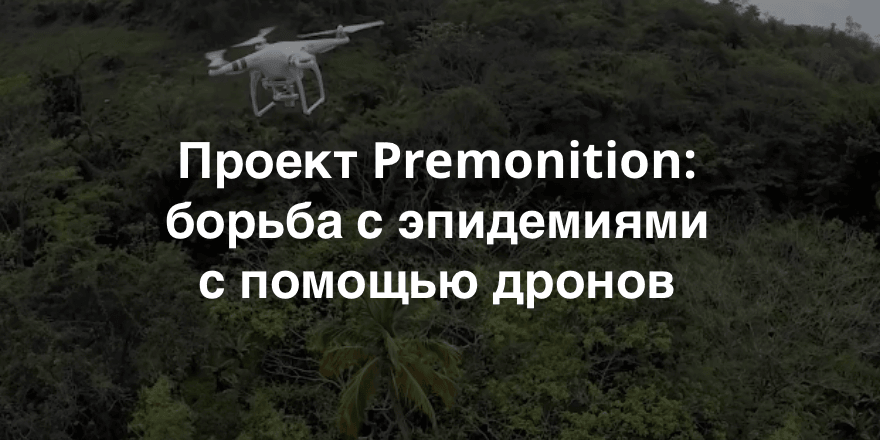
Drones and mosquitoes have a lot in common - they create noise around and annoy. But while mosquitoes spread diseases, Microsoft is trying to teach drones to fight epidemics.
Researchers of the Premonition project (“foreboding”) work on the creation of drones that will help to determine and catch mosquitoes in order to learn more about the source of the possible epidemic.
Using a blood test of mosquitoes, it is possible to determine what diseases they tolerate, as well as what diseases those animals are sick that these mosquitoes bit.
Knowing what diseases circulate in the wild, scientists will be able to reduce the risk of outbreaks of individual diseases and epidemics.
Now it’s difficult to manually get this kind of data where it is difficult for a person to get. Drones can easily cope with this task.
The project team conducted research in March to identify the ability to use unmanned vehicles for fishing and moving mosquitoes.
As a result of tests, it is expected that such drones will appear in the next five years, and Microsoft is not going to create its own drones, since the change in existing models will be sufficient at that time.
Currently, the difficulty lies not only in the mechanics of action, but also in the software aspect, when the drone must decide on the right action.
This will require serious systems of computer vision and understanding the position of the object in space.
Work is already underway on such projects and many of them are already showing good results today - for example, Google unmanned cars.
In other words, very soon, drones will be able to fly over our heads, which will determine, among other things, the spread of infections, unless of course, aviation organs allow this to be done.