
Translated material
Dye with stroncia-90
In the Bryansk region, peatants continue to burn in the Chernobyl trace zone. Despite the statements of the Ministry of Emergencies about the complete liquidation of the fire
In the Bryansk region, peatants continue to burn in the Chernobyl trace zone. Despite the statements of the Ministry of Emergencies about the complete liquidation of the fire
Photo report by Zinaida Burskaya / "New Gazeta"
Burn the beginning not today and not yesterday. Volunteers from the Greenpeace fire project, which are monitoring peat fires throughout Central Russia, discovered smoldering foci in the Novozybkovsky district of the Bryansk region on May 2. That is, two months ago.
- How did employees of the Ministry of Emergencies behave then? As usual: “This does not burn, this is not a fire, it is not a peat,” explains Grigory Kuksin, head of the fire project.
- But in the end, they recognized the fire - and reported on its complete liquidation on the same day, although they did not finish the work. True, together with the foresters, in words, they promised that they would surely doster “tomorrow”.
Bryansk region is the most affected by the Chernobyl accident in modern Russia. Novozybkovsky district, bordering Belarus, is one of the most “dirty” in the region. Here dozens of villages fell under forced resettlement. Today, the radiation background in the district center - the city of Novozybkov - is normal. The lowlands and forests are still unsafe for humans.
Kuksin says that forest -firing fires are atypical for the Bryansk region - usually a lot of precipitation fell out here, and the peat bogging and abandoned and abandoned after the Chernobyl disaster did not light up. But the last two years have been small and low -water. Last fall, smoke from smoldering Bryansk peat bogs reached Moscow. And this year it is already burning not only in the Bryansk region, but also in the contaminated territories in Ukraine and Belarus. Unlike Russia, there are not hidden information about fires.
On the website of the Department for the Elimination of the Catastrophe at the Chernobyl NPP of the Belarusian Ministry of Emergencies, it is directly said: the struggle with natural fires is one of the main problems of the content of the zones of resettlement and alienation.
In May, the Greenpeace volunteers took the peat samples at the site of the discovered natural fire and sent to research to the department of the radio chemistry of the Faculty of Chemistry of Moscow State University. According to the results of the strontium-90 and cesium-137 tests, the soil was equated with laboratory specialists with radioactive waste (see the research protocol).
On Sunday, Grigory Kuksin, together with specialists from the department of radio chemistry, decided to check what condition the peat officer officially extinguished in the spring was located - and again discovered a fire.
- I do not see the grounds to believe that he was then extinguished, and now he has caught fire again. Groups are old and deep, burns exactly in the same place, ”he tried to explain his position to the firefighters who arrived in place after his calls, foresters and head of the settlement of Old Vyshkov, next to which there is a smoldering peat.
The MCHS and foresters were not very surprised to call. From the answers to questions about why they did nothing with the fire for two months, they raised and tried to shift responsibility to each other.
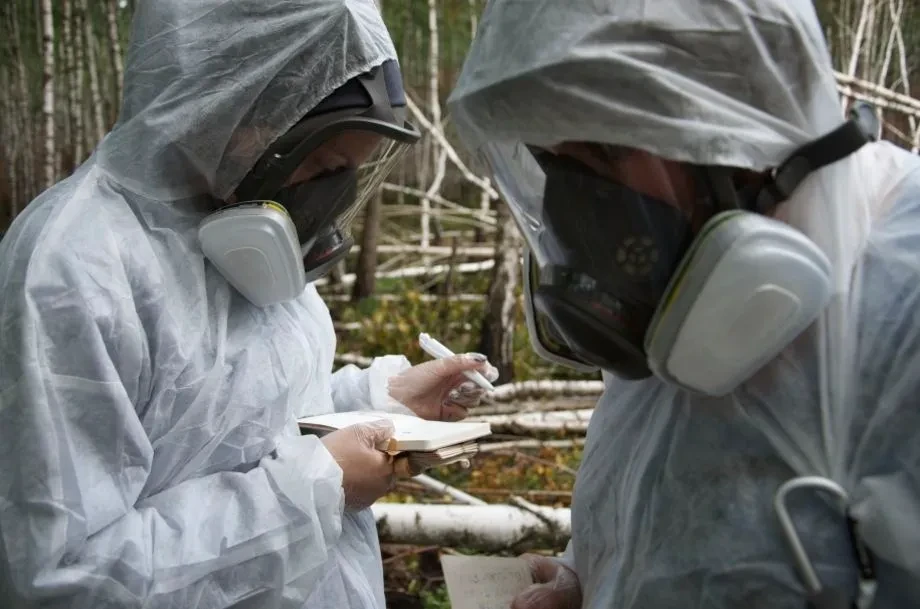
While Kuksin was waiting for firefighters and foresters, the specialists of the department of radio chemistry began fences of smoke samples in a fire.
“Radio fobe is more dangerous than radiation,” Natalya Kuzmenkova jokes, who conducted a study of peat samples, “but, given the content of cesium and strontium in the soil, you need to understand how many dangerous elements are contained in smoke and what distance is tolerated with the smoke by the wind.
In 1993, studies of forest fires were conducted in the same area, but no one was engaged in peat. It is known that cesium accumulates in the muscles and is excreted in 30 days. Strontium - in bones and bone marrow, and is not excreted from the body in general.
Employees of the Department of Radiochemistry worked at the place of fire in protective costumes, respirators and gloves. Firefighters and foresters - without means of protection at all. Their superiors know about the degree of pollution of local forests, but they do not even give their employees to the respirators - they say that they simply are not there, or joke:
“We are at home! Will you walk in your mask at home? "
Already on Sunday evening, the Main Directorate of the Ministry of Emergencies in the Bryansk region reported a complete elimination of the fire next to the village of Stary Vyshkov, but on Monday the fire still continued.
The results of radio chemical studies will be ready by the end of the week.
Bryansk region