
Translated material
Rector, rating and rally
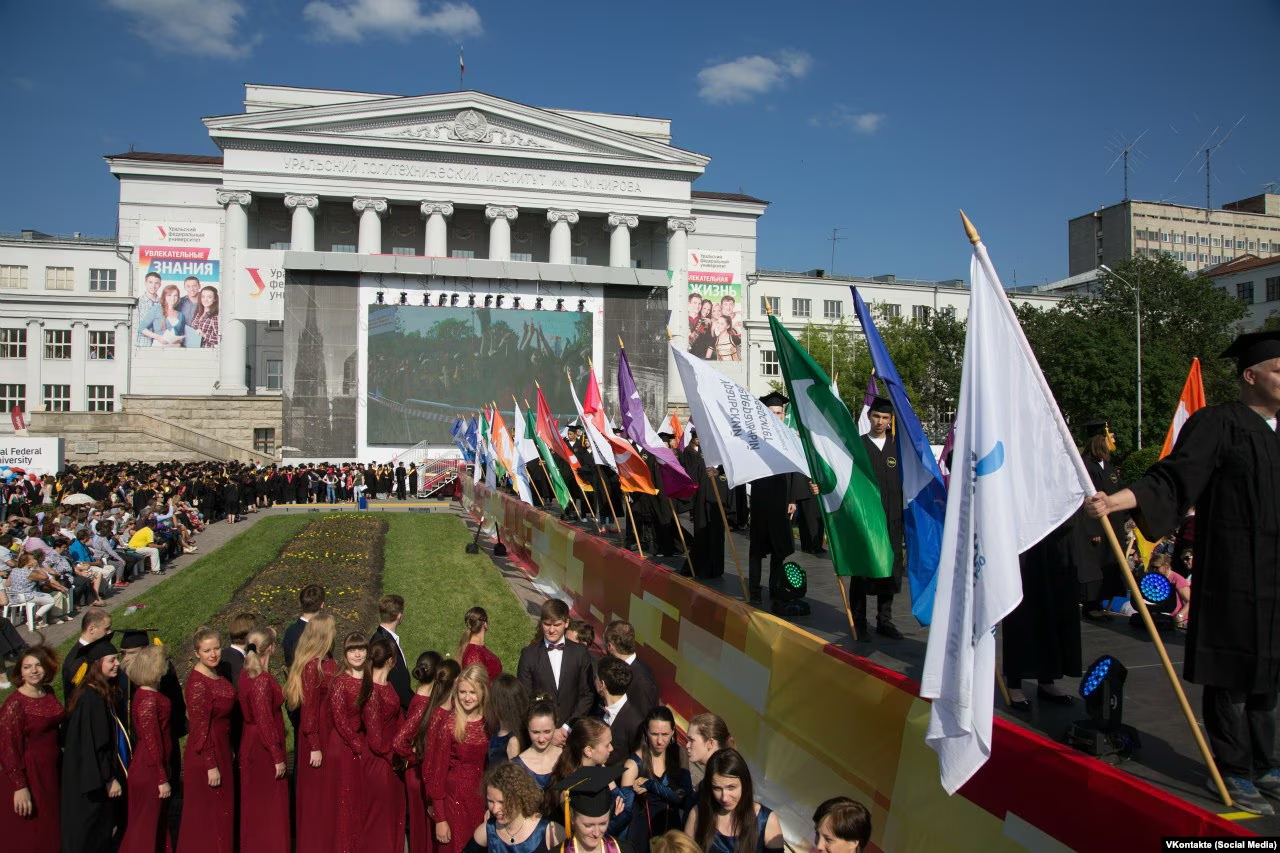
Employees of the Ural Federal University are unhappy with the rector of the rector to reduce 700 teaching rates
The Ural Federal University (URFU) was one of those fifteen universities that the Russian government supports. The program is called "15-100-2020"-the 15 best Russian universities should get to the hundred best universities in the world by 2020. Such a task was set by Russian President Vladimir Putin and the Ministry of Education and Science of the Russian Federation. Two years ago, the so-called "roadmap" of the development of the Ural Federal University was adopted, and its rector Viktor Koksharov chose his tactics to achieve the goal "15-100-2020".
The head of the university explains the upcoming changes by the fact that bets will be reduced, not people. According to him, teachers will have more time for scientific work. But on this basis, a conflict arose, which resulted in a rally, held on June 29, explained the co -chair of the university solidarity trade union Dmitry Trynov :
This is one of the ways to achieve a high rating and visibility of the presence of a university in the global market of educational services
-In the ranking of the best universities in Russia, UrFU takes 13th place, actually closing the list. The rector of Koksharov this year underwent the procedure for extending the contract. These factors influenced what tactics were chosen for the next year. A number of units of our university are not effective enough from the point of view of ratings indicators, one of the main factors of which is the ratio of the faculty to the number of employees with degrees and their publication activity. The rector plans-to reduce 695 rates of the professorship and previous personnel by September 1. At the same time, the order on mass reductions has not been issued, that is, all the procedures laid down according to the law with mass contractions do not apply. For veiled reductions, this will create “other categories of workers” and translate this category of part of the PPS - assistants, senior teachers, associate professors, and professors. They will be called professors-consultants, teachers-trainers and so on. But already with other working conditions ...
- How exactly will the teachers suffer?
The educational process at the university takes, at best, on the third, or even fourth plan
- Until now, a sane position has not been created on these "other categories of workers." In our collective agreement, there are also no such regular units, which, of course, is surprising. As for the deterioration of conditions, this is, firstly, an increase in the load. Secondly, all payments for the position and degree are included in the main rate of the employee. Where is the guarantee that during the transition from the PPS to "other categories of workers", these allowances will remain? I think that these changes will affect our university about 1000 people.
- How was the meeting of the labor collective with the rector?
- The hall holds 238 seats, it was filled to capacity, the people stood between the rows. There were many questions, speeches, dissatisfaction with the plans of the administration.
- What the teachers are unhappy, clear. And how will these changes affect students?
Students from other countries go to URFU not on a common basis, without the exam, but through an interview and testing
- Already affect. The educational process at the university takes, at best, on the third, or even fourth plan. The ability of university units to earn, the ability to find money in parallel to state financing comes to the first place. From the point of view of profitability, they are now evaluated. In second place is the spelling of scientific articles. Accordingly, the most talented and interesting teachers will be inaccessible to students. Today in graduate school it is no longer required to work out, to "read" a certain amount of audit hours. We at the university cannot but reckon with what contingent comes to us. In fact, the minimum bar in physics and mathematics is constantly reduced. This year, the dynamics of the performance of the exam in a number of disciplines worsened again. We must work in a close bundle of a school - university. And what does the administration of the URFU offer? More foreign students, more foreign teachers. Students from other countries go to URFU not on a common basis, without the exam, but through an interview and testing. It is very difficult for us to teach children from Guinea, Kazakhstan, China, which make up the bulk of foreign students.
- What is the benefit of increasing the number of foreign teachers and students?
The heads of the departments are in a state of heavy moral choice: who should they be transferred and who to reduce?
- This is one of the ways to achieve a high rating and visibility of the presence of a university in the global market of educational services. The more foreign teachers and students, the higher the rating turns out. After all, the rating indicators are calculated on the unit of the PPS. It is enough to throw 700-800 people from the faculty, transfer them to the "different category of workers." Indicators will grow right away!
- What are you expecting from protest?
- Everyone is very wary. There is strong pressure from the administration. And most importantly, the heads of the departments who have not received real mechanisms of reduction and translation are in a state of severe moral choice: who should they be transferred and who to reduce? Of the 300 rally participants, at least a third - teachers. We were supported by the local branch of the Russian Academy of Sciences, several public organizations, including an independent student union.
- What are you putting forward?
- First: "freeze" for a year of change and reduction. For this year, bring the regulatory framework to the appropriate state, discuss the proposed changes with the university public. Seriously think about the status of these "other categories of workers" in order to equalize them with the faculty. Second: to change and modify the "road map" of the university, taking into account the opinion of the public and experts in the field of economics and law. Third: to introduce three representatives of university employees into the Supervisory Board of UrFU. Today in this structure there is no one from the public of the university. And the fourth: radical debit and optimization of administrative and managerial personnel.