
Translated material
Pictures from the exhibition
China is in fashion and music
Alexander Genis: Today, our traditional section “Pictures from the exhibition” will go to the Museum of the Metro, where the exhibition of the year is now being held (I am sure that all critics will be called by this).
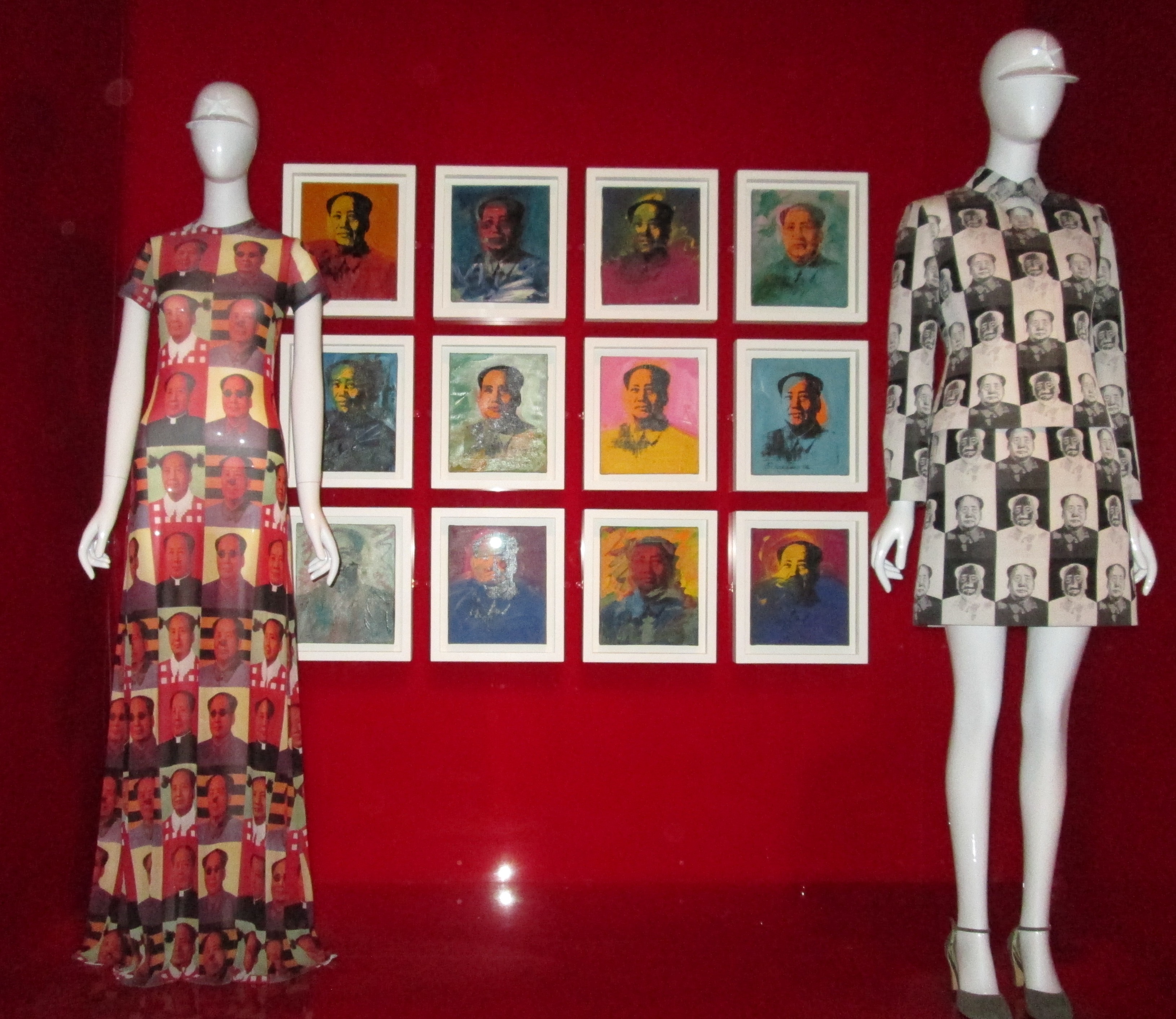
For his seventy years, the institution of the costume has not yet seen this. The exhibition dedicated to the influence of China for Western mods has become the best and the largest. She captured three floors of the metro museum and, opening with a luxurious ball, attracted an unprecedented number of movie stars, fashion designers and paparazzi. Her curator moving from London to New York Andrew Bolton undoubtedly created a sensation. He connected costumes with cinema, music, installations, and most importantly - the exhibits of the richest Asian department met, forcing the new to rhyme with the ancient. The result of the combined efforts of many museums, including, of course, Chinese, was unprecedented, except for the Beijing Olympiad, a spectacle. The exhibition in the metro managed to embody in silk and brocade a gold myth about China, which has been exciting Western fantasy for centuries. The “China” that shows us the exhibition needs quotation marks and an old spelling: Katai.
(Music)
Alexander Genis: The Far and Inaccessible East, united by a foggy medieval geography into one mythical “Katay”, has become a source of utopia since they learned about it. The very existence of the world independent of the old oikumen with the undoubtedly highly developed civilization was abolished by Christian universalism. The Bible turned out to be the history of not the whole world, but only its parts. The radically different religious, intellectual and aesthetic development of China made it a natural training ground for European fantasy. “Katai” was a pure page on which philosophers and poets tested their concepts. And each era found there what she dreamed about. One he seemed to be an empire of the mind, which managed to create the perfect state system for Plato with a philosopher king on the throne. Others, on the contrary, were looking for the harmony of man with nature in the East, which abolished the need for authorities at all. Tolstoy, who retold Lao-Ozu, was so worried that he said shortly before his death: he would be young, he would go to China.
Often, Europeans saw in the “katae” sophisticated and delicate praise of customs, corresponding to the most important (after tea) eastern export - porcelain. This image in the style of “Shinoiseri” survived, despite all the Asian cataclysms, to our time. The legendary “Katai” is his elegant grace, the serene old age of the long -liver, wise mysticism and earthly religiosity became the standard with which this exhibition works.
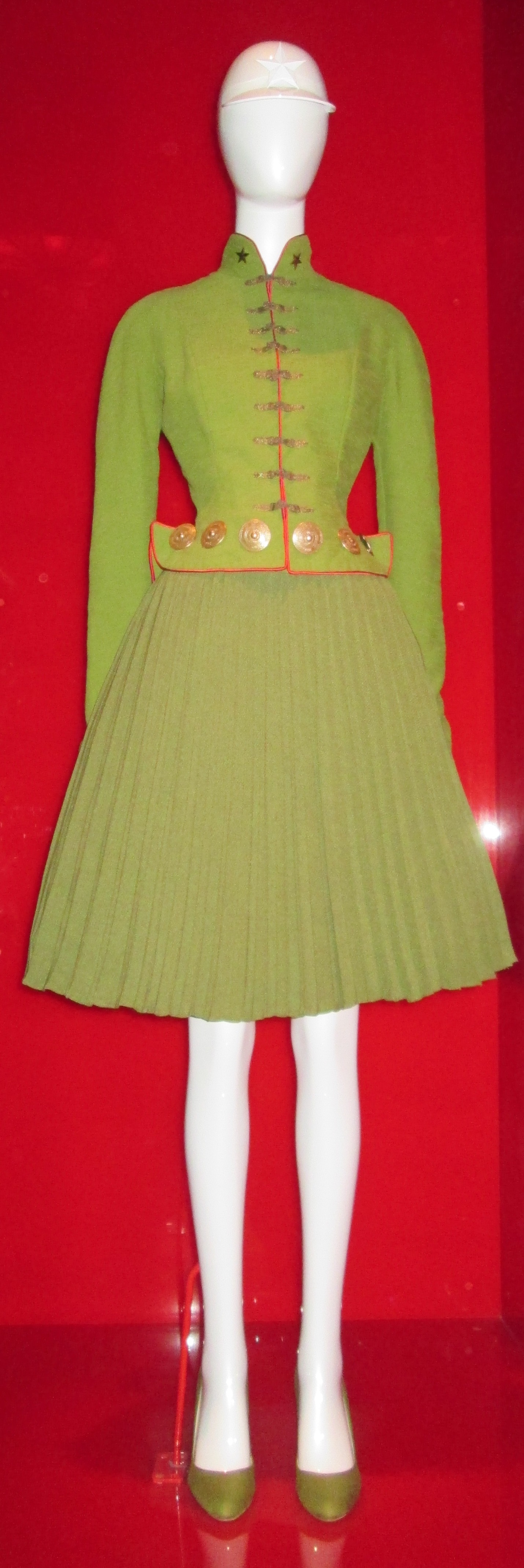
Transmitting the influence of Chinese images on the European costume, the exposition bypasses all the nursers of fashion, up to silent cinema and the Maoist outfits of the time of the cultural revolution, which had its fans in the West (recall Sarta). But the best exhibits belong to the Rococo era. With the help of costumes, furniture, mirrors and trinkets, the curator of the exhibition spoke about the era unsurpassed in elegance, playing in Katai and trying on her larva.
(Music)
Alexander Genis: dressed mannequins dressed in priceless dresses from a huge (35,000 objects!) Collections of the costume institute, sang a woman who was in the center of that culture. Galance is a languid delay in front of the denouement, which transforms life into a ritual, we are into gentlemen, and I will give us to architectural excesses. Nowhere and never women, except for the same imperial China, did not dress so difficult, expensive and beautiful that in the end result they lost their resemblance to people. The silhouette of a correctly dressed lady, which is easy to verify at the exhibition, repeated the outlines of a sailing ship. The stern was depicted by a silk skirt with a Chinese pattern, stretched over the fihma (a frame from willow rods or a whale mustache). In such a dress, the lady could only go through the door sideways, sit only on the sofa and walk only with Pavoy, and not far. Having rocked his royal harem, approximately the way they did with the ladies in Old China, the 18th century did not get tired of admiring his greenhouse charm. Having become a masterpiece of decorative art, the woman finally turned out to be what, whatever the feminists said, she always dreamed of being - an invaluable trophy, the crown of creation, a precious toy. Turning under it, the surrounding acquired femininity and decreased in size - hunting dogs, say, were reduced to indoor Chinese Beijes dogs.
It is amazing to the decadent excesses of the 18th century that became the subject of imitation for modern fashion designers who develop the same fashion features - crazy luxury, total impracticality and sophisticated fantasy. All this is attracted by crowds of spectators to the crown exhibit of the exhibition. Golden dress of Chinese Gao Pie. Distinguished by her costumes at the opening of the Beijing Olympics, she introduced a royal dress of gilded brocade. The hem of this royal outfit depicts lotus petals and covers the crawl allotted by Buddhist sculpture. Of course, you can’t walk in such a dress, sit down or dance. It resembles architecture and a lady dressed in it looks like a gilded Budian stupa.
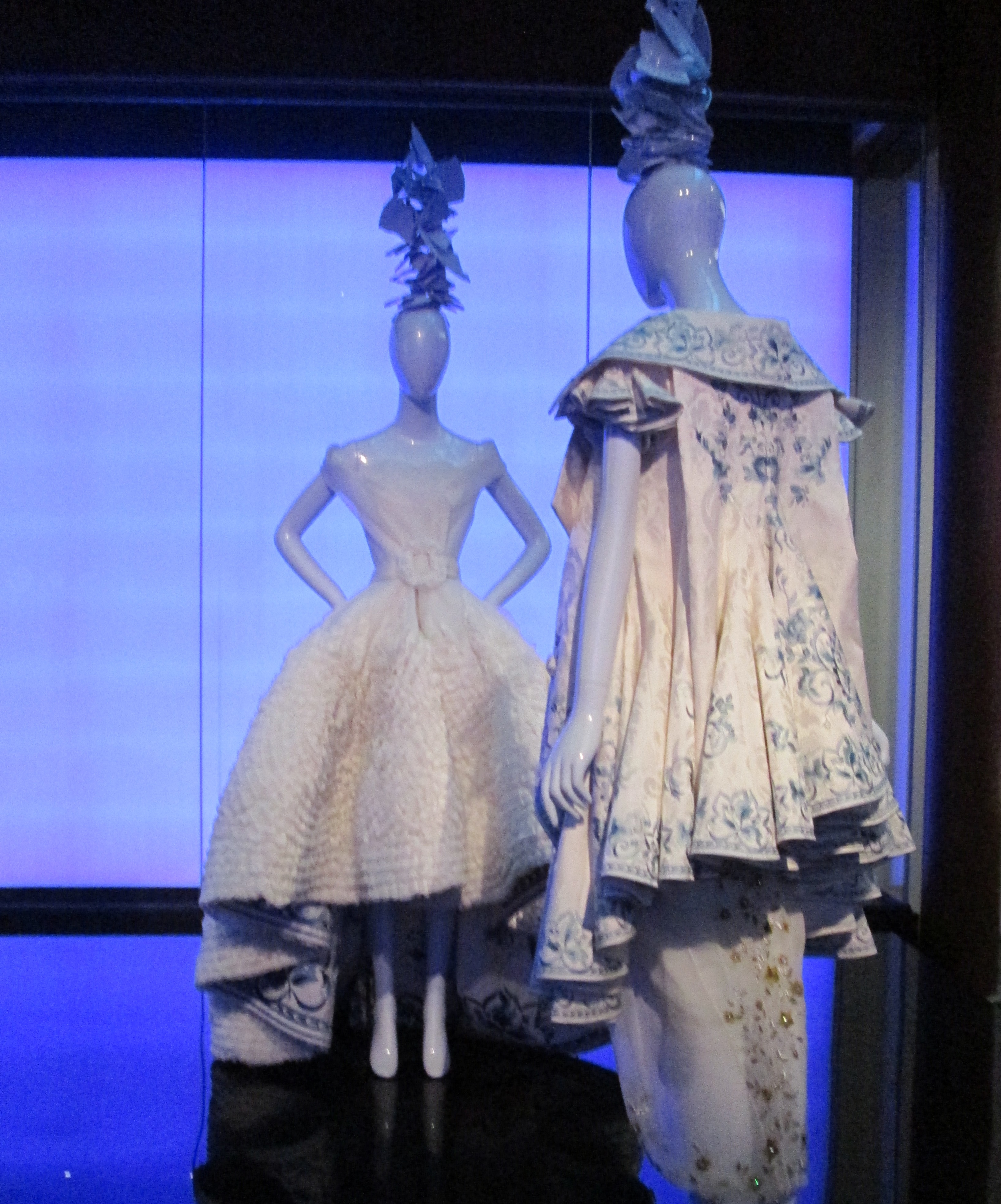
Another masterpiece of the exhibition was the hooligan work of Alexander Makuin, who sewed on a dress Sweets of a blue-white porcelain service. Perhaps this is the irony of the master, who defeated the Far Eastern dream of the West into pieces. But if the XX1 century is passionate about it no less than in the time of Marco Polo, mythical Katai is still with us. In any case, on three floors of the New York Museum of the Metro.
(Music)
Alexander Genis: Well, now we will continue today's issue of “Pictures from the exhibition” with a conversation with Solomon Volkov about Chinese motives in classical music.
Solomon Volkov: When I thought that to show our listeners in connection with this hobby of Chinese ... I will immediately say that you somehow do not really like this term and you replace it with foreign words, and I, as Admiral Shishkov in this case, insist ...
Alexander Genis: Well, Shishkov, well, the admiral.
Solomon Volkov: ... I insist on the use of this. What can I break the language, as Nathan Mironovich Milstein once said when we discussed one language problem with him. So I also do not want to break the language and I will say “Chinese”.
Alexander Genis: Only the suffix confuses me. When we say “Chinese” is something bad. One thing is Oblomov, another is Oblomovism.
Solomon Volkov: But I use this term without any negative meaning, one, as they like to say on the Internet, “Positiff”.
Alexander Genis: Okay, we will say China.
Solomon Volkov: So, speaking of the Chinese, I wanted to present two very curious works belonging to two great masters who, probably in real life, were not emergency fans of each other - this is Jakomo Puccini and Gustav Maler. It seems at all that nothing connects these two people, one such open, romantic Italian faith, populism, and the other ... The paradox is that the other open, romantic, but only Mahler is Viennese sourdough.
Alexander Genis: Great difference. Alpes are changing. I have to say that it always amazes me, as the same topic is decided differently in Teutonic art and with Italian artists.
Solomon Volkov: And no European community can correct this now.
Alexander Genis: In any case, not in art. Look: there are two remarkable works of cinema on the same topic - the fascism of the eyes of a teenager. One film on such a topic was shot by Fellini, and it is called "Amarkord". It can be my favorite movie in general. And another film is a “tin drum” based on the novel by Gunter Grassa. Both films talk about childhood conducted during the time of fascism. But what a gigantic difference between these paintings. Indeed, terrible things are shown in both films, but if in “Amarkord” all this is dissolved in a complacency smile, then the “tin drum” is all tin, he rattles, and not sings, like Fellini's. So, I repeat, the Alps are changing.
Solomon Volkov: But in this case, just the opposite. I wonder how time is smoothing out. People who during life were perceived as perfect antagonists in culture, now, in my opinion, their positions are coming closer, it will soon be possible to confuse Puccini and Malera, although in the perception of the broad masses of classical music lovers.
Let's start with Mahler, because his composition associated with China is earlier, he wrote it in 1908, when he found out that he was mortally ill, his daughter died shortly before. Mahler was generally a pessimistic person, philosophically configured.
Alexander Genis: When Mahler was a boy, he was asked: who do you want to be when you grow up? He said: "Martyr."
Solomon Volkov: Yes, it is very similar to him and his music. He constantly thought about death, and then the doctors simply told him openly that it was not so long to live, and they were right, he died in 1911, when he was only 50 years old. This is a “song about the earth”, written in the words of medieval Chinese poets, the main of which is Bo. Lee Bo is probably the most famous Chinese poet. How do you evaluate it?
Alexander Genis: This, of course, is a classic. This, of course, is the most famous poet in China and in the West. Whether Bo is an extremely curious figure in all respects. It is characteristic that not so long ago in America a novel dedicated to Bo was released in America. And this novel is not just a poetic meditation on Lee Bo, the author also talks about what the poet was a wonderful fencer, which, by the way, is true.
Solomon Volkov: This is a surprise for me.
Alexander Genis: A very curious figure, he always entered the myth of China, about the very catai that we just talked about. Chinese verses are very difficult to translate, every country has its own traditions of these translations. I recently found out, a Russian woman lives in America, who translates from Chinese. Shortly before his death, Brodsky made friends with her, she showed him Lee Bo's trowels, to which Brodsky wrote poetry. This is from a textbook poem Lee Bo “Remembering the Native Country”.
The lunar lunar seemed to me snow,
The cold wind suddenly died from the window ...
Above the house where my friends stayed,
Now, probably, the moon.
It is amazing that Brodsky shortly before his death, like Mahler, became interested in ancient Chinese poetry, in particular, precisely Lee Bo. That is, there is a parallel, I would say, mystical properties.
Solomon Volkov: As for Maler, you are very interesting to say precisely about not only every country, but also every segment of the time of his tradition of translating China. That is, the Chinese are adapted. Sometimes this adaptation is extremely far from the original.
Alexander Genis: In Germany, there were very high achievements of synology, just at that time there was an excellent school of translations from Chinese. In the first half of the twentieth century, the heyday of this science was marked. So Mahler was in the spirit of time.
Solomon Volkov: I am not a specialist in Chinese poetry, but I know the “Song of Earth”. I want to say that maybe this is my favorite work of Mahler, I love him much more than any of the Malera symphonies. He used the translations of the German poet Hans Bedga there. In turn, the Malera’s work “Song of the Earth” was written by Evgenia Zavadskaya, a specialist in Chinese and Japanese culture, in particular, in Zen.
Alexander Genis: I perfectly remember her very popular book about how Zen influenced Western culture.
Solomon Volkov: It is there that it is discussed among other Mahler, Salinger, Matisse. Now it is perceived more like a certain tribute to time and fashion - to unite such different authors as Salinger, Matisse and Male, but for each of them she has thin interesting comments.
Mahler laid, as I said, music into German translations, and Zavadskaya, in turn, made a substrate, it gives a substrate in her book and there are poems that, in my opinion, are extremely little reminiscent of whether Bo, in any case, whether we were accustomed to more authentic translations. Here's how the “song about the earth” begins with what text is the Maler’s text, and you tell me, it looks like the Bo, which we admire, in particular, to the Bo, which so delighted Brodsky.
The golden bowl is already beckoning your mouth.
Do not drink until I sing the song
Song of sadness, like death,
It should be preserved in your soul.
Gloomy life, gloomy death.
Is it a bo?
Alexander Genis: This is a very free fantasy on Lee Bo. But there is no anyone's fault. The fact is that Chinese poetry is all like that, after all, it is built as a rebus, in essence, the reader needs to be assembled again. In part, the peculiarity of the old Chinese language is guilty of this, which is deprived of many grammatical properties that are characteristic of our languages. Therefore, Chinese verses are a kind of pointers that show where to go to the reader in order to overtake the author and understand how he felt when he wrote poetry. The role of the reader in Chinese poetry is much larger than ours. Therefore, each translator is an interpreter, and every reader is an interpreter, and everyone has the right to do so.
Solomon Volkov: But in the end, this interpreter is composer Mahler.
Alexander Genis: And maybe he is much closer to the original.
Solomon Volkov: Perhaps he is closer to the Chinese original, but he is also closer to our sensitivity, to our attitude, which understands the romantic, self -sinking mood of Malera music and this is his romantic despair in the face of inevitable death. The music, in my opinion, amazing, she just overwhelms you with a wave of dark, thick pessimism. And here, it seems to me, Mahler diverges from the Chinese tradition that seems to me authentic, but his mood is extremely close to my attitude today. Here is this music.
(Music)
Solomon Volkov: And now a completely different example. It would seem that Mahler with his superromanic interpretation of Chinese, and Puccini, in the tradition that we used to associate with Puccini, this should have been even more romantic. But instead - a surprise. The last Opera of Puccini, which he did not have time to finish, was the opera for the Chinese plot. But it was not just a Chinese plot about Princess Turandot, capricious, cruel, who killed applicants for her hand one after another, ordering them to execute them because they could not solve her difficult philosophical puzzles, until she finally fell in love with one of these contenders of Prince Kalaf. The paradox is that this supposedly Chinese plot goes back to the Italian - to Count Carlo Gozzi. This was one of the popular plays of the very popular Venetian playwright of the 18th century with a special fate. Gozzi became a cult figure in Russia in pre -revolutionary time. Meyerhold published his famous magazine (several copies of which I have stored in New York-this is one of the treasures of my library) “Love for three oranges”
Alexander Genis: Gozzi constantly pops up in world culture, and sometimes finds very hot fans. For example, German romantics idolized Carlo Gozzi. They had a strange selective taste. They loved Aristophanes, Cervantes, Shakespeare - and Gozzi, he was their idol. The same thing happened in Russia at the beginning of the twentieth century, when Gozzi was resurrected, Hoffmann was resurrected. That is, each era finds, with whom to coffee.
Solomon Volkov: This is a wonderful word - to crumble. Puccini was in a sense a “Verian” composer and very accessible to the public. This is the secret of its evergreen popularity.
Alexander Genis: Therefore, I love Puccini operas the most.
Solomon Volkov: We all love Puccini, there is nothing to be original here. As for this last opera, it is unusual - it is not at all Puchchinievskaya. Firstly, it is very gloomy. Secondly, there is absolutely no admiration for this Chinese in it.
Say, in Chio-Chio-San, it is Madame Butterflya, another Puccini opera associated with Japan, there is an admiration for Japanese exotic. Nothing like this in Turandot, Turandot is a very gloomy and terrible opera.
American philologist Boris Gasparov from the Tartu school, with whom I have the honor of being familiar, made a very interesting experience, he investigated the origin, the “Turandot” of Puccini. And it turned out that this so -called Puchchinievsky Chinese has roots in Russia.
Puccini tried to rebuild and become a more modernist composer, a more modern composer at the end of his life. He died at the age of 65, without fully committing this coup. Therefore, Turandot is a work of the transition period. He tried to update his language, tried to update his worldview, in the end. And here, which is very interesting, the “Boris Godunov” by Mussorgsky served as a model for him.
In Russia, there are three composers who are at the source of all are Glinka, who, like Pushkin, from Glinka, go to all directions. Glinka is “our everything” in Russian music, which, unfortunately, is not so often remembered now. Then it is Tchaikovsky, from which endless threads also stretch in a variety of directions. And the last author in this great three is a Mussorgsky, to which a variety of composers also fell as a source. Two such largely opposite author as Shostakovich and Stravinsky, both drew a lot in Mussorgsky. Так вот, Пуччини пришел к Мусоргскому через Стравинского, он сначала услышал «Петрушку» и «Весну священную», сначала он подружился лично со Стравинским. Дорого бы я дал, чтобы присутствовать на беседе Пуччини со Стравинским.
Александр Генис: Как говорят: хотел бы я быть мухой на стене.
Соломон Волков: В разговорах с ним, я думаю, они должны были обязательно обсуждать Мусоргского. Стравинский, который был горячайшим поклонником Мусоргского, конечно, должен был рассказывать о нем Пуччини, и тот заинтересовался «Борисом Годуновым». И итоге Мусоргский оказал грандиозное влияние, как мы знаем, на французов, на Дебюсси, но это был гармонический язык, а у Пуччини это - драматургия оперная. Гораздо более сильное влияние и глубокое, чем это было в случае влияния Мусоргского на Дебюсси. Чтобы не быть голословным, я предлагаю нашим слушателям самим убедиться в этом убедиться и прослушать красноречивейший отрывок; Вот как начинается опера Пуччини «Турандот» - точно так же, как начинается опера Мусоргского «Борис Годунов».
(Music)