
Translated material
Gadgets of the week: robots, the first iPhone, the unexpected leader of tablets in Russia and houses of the future from IKEA
The material was written with the support of M.Video
Every week TJ reviews the most discussed and notable news from the world of gadgets. In the new issue: a “robot wedding” with the participation of the Japanese “toastmaster” Pepper, the eighth anniversary of the start of sales of the first version of the iPhone, the unexpected leadership of the Russian tablet manufacturer, trends in the home of the future from IKEA and a robot assembling brick houses.

Eight years since the start of sales of the first version of the iPhone
On July 29, 2007, the iPhone 2G went on sale in the United States - the first iPhones with an aluminum and plastic body that could neither record video nor connect to the Internet via 3G. But they were the first to choose a touchscreen (almost) on the entire front panel over all other advantages - and Apple put a lot of effort into making the famous smooth scrolling through the notebook work without failures.
 How the appearance of the iPhone changed from the first version to the iPhone 6. Animation by Gadgetlove
On this occasion, the publication “Zuckerberg will call” recalled the forecasts of famous domestic analysts and Western media. If the latter were cautious in their expressions, then the masters of Runet Artemy Lebedev and Eldar Murtazin immediately dubbed the new product as unpromising.
A phone without buttons is shit, because you can’t dial a number by touch while driving. And you can’t send an SMS normally. Let's hope that manufacturers like Griggin or Belkin are already developing a connected keyboard.
In general, Apple did not introduce anything particularly new, except for speed and a good interface. The functions of the iPhone (including the touchscreen) are repeatedly overlapped by offers from other manufacturers (which lack only speed and a normal interface).
The only really good thing about the iPhone is the automatic formatting of numbers (like 212-85-06, not 2128506, like everyone else).
Artemy Lebedev, founder of Artemy Lebedev Studio
iPhone 2G was my first smartphone. I remember that in 2007 I couldn’t afford to buy it right away, and only in May 2008 did I buy an iPhone second-hand from a man who brought an “extra” one from Los Angeles. A month later, the iPhone 3G came out, and my smartphone, as they say, turned into a pumpkin.
Over the entire period of use, the back cover was worn black (I almost never let it out of my hands), once the “mother” burned out due to a voltage drop, and in 2011 the screen broke from an unexpected fall on the asphalt - but everything else continued to work. The repair was extremely expensive: I gave the iPhone to a friend so that it would not sit idle in the nightstand. 3.5 years of faithful service - it was the longest relationship in my life.

“Wedding of robots” or SoftBank PR
On July 27, the so-called “robot wedding” took place in Tokyo, an event designed to demonstrate the humanity of advanced technological developments, organized by the artist brothers from the Maywa Denki team. The groom was the clumsy robot Frois, similar to “Samodelkina” from “Funny Pictures,” and his bride was the android Yukirin, who looks like a real Japanese girl.
Of course, the event cannot be considered an official wedding: not a single registry office in the world registers marriages between computers - at least not yet. The robots themselves behaved extremely unnaturally: there was no exchange of rings, and the symbolic kiss looked like extending a metal disk from Frois’s “mouth” to Yukirin’s face.
 Frois and Yukirin. Photo Rex
The crowning achievement of the performance was the robot Pepper, playing the role of toastmaster - a commercial development of the Japanese company SoftBank, known as an “emotional robot”. Pepper has recently become an object of interest in the technology press: SoftBank is scheduled to hold an important press conference in early July, and something tells us that we will hear more about Pepper - but not because of the art performances of Japanese avant-garde artists.
Trends in the “home of the future” from IKEA
Mashable spoke to Australian futurist Barry Barton, who has teamed up with IKEA to figure out what homes will look like in the future—at least in Australia. We are talking primarily about megacities, where the design of houses and apartments plays a decisive role in the efficiency of work and personal life: according to Barton, the notorious “four walls” are awaiting dramatic changes.
1. The walls will move. Previously, only furniture moved in the house, but the main feature of the future will be the constantly changing requirements of residents in conditions of lack of space. For example, the owner of a two-room apartment can, within a few days, turn from a businessman into a party-goer, and from a party-goer into a homebody-family man, and back into a businessman. Changing your place of residence is expensive and ineffective, so you need to quickly turn the living room into a study, and the kitchen into a bar.
 Moving walls make the apartment arrangement more adaptable. IKEA concept photo
2. Walls and roofs will become a formality. The surrounding world will merge more and more closely with the interior of the apartment or house. Walls with windows leading to the garden are already often made transparent so that you can admire the greenery and let more light into the house, and in the future this will happen with the ceiling. The world can move away from air conditioners to systems that manage air quality to create a sense of “nature.” Another solution is indoor planting systems.
3. Homes will obviously become smarter. It's not just about locks that can be opened via Bluetooth via an iPhone app, but also about the fact that houses will be able to detect who is in them and change based on the preferences of different residents. The technology will also become smarter, but we won’t notice it: it’s easy to get used to the fact that the surface of the kitchen table itself measures the weight of the products placed on it.
 A “smart” kitchen table surface measures the weight of food by pressing a button. IKEA concept photo
4. The floor will be cleared of unnecessary things. As part of saving space, they will try to hang all the equipment on the walls as much as possible, including exercise equipment and bicycles, which will double the amount of useful furniture on the floor.
Russian Oysters tablets temporarily became the market leader due to the M.Video promotion
On June 29, the topic of the day in Russian specialized media was the story about the market share of little-known Oysters tablets running on Android. In the first quarter of 2015, they occupied 17.1% of the Russian market in unit terms, even surpassing such brands as Samsung and Lenovo.
Of course, there was no talk of market leadership in monetary terms. Oysters are budget tablets (5-10 thousand rubles), and the share of revenue was only 5.9%. But, according to the company itself, in January-March it sold about 300 thousand devices.
 Oysters T34 tablet. Photo Foxter
However, the secret of such local success was a promotion with the M.Video chain of stores, according to which the Oysters tablet was included in the “load” for free with a purchase worth 9,999 rubles. About 170 thousand devices were issued under it, and after the end of the campaign, the share of the Russian company decreased back to 8%. And we were already hoping for import substitution.
No need for 3D printing: Hadrian is a robot that assembles brick houses
The Australian company Fastbrick Robotics is a rare example of a name that matches its core business. Her Hadrian robot, which lays bricks at a rate of 1,000 bricks per hour, assembles the house in two days.

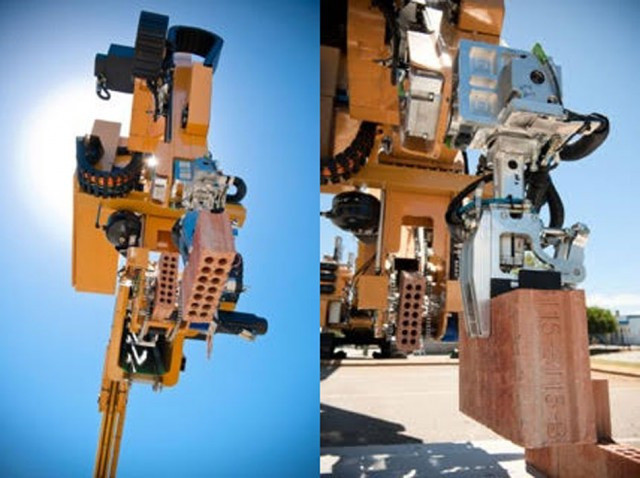
True, we are only talking about laying the brick itself, and not the mortar - for this, the robot named after the Roman architect still needs human operators, so in the near future it is unlikely to be able to lead the uprising of the machines. But Hadrian can take into account the laying of various communications in the thickness of the brick - electrical wires, sewerage, water supply - however, working only in a strictly defined position.
Despite the $7 million investment already spent on research and development, Hadrian is still at the working prototype stage, while entire houses are already being built using 3D printing in China.
#Article #Apple #iPhone #3D_printing #robots #tablets #smart_home #IKEA #M_Video #Pepper #first_iPhone #SoftBank_Robotics #iPhone_2G #Oysters