
Translated material
You need to drink less
Crimean winemakers for the second time asked Vladimir Putin to ban the import of wines from the EU into Russia
Crimean winemakers for the second time asked Vladimir Putin to ban the import of wines from the EU into Russia
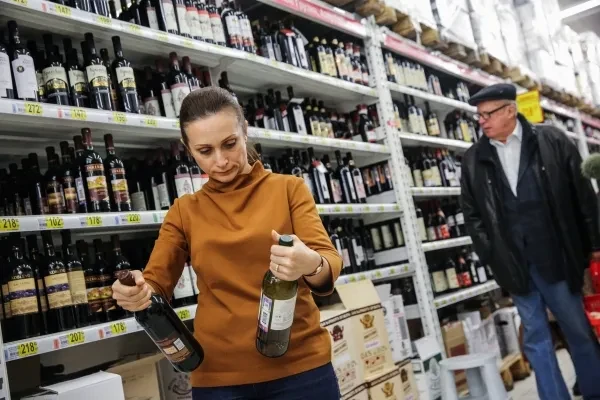
For the first time with this initiative, entrepreneurs performed last summer. But then not all manufacturers supported the idea: “Golden Balka”, “The Legend of Crimea” Iinkerman were against it. Maybe that's why the proposal has not passed.
But this year everything has changed. Alexei Lipko (director of the Inkerman Marych Vin Plant) spoke in support of the request for the embargo: “In terms of price-quality ratio, European wines are not competitors for us at all. But if the European partners will be trolling, then I, as a patriot of the country, and our entire labor collective will support the policy of the Government of the Russian Federation. ”
As they say, from trolling to patriotism is one step.
Where does the wind blow
Last year, about 30 winery households of the peninsula united in the Crimean Bureau of Grapes and Wine. The chairman of this professional organization was the ex-director of the New Light winery plant, and now the general director of the Massandra production association Yanina Pavlenko.
At one time, she was an activist of the Party of Regions and had close ties with the speaker of the Crimean parliament Vladimir Konstantinov (she was the third number in the list of regionals in the local elections of 2010 - while Konstantinov headed the republican organization).
In the last election, Yanin Pavlenko defiantly refused to run for the Crimean parliament from the Playan party, which was in a state of confrontation with the future leader of the republic. After that, Mrs. Pavlenko entered the circle close to the head of the peninsula Sergey Aksyonov.
In Ukraine, an entrepreneur has a scandalous reputation associated with a case that occurred 5 years ago. On the eve of the New Year, in a Snegurochka costume she arrived in one of the orphanages of Feodosia with flags and balls of the Party of Regions, and then began to endow the pupils, pronouncing about the following text: “They arrived from the New World Champagne plant. Do you know such a factory? Do you know the Party of Regions? Raise your hand, who knows! Here from the Party of Regions we want to congratulate you on these wonderful holidays and give these wonderful gifts. ”
The public was outraged not so much by the ethical inadequacy of a person, but by the fact that the top manager of the state enterprise handed the children gifts from this very enterprise within the framework of political agitation.
It was this person who now oversees all winemakers and vineyards in Crimea, became a public initiator of the new proposal to introduce a wine trade embargo, which will be officially framed at a meeting of the Crimean Bureau of Grapes and Wine under the guise of defending honest competition (as if it were about economic rivalry, and not about fundamental political things).
The situation was like this: on June 24 it became known that Vladimir Putin signed a decree on the extension of food counter -sanctions for a year. The next day, Yanina Pavlenko made a request to include European wines in the list of sanctions products. Then the commentary of Sergei Aksyonov appeared in the press: they say, he talked about the need to protect the Crimean winemakers on June 16, during the visit of Dmitry Medvedev.
It is quite obvious that the initiative of Mrs. Pavlenko is “the development of the topic”, lowered from above from the team of the head of the republic, since an entrepreneur cannot be called an independent figure.
But the main question is different: what will the wine embargo give Crimean manufacturers and how will it affect ordinary Russians?
Indeed, last year, when entrepreneurs made the same initiative, it was not about the ban, but about restrictive measures - an increase in import duties, which could indirectly increase the sales and volumes of production of Crimean wines.
But now the hard embargo is being discussed.
Russian Provence?
Suppose the Government of the Russian Federation will really include European wines in the list of sanctions products. The question immediately arises: then what will the officials drink? But we will lower it. Another thing is more important: will Russia be able to find internal resources to compensate for the volume of missing alcoholic beverages?
In 2014, only 24.1 million was imported in the Russian Federation (Dal - this is a wine designation of the volume equal to the decalitra). Of these, France delivered 4.6 million, Spain - 3.7 million, Italy - 3.6 million, etc. At the same time, Crimea produced a little less than 3 million over the past year, and Russia as a whole gave 47.7 million to wine (quiet varieties - 32.1 million, playful - 15.6 million).
Looking at these numbers, we can assume that Russia may well do without imported European wines. But the impoverished market is unlikely to chase their Crimean analogues. Why? The specificity of this market is that winemaking is developing due to the minimization of state pressure on the industry (minimum regulation) and ensuring investment for long -term guarantees. Winemaking is far from the same as ordinary agriculture: the first grape crop that can be used to make a drink is collected 3-4 years after laying vineyards.
In Crimea, these difficulties are added a risk factor. Grapes withstands a temperature of up to -20 degrees, therefore, according to statistics, once every 7 years, vineyards on the peninsula have significantly suffer from frosts, and once every 15 years, 90% of the table grapes and 40% of the technical die due to the cold in the republic.
But, instead of dealing with natural and economic difficulties, working to improve the quality of their own products, local winemakers launch creative ideas about the prohibition of “competitors” goods into public space. Of course, this is much easier than asking questions about the quality of the soil, the region of growing grapes and the number of sugar in it. The main thing is production volumes and plan. Here he smacks of a “scoop”, and not with market competition for the consumer.
In this sense, the “wine question” is only a reflection of the general economic problems of Crimea. After all, if winemakers without direct state patronage cannot overcome competitors in the domestic market and significantly expand their own production, preserving the quality of products, it becomes clear: the key to success lies certainly not in imposing a “symmetrical struggle” to the government, but in the removal of sanctions restrictions in general.