
Translated material
The market of donor kidneys
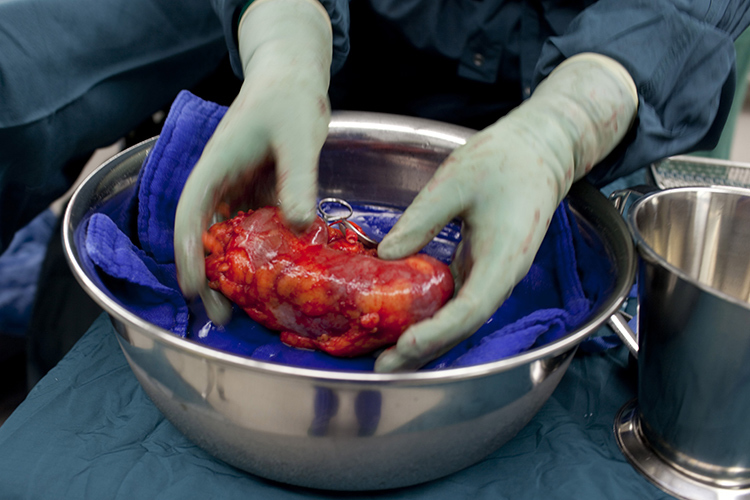
It makes sense to carry in pairs in pairs in the poor Africans. One, healthy, will cut the kidney. The second, the patient, will be transplanted (and there will be life, because somewhere in Nigeria, doctors cannot help patients with refusing kidneys). After this operation and the necessary postoperative departure, both will sit on the plane and go home. For free. And the American medical insurance system will save at least 125 thousand dollars. What, one wonders, is the benefit?
The author of this idea Alvin Roth , a 64-year-old professor of economics in Stanford, divided with another economist, Lloyd Shepli, the Nobel Prize for “Market Design” in 2012. Probably, the most important example of this “design” is the operating system of renal transplanting in the United States with a complex diagram of the exchange of donors, which in 2014 already had most of the 17,000 transplantations. So far, however, without invited patients and donors from the third world.
A person has two kidneys, and you can survive with one - and this creates a rare opportunity to become an organs donor during life, consciously, without turning into a disabled person. For example, if you needed your brother or your beloved girl who got into an accident. But in no country in the world, except Iran, a donor kidney can not be legally buy or sell. The economist seems to have nothing to do here: there is no exchange of money for goods - there is no subject for conversation.
It’s unreasonable to marry your favorite classmate - simply because you chose from few options, and at the university you will find a “dense market” of brides.
In the newly published book “Who Gets What - And Who”, Professor Roth objects: there are markets not only where there is money. Having rummaged, the economist can see them - and apply the laws of supply and demands bred for the most “money” markets like the stock exchange, in situations such as the choice of a wife or a parking place.
Here you are driving around the city at rush hour and a few quarters from the office you see one empty parking place in a dense comb of cars along the side of the road. Isn't it time to park? The solution depends on your ideas about how things are further along the route. If you suspect that everything is clogged there (zero proposal), then it is time-because if you move further to reconnaissance and return with nothing, then this is a distant place from the office someone instead of you will take place.
Such tasks are about the adoption of strategic decisions, when the future depends not only on us, but also on the unpredictable free will of other players (drivers on the road, kidney donors, potential brides, anyone), the theory of games, the area of the mathematical economy, in which Elvin Roth specialized.
If in the ninth grade you have love with reciprocity, which withstood all the trials until the 11th grade, then the professor’s mouth claims, it is still unreasonable to marry a classmate-simply because you chose a few options, and at the university you will find a “dense market” of brides, a choice of many. And the probability of finding the optimal pair above. As in the famous task about the Monty Hall show . There are three doors in front of you, behind one car. As soon as you put your finger at one, the presenter will open that of the two remaining, behind which there is nothing, and will ask if you want to change your decision. The theory of games says that whatever door you indicate at the beginning, the decision must be changed: this increases the chances of winning in half.
Why is it necessary to operate at the same time? Because otherwise one of the donors can change his mind.
Kidney transplant is also an example of the game. Trade is prohibited here, but exchange is possible, and this turns a medical problem into an economic task about the market.
If your beloved girl or brother suddenly is diagnosed with chronic renal failure, one of your desires to become a donor will not be enough. At least you should coincide with blood groups. Doctors also have much more stringent histocompatibility criteria - roughly speaking, so that the body is not a transplanted organ, the immune system must recognize it as “its own”. It is best if the kidney donor has a twin brother to her recipient. But already among spouses, histocompatibility is sometimes disrupted at the birth of a child: the mother’s body produces antibodies to some proteins of the child, which the father also has. Therefore, after childbirth, the probability of rejection of the organs is higher.
And complete histocompatibility is a rarity.
The possibility for kidney exchange occurs when another couple is found where your kidney is suitable for the patient, and your brother or girl is a donor kidney from this second pair. Doctors in the United States have learned to conduct such exchanges only in the early 2000s, since the procedure is quite troublesome. We need four operating rooms at the same time, where four brigades of transplant doctors will cut the kidneys with two donors and transplant them to two patients.
Why is it necessary to operate at the same time? Because the kidney cannot be taken by force, no matter what agreements. If there is at least a minimum temporary gap between the operations, then the donor whose relative received the kidney first will have time to change his mind. And then the other pair will be in a hopeless situation-not only without a kidney for the patient, but also without a donor that can participate in further exchange: this is the first critical theoretical and game conclusion.
A lifelong hemodialysis costs a quarter of a million dollars - twice as much as the operation.
There were no risk of refusal, the “patient-donor” steam in the chain of transfers could have more than two. From this, the number of permissible combinations increases sharply. The first donor gives the kidney the second pair, the second donor - the third pair and so on, until it all ends with a couple, where the donor is compatible with the first patient. But for practitioners of doctors, six, eight or ten free operating rooms at the same time are the same fantasy as the head transplantation.
Professor Roth found a way to get rid of the requirement of simultaneousness. The way out of the impasse is to start a chain from the altrouin donor. If he gives his kidney the first pair, then at whatever point the refusal happened, not a single couple will be in a hopeless situation.
In 2007, according to this scheme, a chain of transplants was launched, stretching for several years and ending only on the 16th kidney (which was transferred to the patient without a donor partner). The record as of April 2015 is a chain of 34 donors and 34 patients.
What is the drawback of this mathematical-medical idyll? The fact that with 17 thousand transplants per year another 100 thousand people in the United States are waiting for their turn for surgery. Demand exceeds the proposal. The neutral word “waiting” means that each of them travels to the clinic for hemodialysis three times a week - a blood treatment procedure using an artificial kidney. My mouth calculated that the medical insurance system for lifelong hemodialysis costs a quarter of a million dollars - twice as much as the operation.
Longer chains of transplants could correct the situation. So far, the idea of a company with invited Africans (and generally pairs of “patient-donor” from the third world countries, where the transplantation of organs is not available) is not a double winning about a double winning for both sides. Possible practical obstacles in the book are said little, but we, unlike the Nobel Laureate of the company, are easy to imagine the headlines of the Zimbabbvian or Nigerian newspapers "Americans take out our citizens to cut the organs from them."