
Translated material
The embassies will open, the questions will remain
US President Barack Obama announced the restoration of diplomatic relations with Cuba. Countries were in a state of open hostility for 54 years, 5 months and 20 days
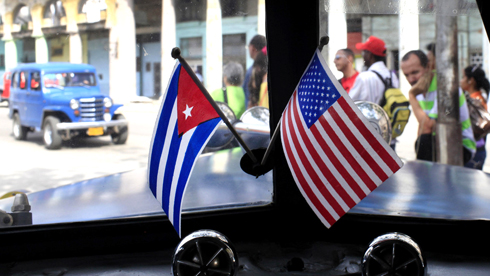
When Obama made a statement in the Pink Garden of the White House to restore diplomatic murals with Havana, next to him was Vice President Joe Biden, which was supposed to give a special solemnity to the moment. A historical turn in the relations of the two countries is scheduled for July 20 - the mutual opening of embassies will occur within a few days after this date. It is assumed that at the opening ceremony of the US Embassy in Havana, during which the star-striped American flag will rise over the building, Secretary of State John Kerry will come.
Over the years, two countries had only the so -called departments of interests that mainly performed consular functions, and the restoration of diplomatic relations in full became the result of the Obama decision, which he announced on December 17 last year. This was preceded by a year and a half of secret negotiations, held with the mediation of the Canadian authorities and the Pope Francis. In the first half of 2015, several rounds of negotiations took place between the United States and Cuba, where the details of the restoration of relations were determined - the topic of ongoing human rights violations in Cuba remained the main obstacle.
The parties remained in their positions, and the Cuban leader Raul Castro found even necessary to emphasize: after the restoration of diplomatic agents with America, the nature of the authorities in his country would remain unchanged. Nevertheless, employees of the US diplomatic mission will now be able to freely move around the island - for this they will only need to send a special notification to the Cuban Foreign Ministry. This will allow American diplomats to communicate more with Cubans, including the opposition. “No one expects that the Cuban state will change in one night,” says Rick Errero, director of the American non -governmental organization Cuba Now. “But that is why the appearance of the American embassy in Havana is so necessary and significant: its presence deprives the Cuban authorities of one of the main trump cards- the opportunity to refer to the hostility of America in order to cover its own failures and repressions against its people.”
In April, Obama and Raul Castro first met and talked at the summit of the organization of American states (OAG) in Panama, and in May of the United States brought Cuba from the list of countries supporting terrorism. The road to the exchange of embassies was cleared. However, there are still a great many unresolved issues. One of them is Washington’s refusal to return the territory in the east of the island to Guantanamo, which is now occupied by the US Naval Base. But there is a more important question: will America give the reverse move in its relationship with Cuba if the Republicans will win in the 2016 presidential election?
A possible presidential candidate from the Democrats Hillary Clinton completely supported the restoration of relations. “The new US embassy in Havana will help us communicate with the Cuban people and promote efforts to achieve positive changes on the island,” she wrote on her Twitter. “This is a good step for the USA and the Cuban people.” The diametrically opposite opinion is shared by influential republican senators. “While the Castro regime only enhances the repression against its people, the Obama administration makes him one concession after another,” comments on the restoration of the diplomatic dealer with the Cuban roots of Marco Rubio, one of the presidential candidates from the Republicans.
Among opponents of rapprochement there are also influential democrats in the Congress. “The US policy towards the Castro brothers is not in the national interests of our country,” says Senator Bob Menendes. Obviously, with this approach, the congress will block all the attempts of the White House to remove the economic embargo, without which there can be no question of normal trade relations.