
Translated material
About how Siriza defeated Hellas
By the time Greece said “no” to the Euro -Creditors, she had been in a state of actual default for a week. How could this happen in the European Union and what is now waiting for the Prime Minister of Tsipras, his country and all of Europe - the New Times was versed
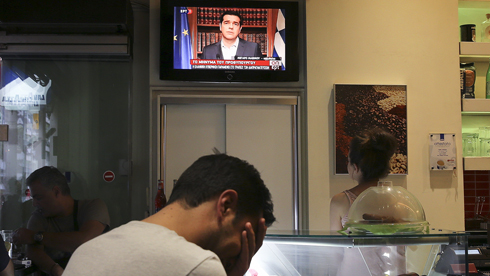
Visitors to the Coffee shop listen to the Prime Minister of Tsipras, Athens, July 1, 2015
On the evening of June 30, when the term of Greece was expired € 1.6 billion to pay off the debt to the IMF, the Greek Prime Minister Alexis Tsipras darted from extreme to extremes - at first he, according to the Financial Times, allegedly agreed to the demands of Eurorocreditors, but then suddenly called to tell them on the referendum on July 5, the solid “no”. For the Eurogroup ( an advisory body, which includes the heads of the Ministry of Finance of 19 countries of the eurozone. - NT ) this was a final signal: communication with the Greek government is pointless to at least a referendum he has been launched. And then let's see.
"Eternal loser"?
Many experts consider Greece an eternal loser: they say that over 180 years the country experienced default 7 times, and almost 40 out of the last hundred spent in a state close to bankruptcy. It is much more useful, however, to look at the relatively recent past.
Being accepted into the European Economic Community in 1981, “Avans”, for purely political reasons, Greece for a long time turned out to be the largest recipient of European assistance, which in some years reached the revenue of the budget. Investments flowed into the country, tourism and service sector developed. The standard of living increased from 29 % of the pan-European indicator in 1982 to 78 % in 2002. True, in the early 2000s, the indicators began to decline due to the entry into the EU of more poor countries, but the Greeks were also lucky: the euro was introduced, which, in fact, spread the German interest rates throughout the eurozone. Having entered this privileged club, the Greek government has achieved a reduction in betting on its 10-year bonds from 11.8 % (in drachmas) in 1990 to 3.2 % (in euros) in 2005. During this period, the authorities saved up to 1.45 trillion drachm (4.2 % of GDP annually). It is not surprising that in such conditions from 2001 to 2009 the amount of loans issued on average by 16.7 % per year (in Germany at the same period - by 2.7 % annually). It would seem, what else to wish? 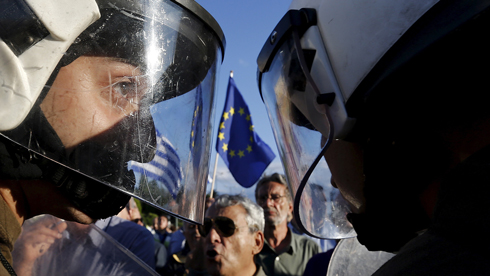
30 years of dependency
However, the Greek authorities began to think that now everything will get away with them: Europeans will solve infrastructure problems, and cheap loans will create conditions for the comfortable life of bureaucracy and plebs. As a result, duty began to grow rapidly, as well as budget expenditures. We will call only one figure: in 2009, officials and civil servants in Greece received salaries 15 % more than in France, and budget expenditures amounted to € 128.2 billion (if transferred to rubles, they exceeded the Russian indicator of the same year by ... 7.5 times). In 2010, investors doubted the stability of the Greek financial system, and European auditors, opening their eyes, saw the real state of affairs: Greece's debts completely blocked its ability to serve them. 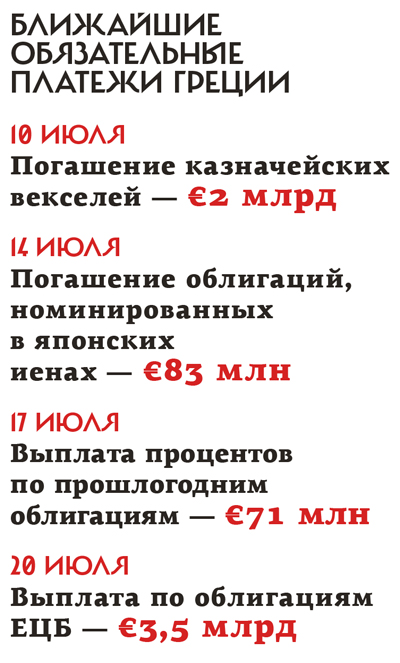
By and large, a problem named Greece never came down to a purely financial issue. Thirty years of dependency destroyed the foundations of entrepreneurial culture, creating a bureaucratic and corrupt system. It was built on the conspiracy of the local oligarchy (represented mainly by gearing companies - Greece today owns at least 16% of world transportation, and the export of transport services exceeds 6% of the country's GDP) and the authorities, which collected taxes from all other sectors of the economy, while the share of taxes from shipowners in budget revenues did not exceed ... 1.4% of all its income (and budgetary The Code now provides them with ... 58 types of tax discounts). Seeing this, the population ruthlessly deceived the state, underpaying taxes and leaving for the shadow sector, but without ceasing to use social benefits. 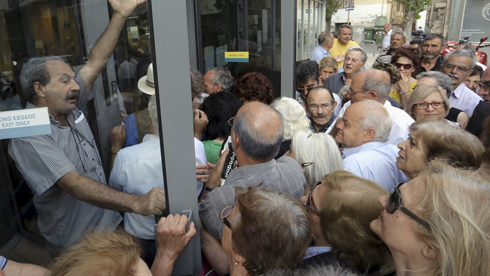
Lifebuoy
Seeing that Greece was drowning in debt, Europe took unprecedented measures to save it. The total amount of loans to Athens for the period from 2011 to 2015 amounted to € 244 billion, not counting € 89 billion, which the Euro -Central Bank (ECB) allocated to local banks for “maintaining current liquidity”. (For comparison: these amounts make up 60 % of the entire current volume of external debt of Russia and all Russian companies and banks.) At the same time, funds were allocated cheaply or even almost free. Yes, shortly before the failure of the June negotiations ( between the Tsipras and the Eurogroup government. - NT ), Greek papers were bought at the calculation of the profitability of 13.1 % per annum on Greek duty, but they traded in the secondary market, but in reality, Greece paid them an average of less than 2 % per annum.
Until 2021–2022, the total payments of Athens for debts should not exceed 3.4 % of the country's GDP - no dramatic situation. And Greece tried to fulfill the terms of creditors, reducing budget expenditures. The economy compressed by 25 % in five years - in many ways also because investors deduced funds from the country. The real income of citizens collapsed by 22 %. Real estate prices are almost 40 %. But the goal was achieved: in mid -2014, the decline ceased and slow growth began (in general by 0.6 % in 2014).
But the general dissatisfaction of citizens “delaying the belts” nevertheless did its job - in the elections in January 2015, with 36 % of the vote, the left -wing party of Siriza, headed by Alexis Tsiprase, won.
The new prime minister frequented to Moscow, began to talk about the “madness of world capital” and refused to bring the primary budget surplus to the parameters previously agreed upon from the EU. Instead, he applied the method according to which, in order to solve the problem, it is necessary to make it into a dead end, because only a way out of the impasse is really worthy. A specialist in games, the Minister of Finance in the Government of Siriza, Yannis Varufakis, is responsible for the implementation of the method-pro-European-minded manifestants in Athens in recent days, not too correctly played out the last two syllables of his last names on their posters-and the game was launched in a large way.
June 30, when Greece did not pay the tranche of the IMF, the methodology reached its apotheosis. Therefore, today it makes sense to talk only about possible options for the further development of events, in the list of which the referendum on July 5 looks the least significant.
Drahma as an illusion
In 2010–2011, in the “first circle of the first” of the Greek crisis, many European banks invested in Greek assets were panicked. Now the situation is different: most Greek assets today are on the balance sheet of the central banks of the eurozone countries, their depreciation will not even provoke panic to zero. This means that Europe is now ready to seriously resist the stubbornness of Greece, which it is offended by - and one should agree, not inhabitably. 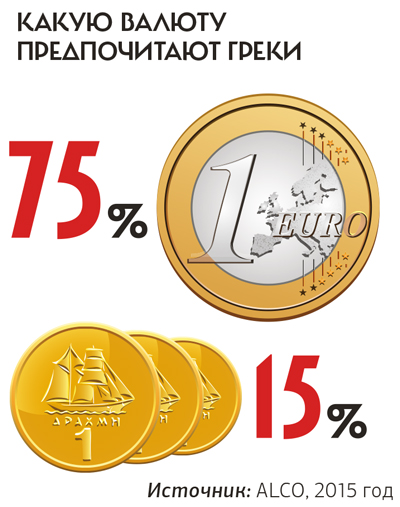
But Greece will not be able to overcome the economic crisis without the help of Europe. Hopes for the return of drachma are illusory. Even if Athens leave the euro zone, they will not win anything: salaries have already fallen by 15–20 %, and export did not grow at all. If salaries collapse due to cheap drachma by another 50 %, this will also not correct the trade balance: Greece imports much more goods than exported. At the same time, the living standing will fall very sharply, as the import will rise in price - accordingly, consumption will decrease. The debt will remain nominated in euros and dollars and therefore will grow from 170–180% to 300-400% of GDP. And tourists simply reorient to Turkey or Croatia, because Greek infrastructure and hotels will continue to age, and the quality of service will deteriorate.
External help should not be expected either: Russia will still “carefully monitor” what is happening, and nothing more. Europe, which has already refused to talk with Athens to the referendum, tomorrow, most likely, will repeat the previous conditions if it does not tighten them even more.
Referendum - not a panacea
Tsipras understands: he will not be able to withdraw the country out of the euro and from the EU, the price of such a step is the destruction of the entire economy, and at least the first year will be a period of complete disorganization of everything and everything. The accumulations of the population in banks will be restructured for many years, the assets of companies will depreciate, taxes will not be collected almost at all. The return of Drahma will take at least six months - during this time, any layman will have time to enrage in the literal sense of the word. Therefore, the decision of Tsipras on the holding of a referendum seemed to be spontaneous - and erroneous.
If the population according to the results of the referendum advocates the refusal of the proposals of creditors (as they themselves emphasize, no longer acting), then no new initiatives of the Greeks will not only be accepted, but even, most likely, are discussed. The default of the country in the eurozone itself does not create insurmountable problems for the whole community-even in relatively healthy economies there are bankrupt companies. And therefore Europeans can wait. But Greece cannot. The country will need to introduce financial restrictions on the transfer of funds and turn into a very specific phenomenon: a state that formally and officially uses the euro as a currency, but not limited by the conditions of membership in the eurozone and does not take part in the work of the ECB. This is not as fantastic as it seems: Greece in this case “only” will replenish a group of countries now represented by Montenegro and Kosovo. It is likely that the non -cash "Greek" euro will have its own course in relation to the "main", all kinds of monetary surrogates will appear - in general, a lot of interesting, but not economic growth will happen. Under these conditions, extraordinary elections will follow quickly, and Tsipras and his entourage will have no chance on them. 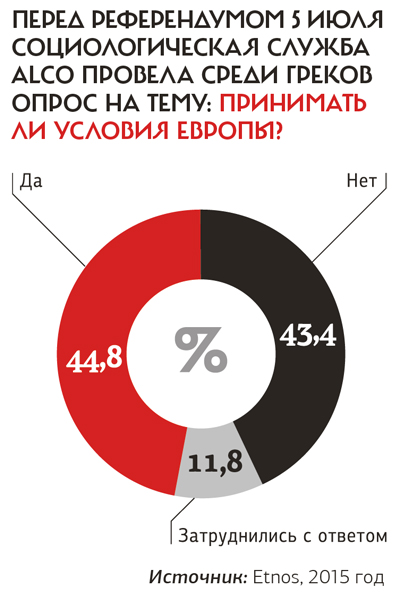
If the population votes for the adoption of the claims of creditors, then the current prime minister receives, in fact, a vote of distrust.
In general, Tsipras should know that there are conflicts in the world that are not resolved with the help of referenda. For example, referendums do not cancel international law. And referendums are not able to cancel the claims of creditors. Well, of course, referendums cannot cause a decrease in taxes with the simultaneous increase in expenses. If the politician has a steady impression of the reverse property, then his career ends quite quickly. An example is Gray Davis, Governor of California. Shortly before his coming to power in the state, a series of referenda on economic issues continued with him. As a result, in 2003, the Davis mandate was recalled.
Greece will become the following example of how, after a heavy hangover, a long road to a normal state begins.
Photo: Alkis Konstantinidis/Reuters, Yannis Behrakis/Reuters, Stefanos Rapanis/Reuters