
Translated material
Greek tragedy
Greece added headache to Europe: contrary to sociological surveys conducted in the last days before the referendum, on July 5, 61.4% of the Greeks (the result recorded on the night of July 6 after the counting of 70% of the vote) said “no” to the requirements of international creditors, “yes” - 38.6%. Thus, the prospects of the country's further stay in the eurozone, despite the assurances of Athens about the readiness to continue negotiations with the Euro group, were even more clouded. The results of the Greek referendum are already urgently discussed by the Canler Germany Angela Merkel and French President Francois Hollande
Meanwhile, Greek Prime Minister Alexis Tsipras said that now the main priority is to establish the normal work of Greek banks, which closed on June 29. Near ATMs, of which only € 60 per day can be removed, the lines have grown. The correspondent of The New Times attacked one of them
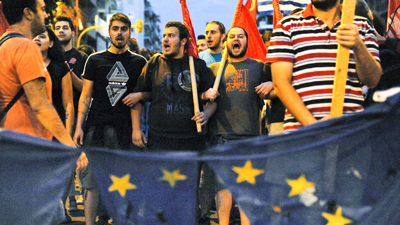
The protest against the EU policy. Saloniki, Greece, July 1, 2015
In the wallet of the 67-year-old stelios Mikhalakis-only one euro. “Just on the candle to the funeral of a friend,” he says. Non -money is a common thing at the end of the month, and at least in the refrigerator, at least a ball: the pension of Mikhalakis is tiny. “I wanted to withdraw some money from the ATM, I’ll come - and then the turn is huge,” the pensioner shrugs his hands.
As soon as Prime Minister Alexis Tsipras announced on June 27 the referendum, thousands of people around Greece crowded at ATMs, trying to withdraw their money. They correctly understood the situation: negotiations with creditors came to a dead end, which will happen next is unknown. And then - the queues of ATMs only grew up, because the government announced the closure of banks and the “introduction of control over the movement of capital”: the limit of funds available for withdrawal - € 60. 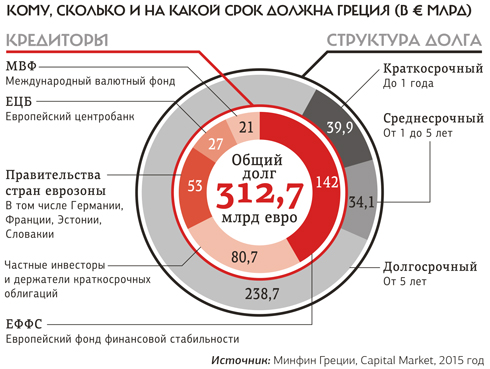

General mood
Athens, Monday, June 29. In front of the ATM - 20 people. The first in line is a 45 -year -old man. He removes € 60, departs from the ATM, quietly scolding.
The next is an elderly lady: having received her 60, she smiles blissfully: “I had lived no better before, there was nothing in the account but these € 60. My children (daughter twenty -two, twenty -five son) - both unemployed. We studied and learned at the university, but to the point ... We don’t know how to live, but we did not know before. ”
A well -dressed girl, proudly clutching her expensive branded handbag with her hand, is indignant: “And will it continue for a long time? Actually, I was going to Mikonos on vacation. Now what: should I sit at home in front of the TV or on the Internet and watch this “Greek tragedy”? ”
Following - a young mother with a gaze full of despair, with her - a five -year -old daughter. The woman complains: “I'm scared. I have two children, my husband has been sitting without work for two years ... I have been working in a private company, I get € 600. I thought it wouldn’t be worse. I'm afraid, mistaken ... "
Having stood at the ATM for a couple of hours, you will see many faces, but everyone has the same mood. There are, of course, exceptions are people who have nothing to lose or win. For example, a 35-year-old man declares: “Personally, I do not hope for anything and I'm not afraid of anything. Just everyone and I say no "no" ... " 
The news of the referendum turned the life of the Greeks, everything around has changed. It seems that trade has stopped overnight: only supermarkets, refueling and pharmacies work. People try to buy food for the future, stock up on everything necessary, including medicines, because it is not known when banks open and whether it will be possible to get their money. In addition, there is still no money: people worked, but they did not pay them. And pensions were not paid. Commercants in Greece have nothing more to do - no one buys anything even via the Internet.
The story of Kostas Panusakis, an employee of a private company who had a child was born completely typical, is completely typical. Kostas went to the supermarket and bought as much milk for the baby as he could. But there was not enough money for diapers, because the salary was not paid for a long time. The young father is completely confused: he does not understand what is happening, and does not imagine how to vote on July 5. And even more so, he does not understand what the referendum results will lead to: what will happen if the Greeks vote for? Or against?
Anna Kiprai, a 42-year-old unemployed single mother, failed to buy milk to her child, because she lives on benefits. Her mother, a pensioner, does not receive money for a long time. Anna is not sure that she can get a vaccination to her daughter. She decided to vote against the proposal of foreign creditors, because she believes that Greece was quite humiliated.
Panayotis Alexopulos, a civil servant, says: “Of course, most do not like the restrictions on the movement of capital, which the state introduced after the announcement of the referendum. Problems with cash flows are alarming: will the accounts themselves cut out, will Greece come out of the eurozone? ”
Nkitar Fotini was dismissed by the previous government and was again hired by the new - levoradical, formed after the victory of the Siriza party. She admits: “I am not worried that the banks are closed, first of all, because I still can’t remove these € 60, although in general, there are enough of them for a day. For me personally, in my daily life, nothing has changed. I only became happier, because for the first time in the last six years our country finally had the hope of getting rid of creditors! ”
The announcement of the referendum provoked hot disputes between supporters and opponents of agreements with creditors. “For me, a referendum is an opportunity to oppose a hard ultimatum. Although, of course, it is sad to see these people standing in lines in front of ATMs. But still, I think that for ordinary people it will end in the best way. We trust the current government, ”writes Katerina Karakotsiu, a 35-year-old teacher of foreign languages on his Facebook page.
But another user of the social network writes: “We will leave Europe - we will become poor, like Albanians. Our children will not be able to find work, we will be left without a healthcare system. ” 
However, the majority believes: the government is obliged to keep the situation under control and completely bear responsibility for it. Greek society is characterized by some tendency to collectivism, for the Greeks it is completely natural to agree with the opinion of leaders, but they support those proposal of the Eurogroup or not - it is not so important. In addition, the Greeks really do not like uncertainty, it scares them. Finally, since many Greeks live today, without thinking about distant prospects, they are suspicious of any changes in society.
For many in the country, the actions of political leaders of the eurozone countries look like form -baking blackings. The Greece Government does not raise the question of the rejection of the euro, but the rest of the Eurozone members make it clear: if the terms of the agreement are not accepted, the Greeks will “ask for the exit”. Control over the movement of capital was introduced because the Greeks were intimidated and convinced: their country is thrown out of the eurozone - and also because the European Central Bank (ECB) did not provide sufficient mobility for the banking system.
What will happen next - in the best and worst cases? If the majority votes in a referendum against an agreement with creditors, this will strengthen the position of the Ciprass cabinet, and the ball will go over to the side of the Eurozone and its leaders. On the other hand, Greece can offer more favorable conditions for the payment of debt. If the majority say “yes”, the government will have to immediately declare early elections, since it simply cannot deal with a disloyal electorate, not to mention the fact to influence it.
Photo: Alkis Konstantinidis/Reuters