
Translated material
Anti -war secret
Russia is trying on a fashionable army uniform and is not without enthusiasm awaiting a big war
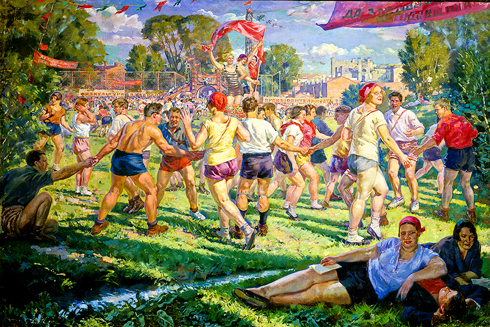
"Sports Games at the Stadium", artist Sergey Luppov, 1927
A time traveler, abandoned from the late USSR to Moscow of 2015, would not find so many familiar household signs; Unless the houses and names of the streets have not changed, and not all. But something would seem familiar to him: the newspapers still draw caricatures on the American president, on the radio reports that the Pentagon is going to install medium-range missiles in Europe, and tram retirees talk about the star war. Perhaps the guest from the past would be surprised by the intonation that all this is said and reported: the state propaganda does not wave the olive branch of the world against the late Soviet manners and does not call for universal disarmament, but on the contrary, it seems to rub their hands: your winged intercontinental ballistic ballistic will be found. Surely he would be struck by how the image of the army changed in the public consciousness: the idea of service as an inevitable and inescapable misfortune like Suma and prison, with an obsessively-out-of-the-hail number of associations-construction battalion, hazing, cargo-200-was put into storage in the field of genetic memory; The new army is the clothes of the work of the fashionable St. Petersburg designer Leonid Alekseev, these are jeeps of a matte protective color near the flagship store on Tverskaya, it is the Topol installation, which decorates the updated VDNH, next to the Gagarinsky missile and the Buran ship; The army is sexy. Instead of the disgrace of rock festivals, the audience is breaking into a giant army festival in the Moscow Region, however, tanks and tents are also on the “invasion”, where they talk about the contract under the contract; Instead of worsened copies of “Artek”, military-patriotic camps for adolescents are built, a T-shirt with “polite people” has become easier to buy than edible cheese-in the expression of Joseph Brodsky, the “stooping of the recruits” is in full swing, already 61% of young people, according to VTsIA polls, express not only their willingness, but even desire to serve in army. And probably, from the 85th, this would not be reminded by the non-native realities, but a familiar spirit of pre-war time from the stories of veterans-the song “If Tomorrow War, if tomorrow, on a hike,” the teachings of Osawahyakhim, propaganda films in which the indomitable Soviet tanks cheerfully smashed, unwatted the enemy. 
It would probably be stupid to demand from the Ministry of Defense to turn military-patriotic propaganda-this is their work, you can only congratulate the fact that for once it turns out well. And whatever the results of the polls, it is hardly possible to make apocalyptic conclusions of them-a huge part of the public still perceives the militaristic show as acute television entertainment, somewhere between Solovyov and Malakhov, and is not at all ready to climb into the trench, abandoning American films, German machines and just peaceful life before the Japanese television. The only thing that could really alert a traveler in time was the tragic lack of pigeons with a monstrous variety of hawks, a complete decline in any pacifism, the absence of at least some intelligible movement for peace, and even anti-war expressions of public and respected people. Only Grebenshchikov now sings at concerts the old song of Tsoi “I declare my house by a nuclear zone”-probably an alien from the 85th remembers her, and could even sing.
Continuation of the topic on page 30