
Translated material
Kaming out in American and Russian
On June 26, 2015, the US Supreme Court recognized the unconstitutional refusal to the same -sex pair in the right to marry. Thirty, twenty years ago it was impossible to even imagine what it would happen someday

The day after the historical decision of the US Supreme Court, in New York and other cities of the country, a festive parade of pride in LGBT was held. It was attended by representatives of the LGBT community of Russia, New York, June 27, 2015
By the age of fifteen, I had a set of conflicting knowledge about homosexuality. On the one hand, a few years earlier, I read the Criminal Code of the USSR, in which it was written in article 121 that “Sodigy” is punishable by three years in prison. Two things followed from this: in the world, besides me, there are people who have sexual attraction to the representatives of the same floor with them, and we are all criminals. There was also a famous lawyer, a family friend, who then defended the still not very famous theater director, who was persecuted in connection with his homosexuality. In the family, this was perceived-as a persecution, unjustified persecution, but from adult conversations, I realized that they would not trust this director with teenage sons. 
On the other hand, shortly after our arrival in America in 1981, a new friend told me that he was gay and that this was not the same as there (he was a student of a Russian, just spent a year in Moscow and knew about “there” firsthand). However, my oncoming semi -recognition - I told him that I “maybe, too” - he met with limited enthusiasm: it was not like there, but not that very good. In many states they still acted, although rarely applied, legal prohibitions on homosexual contacts. Gaev could easily dismiss from work, and in some structures-in the army, for example, in the FBI, CIA and the State Department-they did not officially accept (for a student-Russian, the impossibility, even theoretical, was a completely relevant and painful theme). Families who are ready to accept their children “as they are” were rather a rarity, and those who drove teenagers out into the street are not at all. At the same time, there was another-organizations fighting for civil rights of gays, gay newspapers in all major cities, clubs (though always without a sign and tinted windows), where they played the best dance music in the city.
In 1982, the same friend took me to a student gay party at Yale University. Such parties were still relative rarity, students from several universities gathered at them, and the locals arranged them for the night. I liked the feeling that, having made a caming out, you became a member of the community-not that secret, but semi-underground. And the fact that members of this community united a certain socio-cultural experience and, by default, political views. This a little reminded me of participating in an informal youth Jewish movement in Moscow - I really missed it - minus danger and hopelessness.
I participated in gay organizations and worked in gay newspapers and magazines: at first I glued articles on cardboard (these were ancient times), then I wrote articles, then it became an editor-in-chief. It was a fantastically interesting time and a wonderful school of journalism, including because in the mid-1980s of all my friends and their acquaintances, an unknown and unknown illness began to mow. Almost everyone who worked in a gay press was then forced to learn how to read scientific articles and write about medicine. For several years, the newspapers of the American establishment practically ignored AIDS, only we wrote about illness and treatment. New groups appeared - at first quiet, engaged in the support of the sick and dying, the organization for them care, nutrition, and often - roofs over their heads. Then the organization ACT UP appeared, angry and noisy, demanding that the state take up the salvation of the dying. The organization set the objectives completely utopian: to achieve to be found and found quickly, a cure for AIDS, as well as to achieve the introduction of the right to universal health care for Americans. This was the case when the goals were simultaneously utopian and the only possible - it was a matter of survival, literally. Well, from childhood, I was taught to advocate "for the success of our hopeless work." 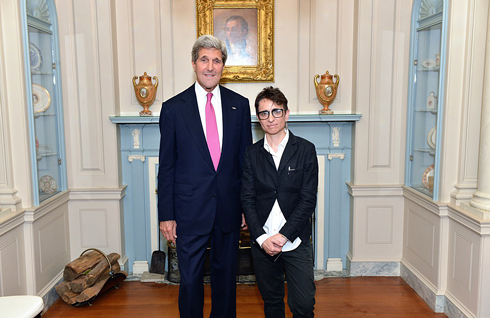
Russia of the 1990s and 2000s
In the early 1990s, I left for Russia. It was the most interesting place in the world for a journalist. And yet - I'm tired that everyone around is dying. I was a little over 20 years old, and the funeral of friends and acquaintances took place at least once a week. The point is not only that in Russia at that moment the air was saturated with hope - the point is also, then I wanted to write about other people, and not just about the illness that killed my loved ones.
While I wrote about the war in Chechnya, in America they learned to treat AIDS. In 1996, AIDS actually turned into a chronic disease from the death sentence. While I wrote about Putin, Dubrovka, Beslan, a dozen American states and 19 Western countries legalized same -sex marriages. While I wrote about the laws on “foreign agents”, “propaganda of homosexuality” and other concepts that can only be used in quotation marks, the United States finally introduced compulsory medical insurance. That is, everything happened that twenty and even ten years earlier seemed utopian. Of course, I knew about this, but all these news were perceived as a kind of abstraction. I mention Putin, war and terrorist attacks not because they are more important, but to explain what my brain was busy with. He knew American news, but did not realize that some aspects of American society changed radically. 
In June 2013, Russia was banned by the “propaganda of homosexuality” and adoption by same -sex couples and single people from countries where same -sex marriages are allowed by law. And in America in the same month, the US Supreme Court abolished the legislative ban on the recognition of same -sex marriages by the federal government - this meant that people living in those states where same -sex marriages have already been permitted have received immigration rights and tax benefits laid down in marital pairs. In September, a bill was introduced to the State Duma on the deprivation of “persons supporting non -traditional sexual relations”, parental rights. We decided not to wait for the appearance of guardianship representatives at our door and left for America.
And in June 2014, I was visiting Vice President Joe Biden-he arranged a barbecue in honor of the month of LGBT, which has been traditionally announced for several years. After a couple of weeks, I played at the PRIDE (Pride - Pride) Previous Entry Share Next Entry in the State Department. There were two speakers with solemn speeches: me and Secretary of State John Kerry. Before the start, the participants told me that recently they have specific difficulties: many of them have been in same -sex marriages, and the countries where they are sent are not always ready to recognize the status of a spouse -diplomat. John Kerry in his speech promised that the State Department would more actively defend the rights of spouses in such situations. And at the Barbecue of Baydenov, the vice president made a well-prepared speech-there was about the first lesson of tolerance presented to him by his father, and there were wonderful words addressed to other countries: “It doesn’t matter what kind of culture you had. Inhumanity is inhumanity, prejudice is the essence of prejudice. ” And then he closed the folder and began to speak to the gag. Usually at this moment politicians roll into stamps and stupidity-if only we are not talking about anything that is really close to the mind and heart of a politician. It turned out that the second case. It was important for Bayden to say that, it seems, in America, progress in protecting the equality of LGBT has gone so far that it is no longer possible to expand him, whoever came after Obama. And for him, an elderly policy ending his career, it is very important to know this. 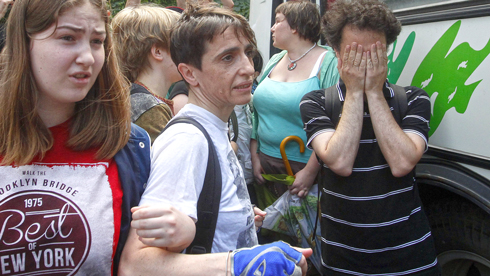
Leap in another era
And then it finally covered me. In English, this is called Whiplash, and into Russian it is translated ugly: "A head and neck injury from a sudden sharp movement." As if I had thrown forward in time. I must say that my American peers have similar sensations, but in my case, fantastic sensations from a “sharp move forward” were aggravated by the fact that Russia has made a no less sharp movement back in recent years. Consider an unimaginable distance traveled by American society in those 20 years that I have not been here, in my subjective perception becomes twice more unimaginally.
On June 26, the Supreme Court made another decision in the case of marriages: now the refusal of a same -sex couple in the right to marry is considered anti -constitutional. That is, all states are required to recognize same -sex unions along with heterosexual marriages. To evaluate the importance of this decision, you do not have to be an ardent supporter of marriage - I have a lot of doubts about the correctness of state regulation of family relations. On the part of the doubters, the importance of what happened even may be more visible: one of the most conservative public institutions is now open to people who, more recently, in many ways, a semi -underground existence. On the day of publication of the decision, many of my old acquaintances wrote on their pages about their own camming out, about the 1980s, about the feeling of marginality, and then, when AIDS appeared, also doom. And that by feeling of community and otherness, one has to get bored (as, indeed, in general in youth), but after all, none of us could imagine that he would live until such a time. And what it is like to realize yourself in one era, and after a quarter century to be completely different. When it is possible to observe the course of history so closely, Whiplash may happen. It’s good when it happens from a sharp movement right.
Photo: Facebook, Vladimir Mashatin/ITAR-TASS, GLIFAA.Files.WordPress.com, Maxim Shemetov/Reuters