
Translated material
The life of Reagan
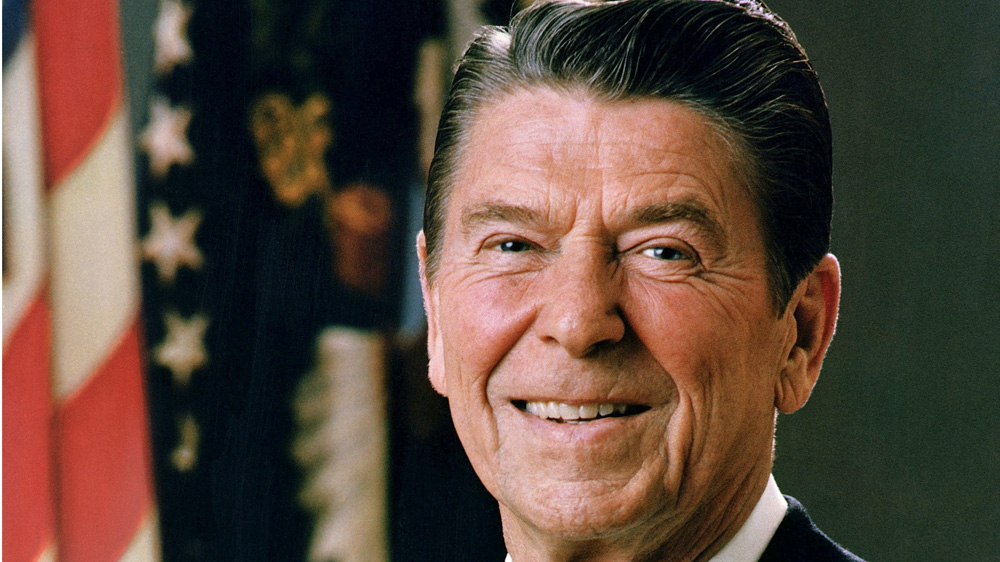
Book Review of Marina Efimova
Alexander Genis: Today, when the Kremlin, having bitten a bit, draws the world into a second Cold War, in America is increasingly remembered by the president who helped end the first Cold War. This, of course, is Reagan. On the eve of the 2016 presidential campaign, many amercians regret that there are no figures of such a scope among the candidates.
The fact is that Reagan was able to rally America better than others. He says about his unprecedented success in the White House, the fact that 49 states voted in the 1984 elections for re -election. In today's, strictly divided by party affiliation of the country, it is difficult to believe in it. But this president, albeit for a short while, but still united both America - red and blue, republican and democratic, the one that swears him, and the one that does not recognize his inheritance (first of all, "Reaganomics"). Everyone agrees that if Reagan was a popular president in the White House, then after him is great. What can I say, during his lifetime he was called the capital's airport.
It is believed that Reagan ruined communism, drawing it into the arms race, excessive for the Soviet economy crippled by socialism.
“Star wars,” they told him in the Pentagon, “an extremely expensive program.”
“The more expensive, the better,” the president answered, “she can afford it, they don’t.”
But the rhetorical bomb turned out to be even more important, exploding a policy familiar to another appeal. The main oratorical find of Reagan was the formula "Empire of Evil", which he, not trusting the speakers, himself inserted into his famous speech.
When I heard her for the first time, back in 1983, this metaphor seemed too simple to me - as if in a fairy tale. But I knew the past, and my experience in life in the USSR could not be retold in a nutshell. Reagan, however, was not interested in the intricacies of civilian feelings, the nuances of party policy and the dialectic of sovereign ethics. He chopped from his shoulder and on the patient. The very speech, where the notorious and fateful formulation first appeared, is devoted to exposing the then “mirror theory” then: reflected in each other, rivals become almost indistinguishable.
But Reagan shared good and evil when he said that freedom would inevitably lead to the victory of the first over the second. At the time when the Soviet army was in Afghanistan, and Andropov was in the Kremlin, in my opinion, two people believed (the second - Solzhenitsyn). But over the past decades, the world has really changed. In a hundred countries, popular uprisings took place; more than 80 authoritarian regimes collapsed; About 60 countries became democratic. Of course, not all changes led to the better. It is clear that not all of them were irrevocable. Nevertheless, in the 21st century, as Reagan promised, there was more freedom than before. Despite the rapid rollback of Russia, this is undoubtedly, and Reagan was not forgotten.
And now Marina Efimova will present our listeners a new biography of Ronald Reagan.
Marina Efimova: The new biography of Ronalda Reagan, written by the famous biographer Henry Brands, accidentally or intentionally, went out of the press in the historical period, marked by the crisis of American foreign policy. The book is called "Reagan. Life ”, but according to another famous biographer, Karl Rollison,“ as much about the art of management as about the personality of Reagan ”was written.
It is worth paying attention to the fact that Brands almost does not use in his biography neither quotes from previous books and articles about Reagan, nor even many documents and letters declassified in recent years by the government. The main source of information is Reagan himself: his speeches, reports, letters, performances on the radio and political essays, which he always wrote himself during the presidency. Excerpts are also included from his diaries, which, by general confession, are written with unusual sincerity. It is curious that, according to many biographers, during the life of Reagan, it was almost impossible to draw some personal information from him. This was written by the reviewer Jeff Shezol in the newspaper Nytims:
The announcer: “For a person who spent most of his life before film and cameras, Ronald Reagan seemed to deliberately rarely fall into focus. Throughout the political career, he managed to remain a person who was detached - as a movie star (although in the cinema he never reached a star status). Reagan became (and remains for decades) the president, who left a deep mark in the political culture of America, but at the same time he was and is an actually unknowable person. At meetings in the White House, he was usually silent, and often left, leaving his assistants to defend his position. His personal relations, according to his wife, were “invariably warm, but rarely intimately trusting. Around him, ”she writes,“ there was a wall. ”
Marina Efimova: Perhaps that is why most of the books about Reagan concern only certain aspects of his personality and government: books about his spirituality; books about his character and dream of a world without nuclear weapons; Books about his career by Governor of California; about the unsuccessful campaign of 1976 and on presidential elections in 1980; Books about his love letters to Nancy; About his relationship with the speaker of the House of Congress representatives by O'NIL and with the British Prime Minister Margaret Thatcher. Reviewer Shezol writes:
Announcer: “Even all together, these books resemble a description of the elephant given by the blind who examined him to the touch. Most of all, such biographies are a replica of the film card of Raigan from the film “Kings Rowe”, to whom the surgeon-senior surgeon amputated and who, waking up from anesthesia, shouts: “Where are I the rest?”.
Marina Efimova: By the way, Raygan made this remark the name of the autobiography.
“The 40th president does not get up from the Brands Brands, as they love to represent him,” writes Reviewer Karl Rollison in the British newspaper Star Tribune, “and a politician and diplomat, who can be called the“ great coherent ”and“ great organizer of compromises ”. And further:
Announcer: “Although Reagan was considered a southern conservative in a political direction, he decisively and boldly maneuvered if necessary. Being in principle against increasing taxes, he raised them when this measure was the only possible for the implementation of tax reform. He printed the Soviet Union with the stigma of the Empire of Evil, but without hesitation went to negotiations with Mikhail Gorbachev, as soon as he felt a gust of goodwill emanating from the Kremlin. Despite the requirement of his own team, they could not go to any agreements that could weaken the Nuclear Arsenal of the United States, Reagan went to them when he realized that Gorbachev really was striving to reduce weapons. ”
Marina Efimova: The biographer Henry Brands does not leave aside the dubious moments in Reagan’s reign-for example, the scandal of the binding with the so-called Iran-Contra transaction-which was actually illegal sale of weapons to Iran in exchange for the liberation of seven American hostages. Money from the sale was sent (without the knowledge of the Congress) to Nicaragua to the “Contrass” groups to fight the Ortega’s pro -communist government. After the hearing in Congress Reagan, only insufficient control of the actions of his subordinates was imputed, but many in America believe that he glying up the responsibility to other people's shoulders. Brands looks at it differently:
Announcer: “In the corporate world, Reagan would probably be dismissed as an incompetent manager. But in the field of public administration, delegation of responsibility and the protection of the reputation of the presidential office is political wisdom, especially when it comes to such controversial actions, which was the deal with Iran. Although, of course, such a position of Reagan led to the fact that some senior officials did not reveal the whole truth about what was done on his behalf. ”
Marina Efimova: Liberal commentators are dissatisfied with the new biography, since she represents Ronald Reagan one of those real big leaders who are able to take the initiative into their decisive moments of history. Reviewer of the newspaper Nytims Jeff Shezol directly writes about this in his article:
Announcer: “Brands's biography is an lost opportunity, a liquid and neutral portrait of a person who has yet to be understood. Fans of the 40th president for so long represented him one-sided-the opponent of the Great Government, the initiator of tax reduction, a fearless winner who did not afraid to call a spade a spade-which became difficult to understand all the contradictions of his personality. But the Americans who do not approve of the Reagan political pragmatism need a more sharp, clear and full portrait than the one that Brands created. We may never find the "rest of Raygan", but we must continue the search. "
Marina Efimova: The reviewer Shezol is dissatisfied with the fact that the biographer Brandes retells the favorite stories of Reagan and his jokes with special pleasure. This approach to the President’s personality seems to be superficial Shezole, and he considers it just a way to conquer the reader. In particular, he mentions a joke (which he himself recognizes amazing), told by the Reagan with a stretcher on which John Hinkley was carried to the hospital after the attempt on him. Reagan was losing consciousness, then it returned, and at some point he felt that the nurse, who was walking next to the stretcher, to cheer up, took his hand. Reagan opened his eyes, looked at the nurse and said in a weak voice: “Does Nancy know about us?”
Still, it was not without reason that the reviewer chose this one from many Rayganov jokes. It somehow reflects the scale of the personality. And in this, perhaps, the main reason for the “unknowability” of Ronald Raygan - with all his mistakes, shortcomings and failures, he corresponded to the inaccurate, but very expressive American definition of the significance of a literary or historical character. They say: he was bigger than life - he was more than life.