
Translated material
Work instead of pity
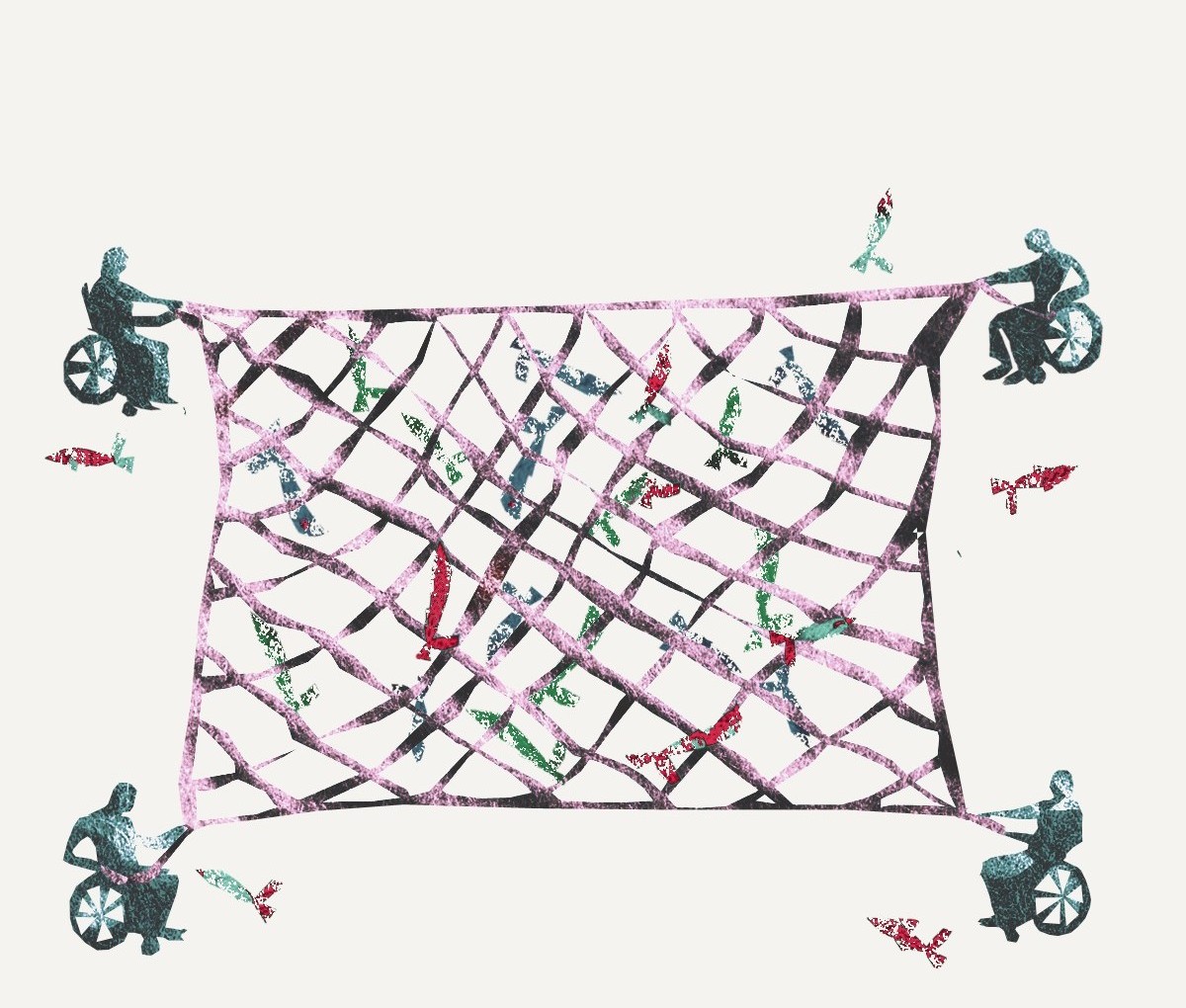
In the current conditions, the volumes of state kindness clearly do not comply with the needs of disabled people, so that the issue of gaining a normal profession for those who are forced to spend most of the time at home has become truly urgent.
We help the Homon collect 363,446 R required 358 750 rThe collection of funds is over
In 2010, I, as part of a delegation of journalists from different countries at the invitation of the same US State Department, got acquainted with American journalism. One day we were brought to the city of Knoxville, Tennessee - there we had to find out how the usual city weekly newspaper is being made.
In one of the corners of the half-empty Newsrum, two employees drank coffee and discussed something with someone on Skype. The bearded man on the screen looked quite self -confident and clearly tried to explain to his interlocutors that they were wrong. “Joseph is an administrator of our site,” explained deputy head, who conducted a tour of the editorial office for us, “and he is also responsible for the schedule.” It turned out that the character of the bearded Joseph is difficult, but he is a professional in his business, so he has to reckon with his opinion. "Where is his table?" I asked to support the conversation. Then they explained to me that Joseph has been working from home, because for fifteen years he has been moving only in a wheelchair.
He was a farmer, an accident with a tractor, a spine, an operation ... When it became clear that physical labor, as well as work in the office for him from now on, some charitable organizations invited Joseph to choose several professions that allow us to work at home. The former farmer chose something like creating sites, gradually became the pros in his new business and now earns no worse than his colleagues who fill the very Newsrum daily. It seems that his penultimate place of work was the Association of the State Goters of the State - for them he administered the site made to them. He, apparently, has preserved somewhat severe arrogance since he himself was a farmer: apparently, a person who honestly lives on honestly earned by honest labor looks. This whole story was voiced to us as perfect banality: well, yes, well, it works, well, the pros, well, from home, well, disabled - so what? Well, yes, well, it works, well, pro, well, from home, well, disabled - so what? Twist this quote
And nothing. It would be appropriate to recall the hungry one, to which folk wisdom recommends that it is not fish, but a fishing rod. To teach a disabled person to earn his own work for his living, if he wants and can do it, is much easier. I remember, in ancient times, in the Research Institute of Tuberculosis, where my grandmother worked as a senior radiologist, there was some mysterious “labor therapy”, during which patients did something so useful. But there it was a kind of “skillful hands” mug, except for adults. It was assumed that the Soviet state would provide a disabled person with a worthy life simply by kindness of sincere. In the current conditions, the volumes of state kindness clearly do not comply with the needs of disabled people, so that the issue of gaining a normal profession for those who are forced to spend most of the time at home has become truly urgent.
"Want? Can? Start! " - the disabled person of the I group Tatyana Trushova told herself and launched a project called “ Homon ” - according to the first syllables of her slogan. Tatyana does not walk, but despite this, she first graduated from the philological faculty of the Pedagogical Institute in her native Biysk, then she went to Moscow to study at a translator in a specialized boarding school for disabled people with violations of the musculoskeletal system. The first time she did not act, but did not despair - she returned home and went to the next meeting at the city hall. "I want education!" - said Tatyana to officials. “So you already have it,” officials answered her, for whom a disabled person, with education, that without - just another dependent on the state neck. "Then get me to work!" - retorted Tatyana. Realizing that it would not be so simple to get rid of a persistent woman, the officials decided that it was easier to give money - and Tatyana went to the capital for the second time, and this time she acted. She herself believes that the disabled person has two options: “The first is comfortable to sit on the couch, it’s not scary, not painful, just life passes by. The second - you buy a bazuka, choose a goal ... and further according to the instructions. The system is always surrendered. ” You buy a bazuka, choose a goal ... and further according to the instructions. The system is always given Twist this quote
Tatyana herself, as you might guess, was not going to give up. But having received a diploma of the translator, I realized that this work is not for her. True, along the way she translated a lot of love novels from English (she herself calls them “garbage literature”, but admits: translating not too high -quality other people's texts, learned to write her own). In addition, they paid a humiliatingly little transfers, and Tatyana had to return to Biysk, where at that time there was not even a normal Internet. All the skills received threatened to remain a dead load, but then one of her friends asked to write an article for his site. Tatyana wrote, and was very surprised when she was paid for this money. So Tatyana found her niche, but continued to dream of her own project. And they became Homon.
There are many groups in social networks in which people with disabilities communicate with each other, there are a wide variety of courses on the Internet. It would seem - go, that is, sit and learn! The trouble is that many, along with the ability to move, take the lion's self -confidence. It is easier for a person to wave his hand at himself than to try to live as fully as possible. But the “Homon”, where people with disabilities work, shows that there is always a choice of a better life. And that this best life is worth fighting for it.
The first step of Tatyana Trushova was the creation of the Sold Journalism Studio as the “Homona”: there, as an experienced copywriter, she teaches to write and edit texts. Pupils - the same as her, disabled people - need only a computer and the Internet. In the final, even beginners will enter the market, but already experts who can offer their skills to numerous sites in need of content written in normal Russian.
The immediate plans are the launch of two more studios - “Photoshop” and “Creation of sites” (hello, Joseph!) In total, Tatyana intends to open seven studios as part of the Homon project, each of which is designed for 40 hours of classes for 6 months.
The Homon website meets visitors with a touching and at the same time ambitious subtitle: “A platform for people with boundless possibilities.” In evidence, you can read several real success stories on the site - all the more valuable, given that this success is literally achieved by “without leaving home”. For people who are forced to spend most of the time in four walls, the “Homon” is not only the opportunity to master a modern and demanded profession, but also the place of communication, and communication with those who, despite disability, managed to become financially independent, can and should motivate other people who are in a similar situation. But if you can communicate for free, then training costs money - in the end, teachers (including Tatyana herself) help people become financially independent - so why should they do it for free? The technical organization of webinars is also worth the money-sites for online learning. Another thing is that students themselves will study for free. If we will help them collect the necessary money for this. If we throw them on the fishing rods with the whole world. By the way, it is not so much required - 285 thousand rubles for six months.
Given the energy of Tatyana Trushova and the motivation of those whom she teaches to write and edit, I will not be surprised if one day another text, written much better - will be one of Tatyana’s students at this very place. And the fact that the person who wrote him moves in a wheelchair is unlikely to interest readers. Just like the inhabitants of Knoxville, clicking on the site of his newspaper, is unlikely to suspect that he was made by a former farmer who simply honestly earns his living with honest labor.